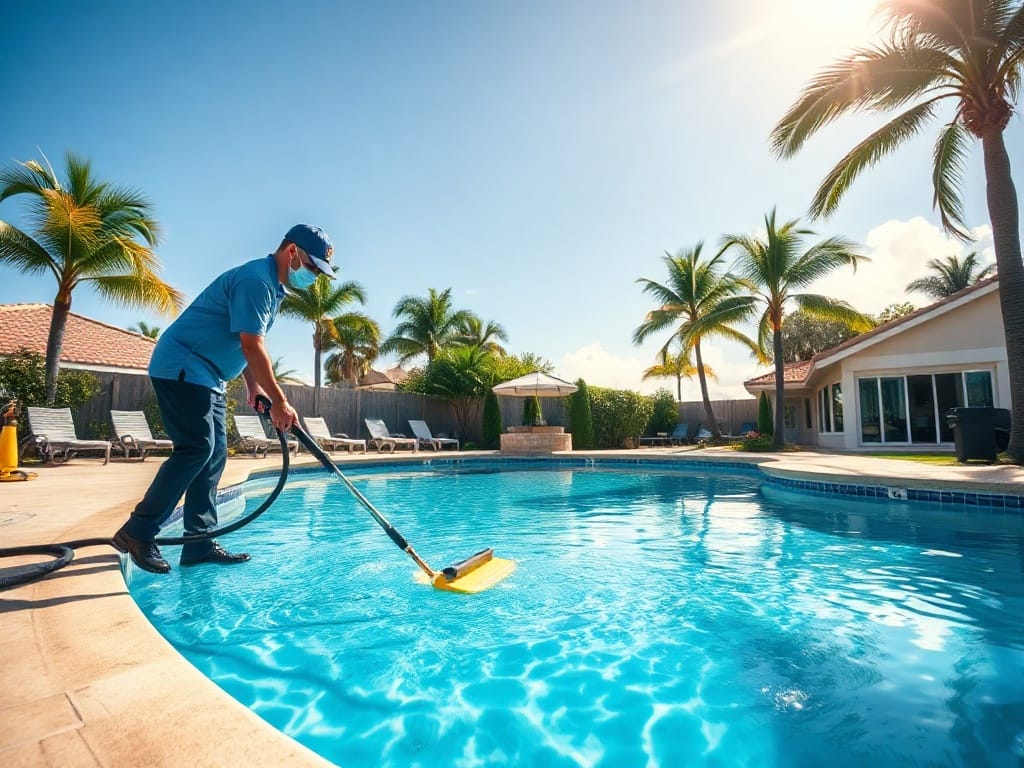
Hallandale Beach occupies a narrow strip of South Florida coastline at the very southern edge of Broward County, where the Atlantic Ocean, the Intracoastal Waterway, and the Golden Isles canal network converge just north of the Miami-Dade County line. It is one of the most densely settled cities in Broward — a mix of high-rises along the ocean, canal-front estates in Golden Isles, and residential neighborhoods stretching west to Dixie Highway. For the homeowners who have private pools here, pool service Hallandale Beach demands reflect the city’s coastal character: salt air corrosion, seasonal usage patterns driven by a large snowbird population, and the chemistry demands of pools sitting close to saltwater canals and the open ocean. This guide covers what Hallandale Beach pool owners need to know to keep their pools healthy year-round — even when they are not there to watch them.
What Professional Pool Service Covers in Hallandale Beach
A professional weekly service visit in Hallandale Beach covers the complete maintenance scope that keeps a South Florida pool chemically balanced, physically clean, and mechanically reliable. Because Hallandale Beach has a significant seasonal resident population — snowbirds who occupy their homes from roughly October through April and leave pools unattended for the summer — the service scope and expectations differ somewhat between the active winter season and the vacant summer months.
During occupied periods, a standard weekly visit includes full water chemistry testing (free chlorine, combined chlorine, pH, total alkalinity, calcium hardness, cyanuric acid, and salt for saltwater pools), chemistry adjustment, surface skimming, wall and step brushing, floor vacuuming or automatic cleaner inspection, skimmer and pump basket emptying, filter pressure check, and equipment visual inspection. This scope handles the bather load chemistry pressure and debris accumulation of a pool in regular use.
During vacant summer months, the weekly scope shifts: bather load chemistry pressure disappears, but algae pressure intensifies as water temperatures rise into the upper 80s with no activity to circulate or break up the water surface. Without someone on-site to notice early warning signs, a neglected chemistry imbalance can turn a vacant pool green within days. Consistent weekly service during the owner’s absence is not optional for a pool in Hallandale Beach’s climate — it is essential to prevent a costly remediation call when the owners return in October.
Items billed separately from standard weekly service include equipment repairs, filter media replacement, algae remediation requiring heavy chemical treatment and multiple follow-up visits, tile and plaster work, and post-storm recovery visits. Confirm scope boundaries in writing before starting service to avoid invoice surprises.
Water Chemistry in Hallandale Beach: Coastal and Hard Water Combined
Hallandale Beach pool water comes from Broward County’s Biscayne Aquifer municipal supply — naturally hard water with elevated calcium and magnesium that creates the same scale formation risks as throughout Broward. Calcium hardness should be maintained between 200 and 400 ppm; in Hallandale Beach’s climate, where evaporation rates are high during summer and pools may go months without dilution through partial drain-and-refill, calcium levels can climb well above 500 ppm in pools that are not proactively managed.
The coastal layer added to hard-water chemistry management is salt air. Homes in Golden Isles, along Three Islands Boulevard, and nearest to the beach and Intracoastal receive airborne sodium chloride deposits that affect equipment surfaces more than water chemistry — but they matter. For saltwater pools, the additional ambient salt can affect salt cell calibration; for all pools, salt air accelerates corrosion on pump housings, filter casings, and electrical connections at a rate significantly faster than in inland Broward.
pH management follows the same protocol as all South Florida pools: test weekly, maintain between 7.4 and 7.6, adjust as conditions require. The sea breeze in Hallandale Beach drives consistent aeration of outdoor pools, which nudges pH upward through CO2 off-gassing. Pools with waterfalls, fountains, or spa spillways experience this effect more strongly and should expect slightly more frequent upward pH correction. During the vacant summer months, automated pH dosing systems that inject acid from a reservoir become valuable tools for maintaining chemistry without an on-site owner to adjust chemical additions.
Cyanuric acid (CYA) accumulation is a particular concern in vacant Hallandale Beach pools where no dilution occurs and stabilized chlorine is added continuously throughout the summer. CYA that climbs above 80 ppm creates chlorine lock — sanitizer is present but inactive, making algae prevention increasingly difficult even at seemingly adequate chlorine doses. Service companies managing vacant pools should track CYA quarterly and schedule a partial drain-and-refill before owners return if levels have climbed into the problematic range.
Seasonal Pool Management for Hallandale Beach’s Snowbird Owners
Hallandale Beach has one of Broward County’s highest concentrations of seasonal residents — homeowners who spend winters in South Florida and summers elsewhere. For pool owners in this category, managing the pool during the unoccupied months is a distinct and important service need that not all pool companies handle with the same attention they give to occupied-home accounts.
Before departing for the summer, snowbird pool owners should confirm several things with their service company: that the weekly service schedule will continue uninterrupted during the absent months, that chemistry logs will be accessible remotely (by email or through a service app), that the automation system timers are set for appropriate summer run times, and that there is a clear protocol for how the service company communicates any equipment failures or chemistry emergencies that require a decision from the owner. A pool left for five months without these protocols in place is very likely to have a problem that goes unaddressed.
Returning to a pool that was properly serviced during absence should mean nothing more than a brief chemistry fine-tuning for the owner’s arrival. Returning to a pool that was neglected or serviced inconsistently means a green-to-clean remediation process that can cost $200 to $400, require multiple service visits over a week, and delay the first swim of the season. The cost of consistent summer service is far less than the cost of recovery.
Salt Air and Equipment Corrosion in Hallandale Beach
Hallandale Beach’s coastal density means nearly every private pool is within reasonable distance of the ocean or Intracoastal, and many — particularly in Golden Isles — are directly adjacent to saltwater canals. The effect on pool equipment is real and requires proactive management that inland Broward County service protocols do not typically include.
Salt air deposits sodium chloride on every exposed metal surface in the equipment area: pump housings, filter casings, heater cabinets, automation controller enclosures, and electrical conduit runs. Left unaddressed, this leads to surface rust on steel components, oxidation of aluminum housings, corrosion of electrical connections, and eventually structural degradation of equipment enclosures that allows moisture intrusion into sensitive electronics. Pool equipment in Hallandale Beach homes closest to the water shows corrosion-related failure years sooner than identical equipment in western Broward County locations.
Service companies working the Hallandale Beach coastal zone should incorporate corrosion inspection into every annual equipment review: checking pump motor vent screens for salt clogging, inspecting heater cabinet seams and louvers for rust progression, applying dielectric grease to electrical connections on controllers and junction boxes, and flagging any enclosure damage that allows direct moisture exposure to electronics. These are five-minute additions to an annual inspection that can extend equipment service life by years and prevent failures that occur at the worst possible time — when an owner has just arrived for the winter season.
Hallandale Beach Neighborhoods We Serve
Hallandale Beach is a compact city, but its neighborhoods have distinct pool service profiles driven by their proximity to water and the character of their residential construction.
Golden Isles is Hallandale Beach’s premier residential community — a series of man-made islands in the Intracoastal with direct canal access and some of the most valuable private homes in the city. Golden Isles pools are typically larger, newer installations with premium equipment and saltwater systems. Direct canal-front exposure puts these pools at the highest end of the salt air corrosion spectrum in Hallandale Beach. Many Golden Isles homeowners are seasonal residents, making consistent year-round service management essential.
Three Islands along Three Islands Boulevard offers a mix of canal-front and interior residential pool homes. Canal-front properties here face conditions similar to Golden Isles; interior lots are somewhat more sheltered but still benefit from regular equipment corrosion monitoring given their proximity to the broader coastal environment.
The Diplomat Golf Resort area along Hallandale Beach Boulevard includes residential pool homes in the surrounding neighborhoods. This central corridor of Hallandale Beach features a mix of older homes with equipment that may be due for assessment and newer renovations with updated installations. The area’s mix of permanent and seasonal residents means service programs need to accommodate both occupied-season and vacant-season requirements.
West Hallandale Beach neighborhoods along Dixie Highway and toward the Broward-Miami-Dade border are somewhat more sheltered from direct ocean salt air than the coastal and Intracoastal zones, but still receive the standard South Florida chemistry demands. These neighborhoods have a mix of smaller residential pools and some larger installations in more recent construction.
We serve pool owners throughout Hallandale Beach, including Golden Isles, Three Islands, the Hallandale Beach Boulevard corridor, and all neighborhoods in zip code 33009.
Hurricane Season Preparation for Hallandale Beach Pools
Hallandale Beach sits at the southern tip of Broward County, where the transition to Miami-Dade’s denser coastal corridor begins. Tropical storms and hurricanes approaching from the south or southeast can intensify rapidly over the warm Gulfstream waters just offshore, giving Hallandale Beach homeowners less preparation time than communities further inland. Hurricane readiness for pool owners here is not a late-season consideration — it is a standing protocol from June 1 through November 30.
Standard pool hurricane prep: lower water level 12 to 18 inches, add triple-dose algaecide, add a shock treatment, secure or store all loose deck furniture and pool accessories, and shut off equipment circuit breakers. For Golden Isles and canal-front homes, check canal water levels as part of your storm assessment — canal overflow during major storms can introduce turbid, debris-laden water into pool systems through deck drains and overflow channels, dramatically complicating post-storm recovery.
Snowbird owners who are not present during hurricane season should have a clear written protocol established with their service company: who is authorized to take emergency preparation steps on the owner’s behalf, what those steps are, and how the owner will be notified. A service company that simply continues weekly maintenance visits through a named storm event without active preparation steps is not fulfilling the owner’s reasonable expectation of care for their property.
Algae Prevention in Hallandale Beach Pools
Hallandale Beach pools face elevated algae pressure from May through October, when water temperatures climb above 80 degrees and the combination of intense UV, summer storms, and warm nights creates ideal conditions for algae blooms whenever chlorine drops. For vacant pools with no bather activity to circulate the water and no on-site owner to notice early warning signs, the consequences of a chemistry lapse are more severe than for occupied pools — a neglected vacant pool can shift from clear to fully green in 48 to 72 hours in Hallandale Beach’s summer heat.
Phosphate control is an important preventive layer for Hallandale Beach pools, particularly those in Golden Isles and canal-front locations where windblown material from the waterway and adjacent vegetation introduces phosphate loads above what a standard suburban pool receives. Quarterly phosphate removal treatment, combined with consistent weekly chlorine management, significantly reduces the nutrient base available for algae growth and makes chemistry recovery faster after any rainfall event that temporarily disrupts chlorine levels.
For saltwater pools specifically — which are common throughout Hallandale Beach’s newer and higher-end installations — salt cell output verification is part of algae prevention. A salt cell that appears active on the controller display but is partially fouled with calcium scale may be generating 60 percent of its rated chlorine output, silently setting the stage for an algae bloom the owner will attribute to some other cause. Quarterly salt cell inspection is especially important in Hallandale Beach’s coastal hard-water environment.
Choosing a Pool Service Company in Hallandale Beach
Florida DBPR license verification is the baseline requirement for any pool service company in Hallandale Beach. Beyond licensing, seasonal homeowners should specifically ask prospective service companies how they handle vacant-period management: whether chemistry logs are accessible remotely, how they communicate equipment issues requiring the owner’s decision, and what their protocol is for pre-storm preparation when the owner is not present. A company that cannot answer these questions clearly is not equipped to manage a seasonal-occupancy pool account responsibly.
For Golden Isles and other waterfront Hallandale Beach properties, ask about experience with canal-front pool environments and salt cell management in hard coastal water. These are not generic pool service competencies — they reflect the specific demands of Hallandale Beach’s most exposed pool locations.
Pricing for weekly full-service with chemicals in Hallandale Beach runs $120 to $175 per month for standard residential pools, consistent with Broward County norms. Golden Isles and larger installations run higher. Vacant-period service is typically priced the same as occupied-period service — the work and the chemistry management do not stop just because the owners are away.
Pool Service Fort Lauderdale: Serving Hallandale Beach Year-Round
At Pool Service Fort Lauderdale, we serve Hallandale Beach pool owners throughout the year — whether you are in residence enjoying your pool daily or back home up north trusting us to keep it ready for your return. We understand the hard-water chemistry of the Biscayne Aquifer, the equipment corrosion demands of the Golden Isles coastal environment, and the seasonal management disciplines that snowbird pool ownership requires.
Chemistry logs are documented after every visit and available for your review remotely. Your assigned technician maintains continuity across your account so equipment history, chemistry baselines, and seasonal patterns are never lost between visits. Equipment concerns are photographed, documented, and communicated to you for a decision before any repair work is authorized — even when you are not on-site.
We offer weekly maintenance service, vacant-period management, one-time cleanup visits for post-storm or long-neglect recovery, and equipment inspection referrals throughout Hallandale Beach. Contact us to discuss a year-round service program that protects your pool whether you are here to enjoy it or counting down the days until you return.
Frequently Asked Questions About Pool Service in Hallandale Beach
How often do pools in Hallandale Beach need professional service? Weekly service is strongly recommended for all residential pools in Hallandale Beach, occupied or vacant. South Florida’s year-round warm water temperatures and summer storm season create constant chemistry pressure that bi-weekly service cannot reliably manage. For vacant pools during the summer months, consistent weekly service is the only thing standing between a clear pool and a costly green-pool remediation when owners return in fall.
We only use our Hallandale Beach pool in winter — do we still need weekly service in summer? Yes. The summer months — May through October — are when Hallandale Beach pools face their highest algae pressure: water temperatures above 85 degrees, daily thunderstorms diluting chemistry, and no bather activity to circulate the water or provide early warning of a problem. Pools that receive no service during the summer almost invariably require a full green-to-clean remediation in September or October before they are usable again.
Does our Golden Isles canal location affect pool maintenance? Yes, in two ways. First, direct canal-front exposure places Golden Isles pools at the highest end of Hallandale Beach’s salt air corrosion spectrum — equipment inspection and corrosion prevention measures are more important here than in any other part of the city. Second, during major storm events, canal water levels can rise enough to overflow into pool decking areas; a pre-storm water level reduction of 12 to 18 inches is standard preparation for Golden Isles pool homes.
What does pool service cost in Hallandale Beach? Weekly full-service with chemicals runs $120 to $175 per month for standard residential pools in Hallandale Beach. Golden Isles estates and larger installations with spas and automation systems run higher. Chemistry-separate pricing starts at $75 to $95 per month before chemical costs. Vacant-period service during the summer months is priced at the same rate as occupied-season service.
How do we prepare our pool before leaving for the summer? Before departing, confirm your service company’s vacant-period protocol: consistent weekly service schedule, remote-accessible chemistry logs, clear communication procedures for equipment emergencies and storm preparation. Ensure the automation timer is set for appropriate summer run times, the CYA level is within range, and the equipment is in good operating condition. A brief pre-departure service visit with your technician to walk through equipment status is a worthwhile investment before a five-month absence.
Is salt air corrosion a concern for pools near Hallandale Beach? Yes, particularly for Golden Isles and canal-front properties. Salt air accelerates corrosion on pump housings, heater cabinets, filter casings, and electrical connections at a rate significantly faster than in inland Broward. Annual equipment inspection with specific attention to corrosion progression, dielectric grease application on electrical connections, and early replacement of failing hardware extends equipment service life and prevents failures that otherwise arrive without warning.
Get Started with Pool Service in Hallandale Beach
Hallandale Beach pools deserve year-round professional care — whether you are here through the summer or trusting your service company to keep everything ready for your winter return. From Golden Isles canal-front estates to the residential neighborhoods along Hallandale Beach Boulevard, we provide the consistent chemistry management, equipment-aware service, and seasonal-occupancy expertise that Hallandale Beach pool ownership requires. Reach out today to discuss a service program built around your pool and your schedule.