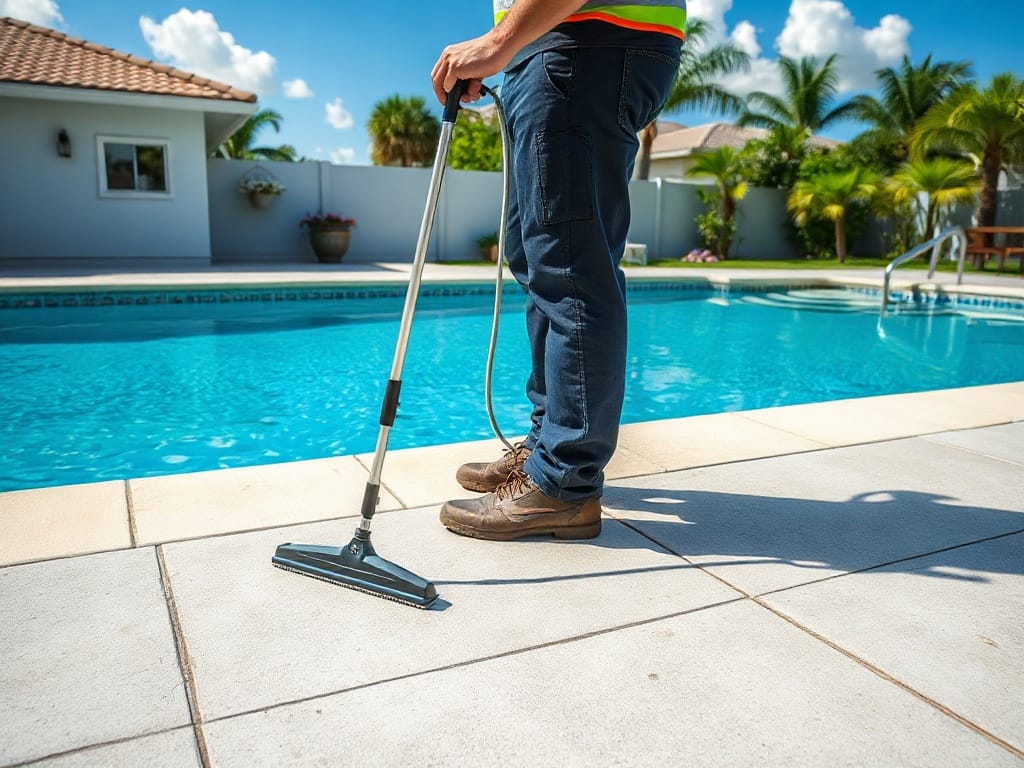
Hollywood occupies a prime slice of Broward County’s eastern coastline, stretching from the Atlantic Ocean west to the city limits and from the Dania Beach border in the north to Hallandale Beach in the south. Its residential mix is one of the most diverse in Broward — oceanfront condominiums and single-family homes along the Hollywood Beach Broadwalk corridor, canal-front estates in gated communities, elevated hilltop neighborhoods in Hollywood Hills, and established interior subdivisions that span nearly every era of South Florida construction. For homeowners with private pools, pool service Hollywood FL involves a layered set of demands: hard municipal water, coastal salt air, year-round UV and temperature pressure, and the routine chemistry management that a South Florida pool requires every single week to remain clean and swimmable. This guide covers everything Hollywood pool owners need to know about maintaining their pool properly throughout the year.
What Professional Pool Service Covers in Hollywood
Professional weekly pool service in Hollywood covers the full range of maintenance disciplines that keep a residential pool chemically balanced, visually clean, and mechanically sound. South Florida’s climate does not allow for skipping weeks or deferring chemistry adjustments — water temperatures above 80 degrees from May through October create continuous algae pressure, and a pool that receives inconsistent care will show it quickly.
A complete weekly service visit includes full water chemistry testing: free chlorine, combined chlorine, pH, total alkalinity, calcium hardness, cyanuric acid, and salt concentration for saltwater pools. Following testing, chemistry is adjusted to bring all parameters into their target ranges. The physical service covers surface skimming, wall and step brushing, floor vacuuming or automatic cleaner inspection and untangling, emptying of skimmer and pump baskets, filter pressure gauge check, and a visual equipment inspection for leaks, unusual sounds, or visible damage.
Items billed separately from the standard weekly service include equipment repairs and parts, filter media replacement (cartridge cleaning is typically included; media replacement is not), algae remediation requiring heavy chemical treatment and follow-up visits, tile and plaster cleaning and repair, and one-time cleanup visits for post-storm or long-neglect recovery. Getting scope and pricing in writing before starting service avoids disputes about what is and is not included.
Water Chemistry Demands in Hollywood
Hollywood’s pool water comes from Broward County’s Biscayne Aquifer municipal supply — naturally hard water with elevated calcium and magnesium content. Calcium hardness should be maintained between 200 and 400 ppm. In Hollywood’s climate, where evaporation rates are significant from June through September and pools do not receive the regular dilution that cooler-climate pools get from rainfall and refill cycles, calcium levels can climb above 500 ppm in pools that are not proactively managed. High calcium leads to scale formation on tile lines, plaster surfaces, and salt cell plates — all of which cause accelerating damage and repair expense over time.
pH management is the daily work of South Florida pool chemistry. Hollywood pools should be maintained between 7.4 and 7.6. The combination of Broward County’s alkaline source water and the aerating effect of warm breezes off the Atlantic nudges pool pH upward consistently, particularly for pools with waterfalls, spas, or other aeration features. Weekly pH testing and correction is not optional in Hollywood’s chemistry environment — it is the core of effective pool maintenance.
Cyanuric acid (CYA) accumulation is a common issue in Hollywood pools that rely on stabilized chlorine tablets as their primary sanitizer. CYA builds in the water over time because it does not break down in normal pool conditions. When CYA climbs above 80 ppm, the chlorine in the pool becomes significantly less effective at its intended concentration — this is called chlorine lock. A pool can test at 3 ppm free chlorine and still be vulnerable to algae if CYA is at 120 ppm. The fix is a partial drain-and-refill, which a good service company should recommend before CYA reaches problematic levels rather than after algae has already appeared.
Hollywood Beach and the Broadwalk: Salt Air and Coastal Pool Care
Hollywood Beach is one of South Florida’s most recognized stretches of coastline — the Broadwalk runs along the ocean for nearly two miles, flanked by hotels, restaurants, and a dense concentration of residential and vacation properties. For homeowners with private pools in the Hollywood Beach corridor, within roughly a mile of the Atlantic, the ambient salt air load is among the highest in Broward County. This has real consequences for pool equipment that routine service protocols designed for inland pools do not address.
Salt air deposits sodium chloride on every exposed metal surface in the pool equipment area: pump housings, filter casings, heater cabinets, automation controller enclosures, and electrical conduit runs and junction boxes. In the most oceanfront-adjacent locations, this deposition is a daily process. Left unaddressed over months and years, the result is surface rust on steel components, oxidation of aluminum housings, corrosion of electrical connections that leads to intermittent sensor failures and automation errors, and eventual structural degradation of equipment enclosures. Pool equipment at Hollywood Beach homes reaches corrosion-related failure thresholds significantly earlier than identical equipment in western Hollywood or inland Broward County.
The practical response is not complex — it is consistent. An annual equipment inspection that includes corrosion assessment, dielectric grease application on electrical connections and terminal blocks, early identification of rust progression on pump motor vents and heater cabinet seams, and proactive replacement of hardware showing active deterioration extends equipment service life materially. Five minutes of inspection during an annual review can prevent a $2,000 equipment failure that shows up without warning on a summer Saturday. Hollywood Beach pool owners should specifically ask prospective service companies whether their annual reviews include corrosion inspection — it is not universal practice, but it should be in this coastal environment.
Hollywood Hills: Older Pools and Equipment Assessment
Hollywood Hills is one of the city’s most established residential neighborhoods — a hillside community of single-family homes that represents some of Hollywood’s oldest residential construction. Pools in Hollywood Hills span a wide range of vintages, from installations dating to the 1970s and 1980s to more recent renovations and complete rebuilds. The older end of this range presents specific service considerations that newer pool installations do not.
Pools built before the widespread adoption of variable-speed pumps (pre-2000s) typically run single-speed pumps that are both less energy-efficient and harder on filter systems due to their constant high-flow operation. If these pumps are still original, they are operating well past their designed service life and replacement is a matter of when rather than if. A service company performing a first assessment on a Hollywood Hills property should document pump age and condition clearly, so the homeowner can plan for replacement before a catastrophic failure rather than being caught unprepared.
Older plaster finishes in Hollywood Hills pools — particularly those that have not been resurfaced in the past 10 to 15 years — tend toward calcium scale accumulation on surfaces and may show the rough, porous texture that accelerates algae attachment. While resurfacing itself falls outside routine weekly service scope, a good service company will document plaster condition and flag when regular chemistry adjustments are no longer sufficient to compensate for surface porosity. This distinction — between what weekly service can maintain and what requires capital investment in the pool itself — is part of honest service company communication that Hollywood Hills homeowners should expect from their provider.
Canal Communities and Waterfront Pool Care in Hollywood
Hollywood has an extensive network of canals and waterways throughout its eastern and central zones, connecting to the Intracoastal Waterway and ultimately to the Atlantic. Canal-front residential communities are common throughout the city, and pools adjacent to these canals carry specific maintenance considerations beyond standard residential service protocols.
Direct canal-front exposure places pools within constant range of salt-laden waterway air, creating conditions similar to — though generally somewhat less intense than — the most coastal-exposed Hollywood Beach properties. Equipment corrosion inspection is equally important for canal-front pools as for oceanfront ones. In addition, pools immediately adjacent to canals accumulate windblown debris from the waterway and canal-bank vegetation at a higher rate than interior-lot pools. Skimmer and basket cleaning frequency may need to increase during periods of high wind or following thunderstorms that strip leaves and organic material from canal-bank vegetation.
During major tropical weather events, canal water levels in Hollywood can rise significantly, and in severe cases overflow onto adjacent pool decking. Pre-storm pool water level reduction — the standard protocol of lowering pool water 12 to 18 inches before a named storm — is particularly important for canal-front properties, where storm surge and canal overflow can add substantial water volume to an already-full pool. Post-storm chemistry recovery for a pool that received canal water intrusion is more demanding than for a pool that only received rain dilution, due to the organic load, phosphates, and microbiological content of canal water.
Hollywood Neighborhoods We Serve
Hollywood spans a wide geographic range with residential neighborhoods that have distinct pool service profiles.
Hollywood Beach and the Broadwalk corridor includes the city’s highest-exposure coastal zone. Pools in this area — whether in the hotel row adjacent to the ocean or in the residential streets within a half-mile of the beach — face the strongest salt air corrosion environment in Hollywood. Annual equipment inspection with corrosion management is standard practice for responsible service in this zone.
Hollywood Hills is an established hillside community with a wide range of pool vintages. Service here frequently involves equipment assessment and honest documentation of aging systems that are approaching or past their expected service life. The neighborhood’s mature tree canopy also means debris load in skimmers is higher than in less-wooded areas of the city.
Emerald Hills is one of Hollywood’s more upscale interior neighborhoods, featuring larger homes and frequently larger pools with more complex equipment — spas, automation systems, saltwater chlorination, and elaborate water features. Service in Emerald Hills requires comfort with automation controller programming and the chemistry complexity that heated spa spillover and high-aeration features create.
West Hollywood neighborhoods stretching toward I-95 and Pembroke Road are somewhat more sheltered from direct salt air than the coastal zones, but still require the full South Florida chemistry management protocol. These areas have a significant concentration of permanent year-round residents, meaning pools are in continuous use throughout the year with consistent bather load and weekly chemistry demand.
Downtown Hollywood and Young Circle area neighborhoods include a mix of single-family residential pool homes and multi-unit residential properties with shared pools. The area’s urban density and mix of older and newer construction creates varied service needs across accounts.
We serve pool owners throughout Hollywood, including the Broadwalk corridor, Hollywood Hills, Emerald Hills, West Hollywood, and all residential neighborhoods in zip codes 33019, 33020, and 33021.
Hurricane Season Pool Preparation in Hollywood
Hollywood’s position on the Broward coastline places it directly in the path of hurricanes and tropical storms approaching from the southeast — the most common track for storms intensifying over the Gulfstream before making landfall in South Florida. Preparation is not a once-per-storm scramble; it is a standing protocol that should be reviewed and ready from June 1 through November 30 every year.
Standard pool hurricane preparation: lower water level 12 to 18 inches below the waterline to accommodate rainfall and storm surge without overflow, add a shock treatment and triple-dose algaecide to carry chemistry through the storm period, remove all loose deck furniture, pool accessories, and flotation devices from the pool area (nothing left out becomes projectile in high winds), and shut off equipment circuit breakers to protect pumps, automation controllers, and electrical systems from power surge and moisture intrusion during the storm.
After the storm, do not run equipment immediately. Check for debris in pump baskets and impellers before restarting. Test chemistry before adding chemicals — storm events often dramatically dilute chlorine while simultaneously introducing organic matter and nutrients that accelerate algae growth. A post-storm service visit within 24 to 48 hours of the storm’s passing is the most effective way to reset chemistry before algae can establish, particularly during the warm summer months when algae growth rates are highest.
Algae Prevention for Hollywood Pools
Hollywood’s year-round climate means algae prevention is never a seasonal concern — it is a year-round discipline. Water temperatures above 80 degrees are the norm from May through October, and even in winter months pool water rarely drops below 70 degrees. Combined with South Florida’s intense UV, summer thunderstorm dilution of chlorine, and the debris load from mature landscaping throughout the city’s residential neighborhoods, algae can establish in a Hollywood pool within 48 hours of a chemistry lapse.
For Hollywood Beach and coastal zone pools, additional phosphate loading from airborne organic material deposited off the ocean and Intracoastal provides a nutrient baseline that makes algae prevention more demanding than in inland pools. Quarterly phosphate removal treatment, combined with consistent weekly chlorine management, significantly reduces the nutrient base that enables algae blooms. This is particularly relevant for pools with heavy landscape screening near the water — dense hedges and palms provide privacy but also shed organic matter into the pool continuously.
Saltwater pools — common throughout Hollywood’s newer and more premium installations — require salt cell inspection as part of the algae prevention protocol. A cell that appears active but is partially fouled with calcium scale may be producing only a fraction of its rated chlorine output, silently making the pool vulnerable to algae despite normal-appearing controller readings. In Hollywood’s hard coastal water environment, salt cells should be inspected quarterly and cleaned as needed to maintain rated output. Neglecting this step is one of the most common reasons Hollywood saltwater pool owners experience recurring algae problems they cannot explain.
Choosing a Pool Service Company in Hollywood
Florida DBPR license verification is the non-negotiable baseline for any pool service company in Hollywood. The Florida Pool and Spa Association website and the DBPR license lookup make this a 30-second check. Beyond licensing, ask any prospective service company about their experience with coastal-zone equipment maintenance — Hollywood Beach and canal-front accounts require a service approach that companies working primarily in inland Broward County do not routinely practice.
Ask about chemistry logging practices. A service company that records test results after every visit and makes them accessible to you provides a factual record of your pool’s chemistry history — valuable both for tracking seasonal patterns and for resolving any disagreement about what was done and when. A company that cannot produce chemistry records from prior visits is not giving you the accountability that weekly service at this price level should include.
Pricing for weekly full-service with chemicals in Hollywood runs $120 to $175 per month for standard residential pools, consistent with Broward County market rates. Larger pools, those with spas, automation systems, or complex water features, run higher. Chemistry-separate pricing starts at $75 to $95 per month. Hollywood Beach and canal-front properties with higher equipment inspection requirements may be quoted at the upper end of the range or slightly above it.
Pool Service Fort Lauderdale: Serving Hollywood Year-Round
At Pool Service Fort Lauderdale, we serve Hollywood pool owners from the Broadwalk corridor to Hollywood Hills to the canal communities throughout the city. We understand Broward County’s hard-water chemistry, the corrosion demands of Hollywood’s coastal and near-coastal zones, and the year-round maintenance discipline that South Florida pool ownership requires regardless of the season.
Chemistry results are documented after every service visit and available for your review. Your assigned technician maintains continuity across your account — equipment history, chemistry baselines, and seasonal patterns are tracked over time, not lost when a route changes or a technician turns over. Equipment concerns are photographed, documented, and communicated to you before any repair work is authorized.
We offer weekly maintenance service, one-time cleanup visits for post-storm or long-neglect recovery, and equipment inspection referrals throughout Hollywood. Contact us to discuss a service program built around your pool and your neighborhood.
Frequently Asked Questions About Pool Service in Hollywood
How often do Hollywood pools need professional service? Weekly service is the standard and recommended frequency for residential pools in Hollywood. South Florida’s year-round warm water temperatures mean chemistry pressure does not stop in winter the way it does in northern climates. A pool that receives bi-weekly service in Hollywood’s summer months is at continuous risk of chemistry drift and algae establishment between visits. Weekly service is not a premium — it is the minimum that responsible pool ownership in this climate requires.
Does living near Hollywood Beach affect pool equipment? Yes, significantly. Homes within roughly a mile of the ocean and Intracoastal are exposed to continuous salt air that accelerates corrosion on pump housings, heater cabinets, filter casings, and electrical connections. This corrosion can shorten equipment service life by years compared to identical equipment installed in western Hollywood. Annual equipment inspection with specific attention to corrosion progression, dielectric grease application on electrical connections, and early replacement of deteriorating hardware is important practice for Hollywood Beach zone pool owners.
How do I prepare my Hollywood pool for a hurricane? Lower the water level 12 to 18 inches, add a shock treatment and triple-dose algaecide, remove all loose deck furniture and pool accessories, and shut off equipment circuit breakers. For canal-front homes, a larger water level reduction is prudent to account for potential storm surge and canal overflow. After the storm, inspect equipment before restarting, test chemistry before adding chemicals, and schedule a service visit as soon as possible — algae grows fast in post-storm warm water with depleted chlorine.
What does pool service cost in Hollywood FL? Weekly full-service with chemicals runs $120 to $175 per month for standard residential pools in Hollywood. Larger pools, pools with spas, automation systems, or water features run higher. Chemistry-separate pricing starts at $75 to $95 per month before chemical costs. Hollywood Beach and canal-front properties with more complex maintenance demands may be quoted at the upper end of the range.
Why does my saltwater pool keep getting algae despite normal chlorine readings? The most common cause in Hollywood is a partially fouled salt cell that is producing significantly less chlorine than the controller display suggests. Salt cells in South Florida’s hard, coastal water accumulate calcium scale on the plates over time, reducing output without triggering an obvious alert. A quarterly salt cell inspection and cleaning — checking actual plate condition rather than relying solely on flow and conductivity readings — is the most reliable way to confirm the cell is producing its rated output and that the pool is actually receiving the chlorine level the controller reports.
How do I know if my pool needs a drain and refill? Two chemistry indicators drive the need for a partial drain-and-refill in Hollywood pools: cyanuric acid (CYA) above 80 ppm, and total dissolved solids (TDS) high enough to affect water clarity and chemistry responsiveness. In Hollywood’s climate, where evaporation rates are high and pools do not receive the natural dilution that cooler-climate pools get from seasons, CYA can climb into the problematic range within one to two years of consistent stabilized chlorine tablet use. A service company that tracks CYA quarterly and recommends a partial drain before it becomes a problem is providing proactive service; one that waits for an algae bloom to diagnose the cause is not.
Get Started with Pool Service in Hollywood
Hollywood pools — whether at the beach, in the hills, along the canals, or in any of the city’s established neighborhoods — deserve consistent professional care throughout the year. South Florida’s climate does not allow for seasonal shortcuts, and Hollywood’s coastal geography adds corrosion and chemistry demands that require service experience specific to this area. Contact Pool Service Fort Lauderdale today to discuss a weekly maintenance program built around your pool, your location, and your schedule.