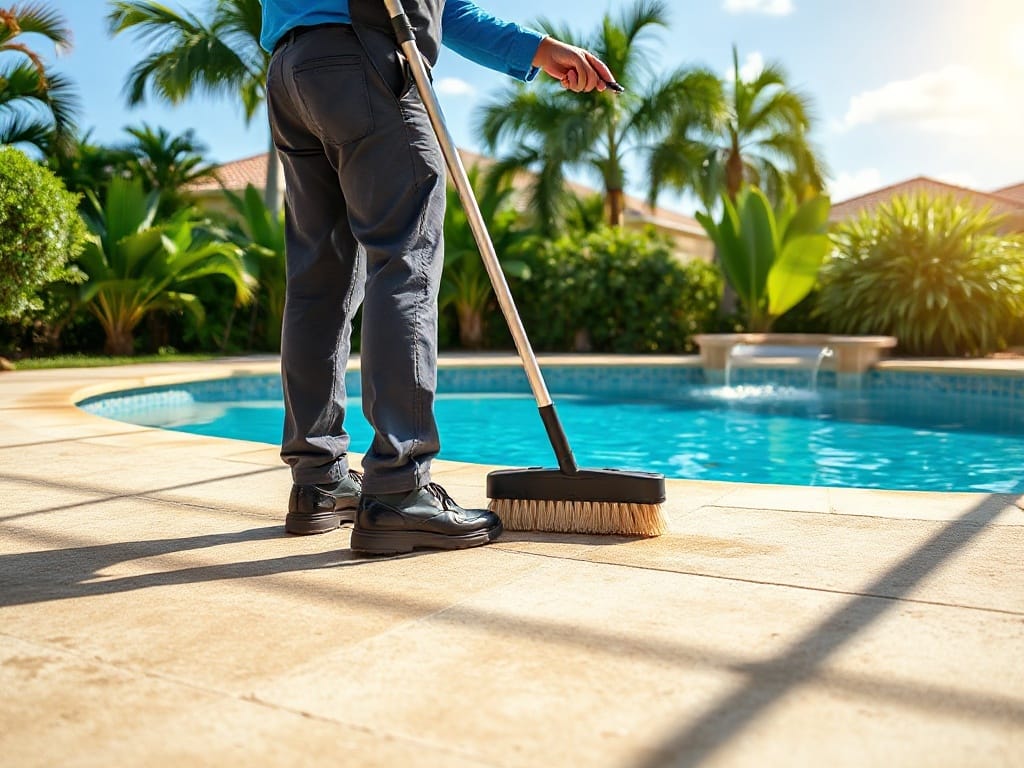
Lauderhill is a mid-sized city in central Broward County, bordered by Sunrise to the west, Tamarac to the north, Lauderdale Lakes to the east, and Fort Lauderdale to the southeast. Its residential character spans a wide range — from the planned communities of Inverrary, one of South Florida’s largest 1970s master-planned developments, to the established single-family neighborhoods along its eastern corridors. For Lauderhill pool owners, pool service Lauderhill FL demands consistent chemistry management, equipment awareness calibrated to the city’s predominantly older pool stock, and a service company familiar with the maintenance requirements of South Florida pools in year-round residential use. This guide covers what Lauderhill homeowners need to know to keep their pool clean, balanced, and operational throughout the year.
What Professional Pool Service Covers in Lauderhill
A professional weekly service visit in Lauderhill includes the full maintenance scope that South Florida’s climate demands. Water chemistry is tested at every visit — free chlorine, combined chlorine, pH, total alkalinity, calcium hardness, cyanuric acid, and salt for saltwater systems — and adjusted to target ranges before leaving the property. Physical service covers surface skimming, wall and step brushing, floor vacuuming or automatic cleaner inspection, skimmer and pump basket cleaning, filter pressure check, and a visual equipment inspection for anything requiring attention.
This complete weekly scope is the foundation of responsible pool ownership in Lauderhill’s climate. Year-round warm water temperatures, summer afternoon thunderstorms, and consistent household use mean chemistry pressure never stops regardless of the season. A pool receiving incomplete service visits — chemistry tested but not fully corrected, brushing skipped, filter pressure not checked — accumulates small deficits that compound into larger problems over time.
Items billed separately from the weekly service rate include equipment repairs, filter media replacement, algae remediation requiring heavy chemical treatment and multiple follow-up visits, and post-storm cleanup visits. Get scope and pricing confirmed in writing before beginning service to avoid confusion about what the monthly rate does and does not include.
Water Chemistry in Lauderhill: Hard Water and Year-Round Pressure
Lauderhill’s pool water comes from Broward County’s Biscayne Aquifer municipal supply — naturally hard water with elevated calcium and magnesium. Calcium hardness should be maintained between 200 and 400 ppm. In Lauderhill’s inland location, evaporation during the summer months is the primary driver of calcium concentration creep; pools that do not receive periodic partial drain-and-refill cycles accumulate calcium above 500 ppm over time, leading to scale deposits on tile lines, plaster surfaces, and salt cell plates that cause accelerating maintenance costs.
pH is the most actively managed parameter in South Florida pool chemistry. The Biscayne Aquifer’s alkaline source water combined with warm temperatures and aeration from filtration equipment consistently nudges pool pH upward. Lauderhill pools should be maintained between 7.4 and 7.6. Pools with spa spillovers, waterfalls, or high-volume air features experience pH rise more quickly and may require weekly acid additions to hold the target range. pH that drifts above 7.8 reduces chlorine effectiveness, accelerates scale formation, and irritates swimmers — even when free chlorine tests at an adequate level.
Cyanuric acid (CYA) accumulation is a routine concern in Lauderhill pools using stabilized chlorine tablets as their primary sanitizer. CYA does not decompose under normal pool conditions and builds steadily over time. Above 80 ppm it significantly reduces chlorine’s germicidal effectiveness — a pool with CYA at 120 ppm can test at 3 ppm free chlorine and still be unable to reliably suppress algae growth. The solution is a partial drain-and-refill, which a service company tracking CYA quarterly should recommend proactively, before the level reaches the threshold where problems become visible.
Inverrary and Lauderhill’s 1970s Pool Communities
Inverrary is one of South Florida’s most significant planned residential developments — a large master-planned community built primarily in the 1970s around the Inverrary Country Club golf courses in western Lauderhill. Inverrary encompassed thousands of homes across a range of residential products: single-family homes, townhomes, and low-rise residential buildings spread across multiple villages within the development. Many of these properties were built with private pools, making Inverrary one of the largest concentrations of same-vintage pool installations in Broward County.
The significance of Inverrary’s pool vintage to service and maintenance decisions is substantial. Pools installed in the 1970s and early 1980s are now approaching or past 50 years of age. The original equipment — pumps, filters, heaters, and any automation components — has almost certainly been replaced at least once, and in many cases is now in its second or third generation of replacement equipment. But the pool shell itself — the concrete structure, plaster finish, and tile work — reflects the construction standards and materials of its era.
Plaster finishes from the 1970s that have not been fully resurfaced within the past 10 to 15 years are operating in a degraded state: rough, porous surfaces that harbor algae more readily than fresh plaster, scale accumulation that is difficult to reverse with chemistry alone, and occasional structural porosity that can affect water loss. A service company assessing an Inverrary pool for the first time should evaluate plaster condition and communicate honestly about what weekly chemistry management can maintain versus what requires a replastering investment.
Inverrary homes that have had their pools renovated more recently — replastered, re-tiled, or fully remodeled — are in a different maintenance category. These pools often received saltwater chlorination systems as part of the renovation, automation upgrades, and variable-speed pump installations. Service companies working Inverrary accounts need to be comfortable with both the legacy older-equipment accounts and the more recently updated installations that coexist throughout the development.
Saltwater Pool Conversions in Lauderhill
Lauderhill has a significant and growing concentration of saltwater pool systems — both in pools built with saltwater chlorination from the start and in older pools that have been converted from traditional tablet-based chlorination to salt. The conversion trend accelerated through the 2000s and 2010s as the technology became more accessible and the perceived benefits — softer water feel, reduced chemical handling, automated chlorine generation — became widely understood.
Saltwater pools in Lauderhill’s hard-water environment require specific service attention that traditional chlorine pools do not. Salt cells generate chlorine through electrolysis, and the calcium-rich Biscayne Aquifer water deposits calcium scale on the titanium plates inside the cell over time. A cell with significant scale buildup may appear active on the automation controller display while producing only a fraction of its rated chlorine output — the controller reads flow and conductivity but cannot directly measure how much chlorine is actually being generated. The practical consequence is a pool that appears to have adequate chlorine management but is chronically under-sanitized, with predictable results in Lauderhill’s warm water environment.
Quarterly salt cell inspection — removing the cell from the housing, visually inspecting the plates for scale accumulation, and cleaning with a dilute acid solution when needed — is a standard maintenance practice for saltwater pools in Broward County’s hard water. A service company that does not perform or schedule this inspection is leaving the most critical component of a saltwater pool’s chlorination system unmonitored. For Lauderhill’s large population of saltwater pool owners, this is not an optional service add-on; it is core maintenance practice.
Salt level management is the other ongoing parameter for Lauderhill saltwater pools. Most residential salt chlorine generators operate optimally in the 2,700 to 3,400 ppm salt range. Rainfall dilutes salt concentration; evaporation concentrates it. A service company managing a Lauderhill saltwater pool should test salt levels monthly and add salt or recommend dilution accordingly — the automation controller’s salt reading is a guide, not a precise measurement tool, and should be verified against an independent test kit periodically.
Canal Proximity in Lauderhill: The C-13 Corridor
The North New River Canal (C-13) runs through parts of Lauderhill, and residential properties along or near the canal have service considerations that interior-lot homes in the same neighborhoods do not. Canal-adjacent pools accumulate windblown organic debris from the waterway and canal bank vegetation — grass clippings, leaves, algae spores, and organic particulate — at a higher rate than pools screened from the canal. This translates to heavier skimmer and basket debris loads between visits and elevated phosphate levels from organic decomposition entering the pool water.
Phosphates are a primary algae nutrient, and elevated phosphate levels make algae suppression harder even when chlorine is maintained at adequate concentration. Quarterly phosphate testing and removal treatment is a worthwhile protocol addition for Lauderhill pools in the C-13 canal corridor. The cost of a quarterly phosphate remover treatment is small relative to the cost of a full algae remediation — and canal-adjacent pools that skip this step are consistently among the first to develop algae problems following a summer thunderstorm that temporarily drops chlorine levels.
During major tropical weather events, canal water levels in Lauderhill can rise significantly with sustained heavy rainfall. Pre-storm pool water level reduction — lowering the pool 12 to 18 inches before a named storm — is especially important for canal-adjacent properties where canal overflow could introduce turbid, organically loaded canal water into pool deck areas and potentially into the pool itself. Post-storm recovery for pools affected by canal overflow requires more aggressive chemistry treatment than pools that only received rainfall dilution.
Lauderhill Neighborhoods We Serve
Inverrary is Lauderhill’s largest and most distinctive residential community — a 1970s master-planned development spread across multiple villages in western Lauderhill. Pool accounts in Inverrary range from original 1970s installations with aging plaster to renovated pools with modern saltwater systems, variable-speed pumps, and automation upgrades. Service in Inverrary requires comfort with both ends of this spectrum.
East Lauderhill neighborhoods along State Road 7 (US-441) and toward the Lauderdale Lakes border are densely developed with single-family homes, many with pools from the same 1970s and 1980s construction era as Inverrary. Equipment age and plaster condition assessments are equally relevant here. This is a high year-round occupancy area with consistent weekly chemistry demand throughout all twelve months.
North Lauderhill neighborhoods near the Tamarac border include a mix of residential construction vintages. Some areas received new construction through the 1990s and 2000s, resulting in a somewhat younger pool stock than the city’s western and eastern zones. Variable-speed pumps, cartridge filter systems, and saltwater chlorination are more common in these newer installations than in the city’s oldest neighborhoods.
We serve pool owners throughout Lauderhill, including Inverrary, the SR-7 corridor neighborhoods, North Lauderhill, and all residential areas in zip codes 33311 and 33313.
Hurricane Season Pool Preparation in Lauderhill
Lauderhill’s central inland location provides some buffer from direct storm surge, but tropical storms and hurricanes delivering landfall impact on the Broward coast bring sustained heavy rainfall and wind well into the interior. Pool hurricane preparation is a June through November standing discipline, not a reactive scramble when a storm enters the forecast cone.
Pre-storm protocol: lower the pool water level 12 to 18 inches, add shock treatment and triple-dose algaecide, remove all loose deck furniture and pool accessories, and shut off equipment circuit breakers. For canal-adjacent properties along the C-13 corridor, the water level reduction is particularly important given the risk of canal overflow during sustained heavy rainfall events.
After the storm, inspect equipment before restarting — check pump priming, clear any debris from impeller housings, verify automation settings before resuming normal run cycles. Test chemistry before adding chemicals; storm events typically dilute chlorine while introducing the organic load and nutrients that accelerate algae establishment in warm water. A post-storm service visit within 24 to 48 hours prevents the chemistry gap from becoming a full algae bloom.
Algae Prevention in Lauderhill Pools
Algae prevention in Lauderhill is a year-round discipline. Water temperatures above 80 degrees for six or more months of the year, consistent household use introducing organic bather load, and the phosphate loading in canal-adjacent neighborhoods create persistent algae pressure that weekly chemistry management must stay ahead of. The primary failure modes are the same as throughout Broward: chlorine allowed to drop to near zero between visits, CYA climbing high enough to neutralize chlorine effectiveness, and salt cells in saltwater pools producing less chlorine than the controller indicates due to calcium scale fouling on the plates.
For Inverrary pools with older plaster surfaces, algae prevention requires somewhat more chemical effort than in newer installations. Rough, porous plaster provides significantly more surface area for algae attachment and makes brushing less effective at removing early-stage algae colonies before they become visible blooms. Service companies managing aging Inverrary plaster should include thorough weekly brushing of all surfaces — not just the visible horizontal floor area — and should communicate honestly to homeowners when plaster condition has deteriorated to the point where chemistry management alone is insufficient to maintain a consistently clean appearance.
Choosing a Pool Service Company in Lauderhill
Florida DBPR license verification is the baseline. Beyond that, Lauderhill homeowners — particularly those with Inverrary pools or other older installations — should ask prospective service companies two specific questions: whether they document equipment condition during the initial service visit, and whether they have experience managing saltwater chlorination systems in Broward County’s hard water. Both questions reveal whether the company understands what Lauderhill pool ownership actually involves, versus offering generic South Florida service.
Chemistry logging matters. A company that records test results after every visit and makes them available to you provides a factual record of your pool’s chemistry history — useful for tracking seasonal patterns, planning partial drain timing, and resolving any disputes about service quality. It also creates accountability that weekly service at this price level should include as a standard practice.
Pricing for weekly full-service with chemicals in Lauderhill runs $120 to $175 per month for standard residential pools, consistent with Broward County market rates. Chemistry-separate pricing starts at $75 to $95 per month. Inverrary pools and other larger installations with spas or complex automation run toward the upper end of the range.
Pool Service Fort Lauderdale: Serving Lauderhill Year-Round
At Pool Service Fort Lauderdale, we serve Lauderhill pool owners from Inverrary to the SR-7 corridor to the canal neighborhoods along the C-13. We understand Broward’s hard-water chemistry, the equipment and plaster considerations common in Lauderhill’s older pool stock, and the saltwater system maintenance demands that Broward’s hard water creates for salt chlorine generators throughout the city.
Chemistry results are documented after every visit and available for your review. Your assigned technician maintains account continuity — equipment history, chemistry baselines, and any known concerns are tracked and carried forward. Equipment issues are documented and communicated to you before any repair work is authorized.
We offer weekly maintenance service, one-time cleanup visits for post-storm or long-neglect recovery, and equipment inspection referrals throughout Lauderhill. Contact us to discuss a service program built around your pool.
Frequently Asked Questions About Pool Service in Lauderhill
How often should a Lauderhill pool be professionally serviced? Weekly service is the correct standard for Lauderhill residential pools. South Florida’s year-round warm water temperatures and the year-round bather load of a full-occupancy household create consistent chemistry demand that bi-weekly service cannot reliably manage. Pools in Lauderhill that shift to every-other-week service schedules are among the most common sources of summer algae calls — the chemistry gap between visits is simply too long in this climate.
We have an Inverrary pool from the 1970s — what are our biggest maintenance concerns? The two biggest concerns for a 1970s Inverrary pool are plaster condition and equipment age. Plaster that has not been resurfaced in 15-plus years is typically rough and porous, making algae attachment easier and more persistent. Equipment from even the most recent replacement cycle may be approaching the end of its service life. A first-visit assessment that documents both honestly — and distinguishes between what weekly service can maintain and what requires capital investment — is the most valuable thing a new service company can provide for a legacy Inverrary pool account.
My saltwater pool keeps testing low chlorine even though the cell appears to be running — why? The most common cause is calcium scale fouling on the salt cell plates. In Broward County’s hard water, calcium deposits accumulate on the electrolytic plates inside the cell over time, reducing chlorine output without triggering an obvious error on the controller display. Quarterly cell inspection and cleaning — removing the cell, checking the plates, and cleaning with dilute acid if needed — is the standard remedy. A saltwater pool in Lauderhill that has not had its cell inspected in over six months should have this done before assuming the chemistry management is correct.
What does pool service cost in Lauderhill? Weekly full-service with chemicals runs $120 to $175 per month for standard residential pools. Inverrary pools with spas or complex automation run toward the upper end. Chemistry-separate pricing starts at $75 to $95 per month. Equipment repairs, filter media replacement, and algae remediation are billed separately.
Do canal-adjacent properties in Lauderhill need extra pool maintenance attention? Yes. Properties along the C-13 canal corridor accumulate windblown organic debris and phosphates from the waterway at a higher rate than interior-lot homes. This raises algae pressure and skimmer debris load. Quarterly phosphate removal treatment is a worthwhile protocol addition for canal-adjacent pools. Pre-storm water level reduction is also more important for these properties given the risk of canal overflow delivering turbid, organically loaded water into deck areas during major rainfall events.
How do I know if my Lauderhill pool needs replastering? The key indicators are visible surface roughness or texture where the plaster once felt smooth, persistent algae staining that returns quickly after chemical treatment, white or gray deposits on the pool floor and walls that brushing alone will not remove, and any structural cracking or spalling of the plaster surface. If your pool was originally plastered in the 1970s or 1980s and has not been resurfaced since, a professional assessment of the plaster condition is overdue regardless of how the pool looks on a given service day.
Get Started with Pool Service in Lauderhill
Lauderhill pool owners — whether in a renovated Inverrary home with a modern saltwater system or an older installation that has never been updated — deserve consistent, knowledgeable service throughout the year. The combination of hard water, year-round use, and a pool stock that skews toward older equipment creates a maintenance environment that rewards a service company with genuine Broward County expertise over one offering generic weekly visits. Contact Pool Service Fort Lauderdale today to discuss a weekly maintenance program built around your specific pool and its needs.