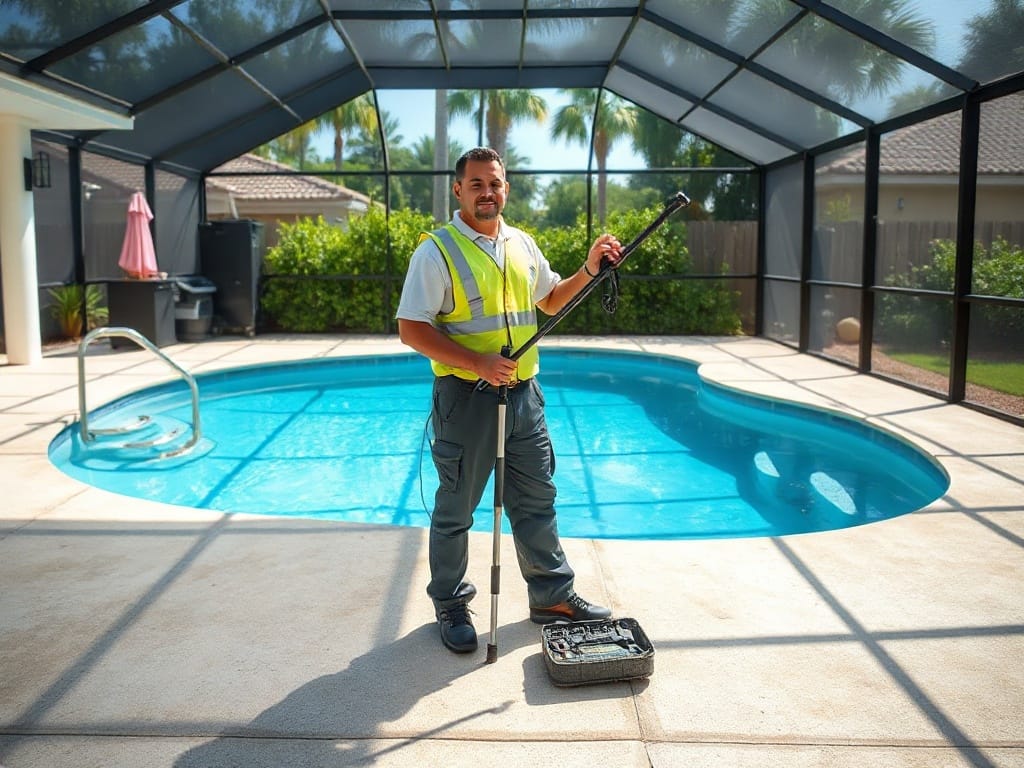
Margate is a residential city in northern Broward County, bordered by Coconut Creek to the north, Coral Springs to the west, Tamarac to the south, and North Lauderdale to the east. Developed through the 1960s, 1970s, and 1980s, the city’s neighborhoods are characterized by single-family homes on modest lots, many of which back directly onto one of the canal systems that run throughout the city. Screened pool enclosures are common throughout Margate, and the combination of canal-backed lots, year-round family use, and the city’s northern Broward inland location creates a distinct set of maintenance demands for private pool owners. For Margate homeowners, pool service Margate FL means consistent weekly chemistry management, an understanding of how screened enclosures affect pool maintenance, and attention to the canal-adjacent debris and phosphate loading that many Margate properties experience. This guide covers what Margate pool owners need to know to maintain their pool properly throughout the year.
What Professional Pool Service Covers in Margate
A professional weekly service visit in Margate includes full water chemistry testing — free chlorine, combined chlorine, pH, total alkalinity, calcium hardness, cyanuric acid, and salt for saltwater systems — followed by chemistry adjustment to bring all parameters into their target ranges. Physical service covers surface skimming, wall and step brushing, floor vacuuming or automatic cleaner inspection, skimmer and pump basket emptying, filter pressure check, and a visual equipment inspection.
For screened enclosure pools — which are widespread throughout Margate — the physical service scope is somewhat different from an open-deck pool. Screened pools accumulate less windblown debris than open pools, but screens themselves collect dirt, algae, and organic film along their frame joints and mesh, and debris that does enter a screened enclosure through open doors or gaps tends to concentrate in corners rather than distributing across the pool surface. A thorough service visit on a screened Margate pool still requires complete skimming and basket cleaning, as debris accumulation in skimmer baskets from fine organic particles is not eliminated by the screen — it is simply changed in character.
Items billed separately from weekly service include equipment repairs, filter media replacement, algae remediation requiring heavy chemical treatment and follow-up visits, screen repair referrals, and post-storm cleanup. Clarify scope and billing in writing before starting service to avoid disputes about monthly rate inclusions.
Screened Pool Enclosures in Margate: Chemistry and Maintenance Differences
Screened pool enclosures — the aluminum-framed screen structures that enclose most of the pool deck and pool surface — are one of the defining features of residential pool ownership in Margate and throughout northern Broward County. They reduce debris, provide some UV filtering, limit direct evaporation in certain conditions, and create a more comfortable outdoor living environment. They also create a pool chemistry environment that differs in meaningful ways from an open-air pool, and service companies working Margate accounts should understand these differences.
The most significant chemistry effect of a screened enclosure is reduced UV exposure. Ultraviolet light from direct sun degrades cyanuric acid (CYA) very slowly, but more importantly it degrades free chlorine rapidly — a screened enclosure that blocks a portion of direct UV reduces this chlorine degradation rate, meaning that a correctly managed screened pool may hold its free chlorine level better between service visits than an unscreened pool receiving full direct sun. This is generally a benefit, but it also means that a service company should not be reducing chemical application rates simply because a Margate pool is screened — the reduced UV effect is modest, and the year-round warm water temperature and bather load chemistry demand remain fully present.
Screened enclosures reduce evaporation somewhat, which affects calcium concentration dynamics. An open-air pool in Margate’s summer heat loses water rapidly to evaporation, which concentrates calcium, dissolved solids, and CYA faster than a screened pool losing less water to the same environment. The difference is not dramatic, but it does mean that screened Margate pools may build calcium and CYA somewhat more slowly than fully exposed pools — a modest advantage that does not eliminate the need for periodic partial drain-and-refill cycles, but may extend the interval between them.
Algae behavior in screened enclosures also differs from open pools. Without direct wind to distribute airborne algae spores widely across the pool surface, algae in screened Margate pools tends to establish first in corners, along step edges, and in shaded areas under the screen structure. Early algae detection on screened pools requires deliberate inspection of these areas — a quick pass over the main pool floor is not sufficient. Weekly brushing of all corners, steps, and wall surfaces near the screen frame is the preventive measure.
Water Chemistry in Margate: Hard Water and CYA Management
Margate pool water comes from Broward County’s Biscayne Aquifer municipal supply — the same naturally hard water that affects calcium management in pools throughout Broward. Calcium hardness should be maintained between 200 and 400 ppm. In Margate’s inland northern Broward location, evaporation during summer is the primary driver of calcium concentration increases, and pools that go extended periods without dilution through partial drain-and-refill cycles accumulate calcium above safe levels. Scale deposits on tile lines, plaster surfaces, and salt cell plates are the cumulative result of unmanaged calcium hardness over time.
pH management requires weekly attention in Margate pools. The Biscayne Aquifer’s alkaline source water and the aeration from filtration equipment consistently push pH upward toward 7.8 and above. Maintaining pH between 7.4 and 7.6 is the core weekly chemistry task. Pools with spillover spas, waterfalls, or bubblers experience pH rise more quickly and may need weekly acid additions to hold target range. High pH reduces chlorine effectiveness even when the free chlorine reading appears adequate — a pool at pH 7.9 with 3 ppm free chlorine is significantly less sanitized than the same pool at pH 7.5 with 3 ppm free chlorine.
Cyanuric acid is the chemistry parameter Margate pool owners most often neglect until it becomes a problem. Stabilized chlorine tablets release CYA into the water with every dissolution cycle, and CYA does not break down under normal pool conditions. Once it climbs above 80 ppm — which can happen within one to two years of continuous tablet use without dilution — chlorine effectiveness drops substantially. A partial drain-and-refill is the only practical correction. Service companies managing Margate accounts should track CYA quarterly and recommend dilution before the threshold is crossed, not after algae has appeared as a symptom of chlorine lock.
Canal-Backed Properties in Margate: Phosphates, Debris, and Storm Prep
A large number of Margate’s residential neighborhoods were designed with canal-backed lots — homes whose rear yards border one of the drainage canals that run throughout the city. This is a common and valued feature of Margate real estate, but it creates specific pool maintenance conditions that service companies working these accounts need to address proactively.
Canal-adjacent pools accumulate windblown organic material from the waterway and canal bank — grass clippings, leaf matter, algae spores, fine particulate from the water surface — at a substantially higher rate than interior-lot pools. Even screened enclosures do not eliminate this loading; organic particles small enough to pass through screen mesh, or entering through gate gaps, contribute to elevated phosphate levels in the pool water over time. Phosphates are the primary nutrient source that enables algae to establish and spread, and canal-adjacent Margate pools consistently show higher phosphate baselines than comparable pools on interior lots in the same neighborhoods.
Quarterly phosphate testing and removal treatment is the standard preventive protocol for canal-backed Margate pool accounts. A phosphate remover application when levels exceed 100 ppb — before visible algae growth, not after — keeps the nutrient baseline low enough that routine weekly chlorine management remains effective through the summer algae season. This is a small and inexpensive addition to the annual service program that consistently reduces the frequency of algae remediation calls on canal-adjacent accounts.
Hurricane and heavy storm preparation is particularly important for canal-backed Margate properties. During major rainfall events, Margate’s canal water levels can rise significantly, and in severe cases canal overflow can reach pool decking and potentially introduce turbid, organically loaded canal water into the pool. Pre-storm pool water level reduction of 12 to 18 inches is standard protocol throughout Broward, but for canal-adjacent homes a larger reduction is prudent given the additional risk. After any storm event where canal overflow is suspected, chemistry treatment should be more aggressive than for a pool that only received rainfall dilution, due to the organic load, phosphates, and microbiological content that canal water carries.
Margate’s Pool Stock: 1970s and 1980s Construction
Margate’s primary residential development period spans the 1960s through the 1980s, and a large share of the city’s private pools were installed during that window. Pools from this era are now 40 to 60 years old, and the maintenance implications of that vintage are worth understanding for homeowners and service companies alike.
Original single-speed pumps from the 1980s and 1990s that are still in service are operating well past their designed service life. These pumps run at fixed high RPM regardless of filtering load, drawing more electricity than modern variable-speed alternatives and placing higher stress on impellers, seals, and motor windings than a variable-speed pump running at lower speeds for longer daily cycles. A service company doing an initial assessment on a Margate home with original or early-replacement pump equipment should document age and condition clearly and communicate the replacement planning conversation honestly — a pump failure during peak summer swim season is among the most disruptive pool equipment failures a Margate family can experience.
Plaster surfaces from the 1980s that have not been resurfaced in the past 10 to 15 years exhibit the rough porosity that makes algae attachment easier and more persistent. Weekly brushing of all surfaces — not just the main floor — is more critical for these pools than for newly resurfaced ones. When chemistry alone can no longer keep an older plaster surface looking consistently clean, the honest service company conversation shifts to replastering options and costs rather than escalating chemical additions that address symptoms without resolving the underlying surface condition.
Margate Neighborhoods We Serve
West Margate neighborhoods along Royal Palm Boulevard and toward the Coral Springs border include some of Margate’s newer residential construction from the late 1980s and 1990s. Pools in this zone tend to have somewhat more recent equipment than those in the city’s eastern and central neighborhoods, with higher rates of cartridge filter systems, variable-speed pumps, and saltwater chlorination. Canal-backed lots are common throughout this corridor.
Central Margate neighborhoods along State Road 7 (US-441) and the Margate Boulevard corridor represent the core of the city’s 1970s residential development. Screened enclosures are standard on pools throughout this zone, and equipment age is the primary service consideration. Many pools here have been partially updated — a newer pump with original filter equipment, or a saltwater conversion installed on an original concrete shell — creating a mixed-vintage equipment profile that requires careful first-visit assessment.
East Margate neighborhoods near the North Lauderdale border include the city’s densest residential construction. Lot sizes are smaller in some areas, and pools tend to be more compact — consistent with the construction economics of the era. Year-round family use is the dominant pattern throughout east Margate.
We serve pool owners throughout Margate, including canal-backed neighborhoods, screened enclosure homes, and all residential areas in zip codes 33063 and 33068.
Hurricane Season Pool Preparation in Margate
Margate’s northern inland Broward location places it somewhat further from direct coastal storm surge than oceanfront communities, but tropical storms and hurricanes delivering sustained rainfall and wind across Broward County affect Margate’s canals and residential neighborhoods as much as any interior Broward city. Pool hurricane preparation is a June through November standing protocol.
For screened enclosure pools in Margate, the pre-storm protocol includes an additional consideration: screen doors should be latched or secured before the storm, and any loose screen panels or damaged frame sections should be noted. While pool screens are not rated to withstand hurricane-force winds and may sustain damage in a major storm, securing what can be secured before the event reduces post-storm debris entering the pool area and simplifies recovery. Post-storm screen inspection and repair referrals are a service value-add that pool companies working Margate’s screened enclosure accounts can provide as part of post-storm communication.
Standard pre-storm pool protocol: lower water level 12 to 18 inches (more for canal-adjacent properties), add shock treatment and triple-dose algaecide, remove all loose deck furniture and accessories, shut off equipment circuit breakers. After the storm, test chemistry before adding chemicals, inspect equipment before restarting, and schedule a post-storm service visit as soon as possible to reset chemistry before algae can establish in the temporary chlorine gap.
Choosing a Pool Service Company in Margate
Florida DBPR license verification is the baseline. For Margate homeowners with canal-backed properties or older pool installations, ask prospective service companies specifically about their experience with canal-adjacent pool phosphate management and their approach to equipment condition assessment on older accounts. A company that can articulate both topics clearly is demonstrating familiarity with what Margate pool ownership actually involves.
For screened enclosure pools, ask whether the service company’s weekly visit includes brushing of all wall and step surfaces — not just the main floor — and whether they inspect corner and shaded areas where algae establishes first in screened pools. These are not unusual questions; they are basic service competency checks that separate thorough service from a quick weekly pass.
Pricing for weekly full-service with chemicals in Margate runs $120 to $175 per month for standard residential pools, consistent with Broward County norms. Chemistry-separate pricing starts at $75 to $95 per month. Pools with spas, automation systems, or water features run toward the upper end of the range.
Pool Service Fort Lauderdale: Serving Margate Year-Round
At Pool Service Fort Lauderdale, we serve Margate pool owners throughout the year — screened enclosures, canal-backed lots, older equipment accounts, and newer installations alike. We understand Broward’s hard-water chemistry, the phosphate management demands of canal-adjacent properties, and the year-round family-use chemistry discipline that Margate residential pools require.
Chemistry results are documented after every visit and available for your review. Your assigned technician maintains continuity on your account — equipment history, chemistry patterns, and any known concerns are tracked visit to visit, not lost between service calls. Equipment issues are documented and communicated before any repair work is authorized.
We offer weekly maintenance service, one-time cleanup visits for post-storm or long-neglect recovery, and equipment inspection referrals throughout Margate. Contact us to discuss a service program built around your pool.
Frequently Asked Questions About Pool Service in Margate
Does having a screened enclosure mean my Margate pool needs less frequent service? No — weekly service remains the correct standard for screened enclosure pools in Margate. Screened pools reduce windblown debris and some UV-driven chlorine degradation, but water temperature, bather load chemistry demand, and pH drift are unaffected by the screen. Bi-weekly service schedules for screened pools leave the same chemistry gaps as for open-air pools, and algae establishment in warm South Florida water does not wait for a service visit. The screen changes the character of maintenance slightly; it does not reduce the frequency needed.
Our Margate pool backs up to a canal — what extra maintenance should we expect? Canal-adjacent pools accumulate higher phosphate levels from windblown organic material off the waterway, and typically show heavier skimmer debris loads than interior-lot pools. Quarterly phosphate testing and removal treatment is the standard preventive protocol to keep the nutrient baseline low and algae pressure manageable through the summer. Pre-storm water level reduction is also more important for canal-backed properties given the risk of canal overflow adding water and organic load to the pool area during major rainfall events.
Where does algae first appear in a screened Margate pool? In screened enclosures, algae tends to establish first in corners, along step edges, and in shaded areas near the screen frame rather than spreading uniformly from windblown spores as in open pools. These areas receive less circulation and are harder to brush thoroughly. Weekly brushing of all corners, steps, and shaded wall surfaces — not just the main floor — is the preventive practice that catches early-stage algae before it becomes a visible bloom.
What does pool service cost in Margate? Weekly full-service with chemicals runs $120 to $175 per month for standard residential pools in Margate. Chemistry-separate pricing starts at $75 to $95 per month. Pools with spas, automation, or water features run higher. Equipment repairs, filter media replacement, and algae remediation are billed separately from the weekly rate.
How should we prepare our screened enclosure pool for a hurricane? Lower water level 12 to 18 inches (more for canal-adjacent properties), add shock treatment and triple-dose algaecide, latch or secure screen doors, remove all loose deck furniture and accessories, and shut off equipment circuit breakers. Screens are not rated for hurricane winds and may sustain damage — the goal is securing what is securable and minimizing post-storm debris in the pool area. After the storm, inspect screen panels before entering the enclosure, check equipment before restarting, and test chemistry before adding chemicals.
Our Margate pool is from the 1980s — do we need to replaster? If the pool was originally plastered in the 1980s and has never been resurfaced, a professional condition assessment is warranted. Indicators that replastering is overdue include visible surface roughness where the plaster once felt smooth, persistent algae staining that returns quickly after chemical treatment, chalky or gray deposits that brushing does not remove, and any structural cracking or spalling. Pools in this condition require more chemical effort to maintain a clean appearance and will become harder to manage as the surface continues to deteriorate.
Get Started with Pool Service in Margate
Margate pool owners — whether in a screened enclosure home on a canal-backed lot, an interior neighborhood with an older installation, or a more recently updated pool — deserve consistent professional service throughout the year. The combination of hard water, canal-adjacent debris loading, year-round family use, and the older pool stock common in Margate’s neighborhoods creates maintenance demands that reward a service company with genuine local expertise. Contact Pool Service Fort Lauderdale today to discuss a weekly maintenance program built around your pool and your neighborhood.