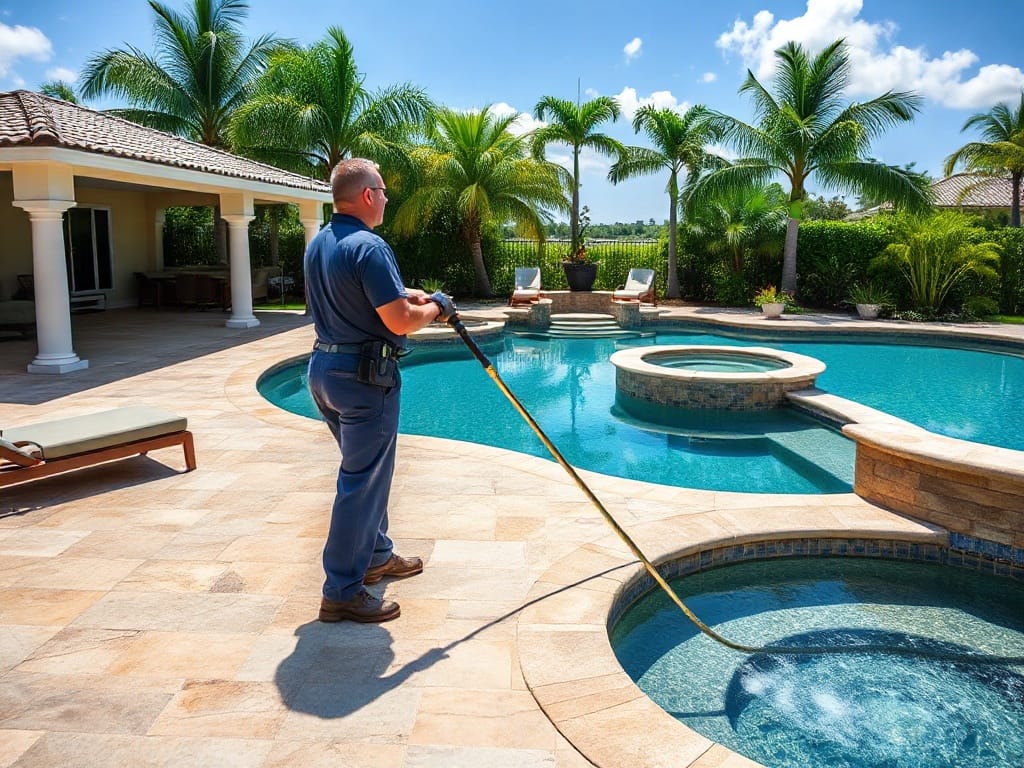
Parkland is Broward County’s most affluent and least densely developed city — a low-density residential community in the county’s northwestern corner where large lots, estate-style homes, and gated communities with golf courses and conservation easements define the residential character. Private pools in Parkland reflect the city’s premium standard: large-format pools with dedicated spas, sophisticated automation systems, saltwater chlorination, heated spa water, and the full range of water features and equipment that Broward County’s highest-end residential construction supports. For Parkland pool owners, pool service Parkland FL demands the technical depth and service consistency that complex, high-value pool systems require — combined with an understanding of the specific chemistry and debris challenges that Parkland’s location near the Everglades and western conservation areas creates. This guide covers what Parkland homeowners need to know about maintaining their pool to the standard these installations deserve.
What Professional Pool Service Covers in Parkland
A complete weekly service visit in Parkland covers water chemistry testing across all parameters — free chlorine, combined chlorine, pH, total alkalinity, calcium hardness, cyanuric acid, and salt — for both the main pool and the spa, which is tested and adjusted independently due to its smaller volume and higher operating temperatures. Chemistry adjustment brings all parameters into their target ranges before the technician leaves the property.
Physical service includes surface skimming, thorough wall and step brushing, floor vacuuming or automatic cleaner inspection, skimmer and pump basket emptying, all filter housings pressure-checked, water feature operation verified, and automation controller settings confirmed. For Parkland pools with multiple pumps, dedicated spa pumps, booster pumps for pressure-side cleaners, and water feature pumps, the equipment check is more involved than for a standard single-pump residential account — each pump, its associated plumbing, and its automation programming is part of the service review.
Items billed separately include equipment repairs, filter media replacement, algae remediation, screen enclosure referrals, and post-storm recovery. The scope and detail of service communication expected at a Parkland price point is higher than for a standard Broward County residential account — prompt notification of equipment issues, documented visit records, and clear explanations of recommended work are baseline expectations, not premium additions.
Water Chemistry in Parkland: Hard Water and Large-Volume Pools
Parkland pool water comes from Broward County’s Biscayne Aquifer municipal supply — the same hard, calcium-rich water that affects pool chemistry throughout Broward. The distinguishing factor for Parkland pools is volume: a large Parkland pool with a connected spa may hold 30,000 to 50,000 gallons or more, compared to 12,000 to 18,000 gallons for a standard Broward residential pool. Larger water volumes dilute the effect of chemistry adjustments, meaning that pH corrections, alkalinity adjustments, and calcium management all require proportionally larger chemical additions and benefit from higher testing precision to achieve accurate results.
Calcium hardness should be maintained between 200 and 400 ppm. In Parkland’s low-evaporation summer environment — where tree canopy and lot size create somewhat more shading than in denser urban Broward communities — calcium concentration may build somewhat more slowly than in fully exposed pools of the same volume, but the underlying hard-water management discipline remains the same. Scale formation on the tile line, spa shell, and salt cell plates is the long-term risk of unmanaged calcium hardness, and Parkland pools with premium tile work and finishes make scale prevention a higher aesthetic priority than in standard residential accounts.
Spa chemistry in Parkland requires independent weekly management. Heated spa water at 100 to 104 degrees consumes sanitizer significantly faster than pool water at ambient temperature, drives pH upward more rapidly, and concentrates dissolved solids through evaporation at a higher rate. A service company that tests the main pool without independently testing and correcting the spa is leaving the most-used recreational water in a Parkland home unchecked — a gap that shows up as cloudy water, irritation complaints, and chemistry drift that affects the spa experience.
Everglades Proximity: Organic Loading and Wildlife Challenges
Parkland’s location at the western edge of Broward County — bordered by conservation areas and with properties in communities like Heron Bay, Parkland Golf and Country Club, and Parkland Isles sitting adjacent to natural areas — creates organic and wildlife challenges for pool maintenance that are largely absent in more urbanized Broward communities.
Windblown organic material from the Everglades buffer areas and adjacent conservation land introduces a higher base level of organic debris into Parkland pools than comparable pools in central or eastern Broward. Leaves, grass pollen, algae spores from natural water bodies, and fine organic particulate carried on western breezes all contribute to elevated phosphate loading in Parkland pool water. Phosphates are the primary algae nutrient, and Parkland pools consistently register higher phosphate baselines than comparable pools in more urbanized areas of Broward. Quarterly phosphate testing and removal treatment is standard preventive protocol for Parkland pool accounts — not an occasional addition but a routine part of the annual service program.
Wildlife intrusion is a real maintenance factor in Parkland. Iguanas — invasive but widespread in South Florida — use pool ledges and spas as water sources, depositing significant organic waste in the water and on pool surfaces. Frogs enter pools through open access points and can be found in skimmer baskets, introducing organic matter and creating chemistry disruption when large numbers are present. Birds perching on pool coping and water feature elements introduce waste that elevates nitrogen compounds and drives combined chlorine upward. These are not hypothetical concerns in Parkland — they are routine factors that service companies managing Parkland accounts should address explicitly in their chemistry management approach, particularly the phosphate and combined chlorine response.
Complex Pool Systems in Parkland: Automation and Equipment Management
Parkland pools are equipped with the full range of modern residential pool automation — Pentair IntelliCenter, Hayward OmniLogic, Jandy iAquaLink, and similar platforms that control pumps, lighting, heaters, salt cells, chemical dosing, and water features from a single interface. These systems deliver significant capability but require configuration knowledge and diagnostic competence that not all pool service companies in Broward have developed.
A service technician working a Parkland automation account should be able to read automation controller diagnostic screens, verify that salt cell output settings are calibrated to actual cell efficiency (not just nominal rated output), confirm that daily pump schedules are achieving adequate water turnover, and identify error codes or unusual status readings that indicate developing equipment problems. These are not advanced skills — they are baseline competencies for responsible service on automated pool systems — but they separate service companies equipped to manage Parkland accounts from those that perform standard weekly maintenance and leave automation system monitoring to the homeowner.
Salt cell management is particularly critical in Parkland. The combination of large pool volume, Broward hard water, and the high-output salt cells used on larger Parkland pools creates more rapid calcium scale accumulation than on smaller residential cells. Quarterly cell inspection and cleaning is standard protocol — and for Parkland pools with very high calcium hardness levels, acid washing the cell every two to three months may be appropriate to maintain rated output. A service company managing a Parkland saltwater pool should track cell inspection dates and communicate the schedule to the homeowner proactively.
Parkland Communities We Serve
Heron Bay is Parkland’s largest gated community — a golf and country club development with a range of residential product from attached villas to large estate-style single-family homes. Pool configurations throughout Heron Bay range from smaller screen-enclosed pools in the attached villa sections to large custom installations with full automation and water features in the estate sections.
Parkland Golf and Country Club features some of Parkland’s most premium residential product — large lots with custom homes and correspondingly large, fully appointed pool installations. Properties in this community represent the highest end of Parkland’s pool service demand profile.
Parkland Isles, Watercrest, and Miralago are established gated communities throughout the city with single-family homes and private pools that span a range of vintages from the late 1990s through the 2000s. Service requirements throughout these communities are consistent with Parkland’s overall modern, complex pool equipment profile.
We serve pool owners throughout Parkland, including Heron Bay, Parkland Golf and Country Club, Parkland Isles, and all residential neighborhoods in zip code 33076.
Hurricane Season Pool Preparation in Parkland
Parkland’s northwestern Broward location provides more distance from direct coastal storm surge than oceanfront communities, but major hurricanes tracking across South Florida deliver sustained wind and rainfall throughout the county’s interior. For Parkland pools with extensive automation systems, pre-storm circuit breaker shutdown should be systematic — confirming that automation controller, pump, heater, and lighting circuits are all secured, not just the main pump breaker. Sophisticated automation systems are the most expensive equipment in a Parkland pool pad and deserve specific protection during storm events.
Standard pre-storm protocol: lower water level 12 to 18 inches, add shock and triple-dose algaecide, remove and store all loose deck furniture and pool accessories, secure screen doors, and shut off all equipment circuits. Post-storm: inspect automation system before restarting, check all equipment pads for debris intrusion, test chemistry before adding chemicals, schedule post-storm service as soon as accessible.
Choosing a Pool Service Company in Parkland
Florida DBPR license verification is the non-negotiable baseline. For Parkland homeowners with complex automation systems and saltwater pools, the service company conversation should go further: ask about their experience with the specific automation platform installed (Pentair, Hayward, or Jandy), their quarterly salt cell inspection protocol, and how they communicate equipment diagnostics to homeowners. A company that cannot speak to automation controller diagnostics, salt cell scale management, and phosphate control is not equipped to manage a Parkland account to the standard these installations require.
Pricing for weekly full-service in Parkland reflects the larger pool volume, complex equipment, and higher service standard: typically $175 to $250 or more per month for full-service with chemicals on a large Parkland installation. Accounts with large spas, multiple water features, and full automation at the high end of this range or above. Chemistry-separate pricing starts higher than in standard Broward residential markets given the chemical volume larger pools require.
Pool Service Fort Lauderdale: Serving Parkland Year-Round
At Pool Service Fort Lauderdale, we serve Parkland pool owners with the technical depth and service consistency that premium pool installations require. We understand automation system management, saltwater pool chemistry in Broward’s hard water, the phosphate and wildlife loading that Parkland’s conservation-adjacent location creates, and the service communication standard that Parkland homeowners expect. Contact us to discuss a weekly maintenance program built around your Parkland pool.
Frequently Asked Questions About Pool Service in Parkland
How often should a Parkland pool be professionally serviced? Weekly service is the standard for Parkland residential pools. The complexity of Parkland pool systems — large volume, saltwater chlorination, heated spas, automation — makes consistent weekly attention more important, not less, than for a simpler residential pool. Weekly visits catch salt cell output changes, automation programming issues, and early chemistry drift before they become expensive problems in a high-value installation.
Why does our Parkland pool require more phosphate treatment than our previous home in eastern Broward? Parkland’s proximity to western conservation areas and the Everglades buffer introduces higher organic and phosphate loading via windblown debris than more urbanized eastern Broward locations. Wildlife intrusion from iguanas, frogs, and birds adds organic compounds that further elevate phosphates. Quarterly phosphate removal treatment is standard protocol for Parkland pools for exactly this reason — the nutrient loading profile is different from what most eastern Broward service routines are calibrated for.
How do we manage iguana intrusion in our Parkland pool? Iguanas are an invasive species throughout South Florida and are particularly active in Parkland’s more natural setting. Skimmer baskets should be checked for iguana waste debris at every visit. Pool chemistry — particularly combined chlorine — should be monitored closely as iguana waste drives nitrogen loading. Some Parkland homeowners install iguana deterrent barriers along pool copings; a service company can document iguana access points and patterns over time to inform deterrent strategies. Chemistry alone cannot eliminate the problem — it manages its effects.
What does pool service cost in Parkland? Full-service weekly with chemicals for a large Parkland installation typically runs $175 to $250 or more per month, reflecting the larger pool volume, complex equipment, and spa chemistry requirements. Standard residential pricing in the $120 to $175 range applies to smaller or less complex Parkland accounts. Salt cell inspection and cleaning, when performed, is typically billed separately.
How do we verify our automation system is managing our pool correctly? A service company familiar with your automation platform should review controller output settings quarterly — confirming that the salt cell output percentage reflects actual cell efficiency after scale management, that pump run schedules are achieving adequate daily water turnover for your pool volume, and that heater and dosing system settings are calibrated correctly for the season. If your service company cannot read and interpret the diagnostic screens on your automation controller, they are not managing the system — they are servicing around it.
Our Parkland pool has a large spa — how is it managed differently from the pool? Heated spa water requires independent chemistry testing at every visit. High operating temperatures (100 to 104 degrees) drive pH upward faster, deplete sanitizer more quickly, and concentrate dissolved solids through steam evaporation at a rate that diverges significantly from the main pool. Spa alkalinity, pH, and chlorine are adjusted based on the spa test results, not the pool readings. Failing to test the spa independently is the single most common service gap on accounts with heated spas in Parkland.
Get Started with Pool Service in Parkland
Parkland pool owners have invested in some of Broward County’s finest residential pool installations — and they deserve a service company with the technical depth, service consistency, and communication standard those installations require. From automation management to salt cell maintenance to phosphate control in a conservation-adjacent environment, the demands of Parkland pool ownership reward genuine expertise. Contact Pool Service Fort Lauderdale today to discuss a weekly maintenance program built to Parkland’s standard.