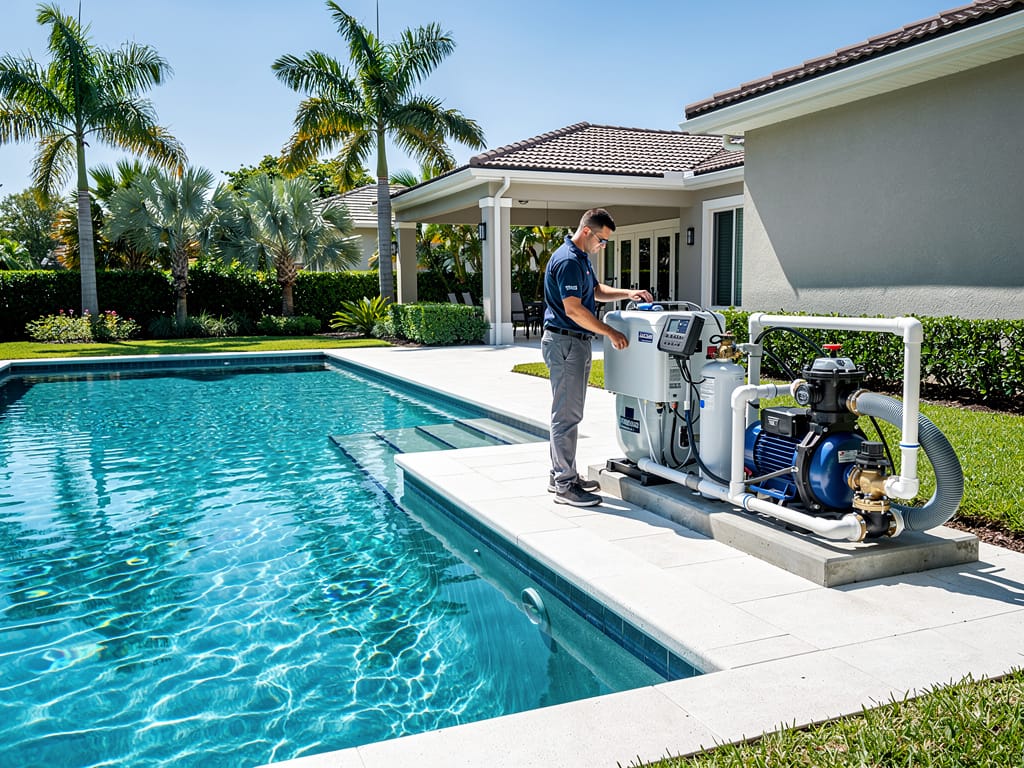
Walk into any Coral Springs neighborhood and you’ll hear pool owners debating this: salt or chlorine? It’s the most common system conversion question we get from homeowners across Broward County, and the answer involves more nuance than most “salt vs. chlorine” comparisons online will tell you — especially in a hard water market like South Florida.
This guide covers how both systems work, the real cost comparison over five years, and the specific Coral Springs factors that should influence your decision.
How Salt Chlorinator Systems Actually Work
One of the biggest misconceptions about salt pools: they don’t use salt instead of chlorine. They use salt to produce chlorine. A salt chlorinator (also called a salt cell or saltwater generator) runs pool water through an electrolytic cell that converts dissolved salt (sodium chloride) into free chlorine through electrolysis. The chlorine sanitizes the pool, then converts back to salt, and the cycle repeats.
The salt level in a saltwater pool — typically 2,700–3,400 ppm — is about one-tenth the salinity of ocean water. You can barely taste it. But it’s enough for the cell to generate a steady, consistent supply of free chlorine without anyone having to add tablets or liquid chlorine manually between service visits.
Traditional chlorine pools rely on external chlorine addition — tablets in a floater or automatic feeder, liquid chlorine added by a service technician, or shocking for supplemental dosing. The chemistry is identical; the delivery mechanism is different.
Cost Comparison Over Five Years in Coral Springs
Salt system: Installation of a quality salt chlorinator (Hayward AquaRite, Pentair IntelliChlor, or similar) runs $800–$2,500 depending on pool size and brand. Salt bags cost approximately $10–$15 each; you’ll add 2–4 bags per year to replace what’s lost to dilution from backwashing and splash-out. The cell needs annual cleaning in Coral Springs (calcium scale from hard water) and replacement every 3–7 years at a cost of $300–$600 for the cell alone.
Traditional chlorine: An automatic chlorinator (trichlor tablet feeder) costs $150–$300 to install. Trichlor tablets cost $80–$150 per 50 lbs, and a typical Coral Springs pool goes through 5–8 lbs per week during summer — meaning $400–$800 per year in chlorine tabs alone. Plus liquid chlorine for shocking events.
Five-year math: A standard Coral Springs pool on traditional chlorine typically spends $2,000–$4,000 on chlorine products over five years (chemicals only, not labor). A salt system owner spends roughly $600–$1,200 on salt, cell cleaning, and eventual cell replacement. The salt system’s higher upfront cost typically breaks even around the 2–3 year mark, and saves money after that.
The Coral Springs Hard Water Factor
This is where South Florida’s specific water chemistry matters. Coral Springs tap water has naturally high calcium hardness — typically 200–350 ppm straight from the tap. As pool water evaporates and you add more tap water, calcium concentrates. Salt systems accelerate this problem in one specific way: the electrolytic cell runs at elevated temperatures, and calcium carbonate scales onto the cell plates preferentially.
A salt cell in Coral Springs hard water needs cleaning every 6–12 months, compared to every 12–18 months in softer-water markets. Cleaning involves soaking the cell in a diluted muriatic acid solution — a job most homeowners can learn to do themselves, but that service technicians handle more safely and consistently.
If you convert to salt and skip cell maintenance, the cell efficiency drops rapidly and eventually the system can’t generate enough chlorine. The pool turns green despite the salt system being “on.” We see this several times a year in Coral Springs with pools whose owners thought salt meant maintenance-free.
The fix is straightforward: annual cell cleaning and monitoring calcium hardness levels, adding a calcium sequestrant when hardness exceeds 400 ppm, and diluting the pool (partial drain and refill) if calcium concentration climbs above 500 ppm.
What Salt Pools Feel Like vs. Traditional Chlorine Pools
This is where salt wins clearly and why most Coral Springs homeowners who convert stick with it. The softer, slightly silky feel of saltwater is noticeable from the first swim. Eyes don’t sting. Hair feels less dried out. Swimsuits last longer because they’re not exposed to concentrated chlorine tabs. Swimmers with sensitive skin or chlorine irritation often report significant improvement after conversion.
The chlorine odor associated with traditional pools — actually caused by chloramines, not free chlorine — is typically reduced in well-maintained salt pools because the consistent, steady chlorine generation keeps combined chlorine low.
Which Is Right for Your Coral Springs Pool?
Choose a salt chlorinator if: you want softer water, you’re willing to invest upfront and do annual cell maintenance, you have household members with chlorine skin or eye sensitivity, or you want to reduce the frequency and volume of manual chemical additions between service visits.
Choose traditional chlorine if: you’re on a tight budget, your pool is temporary or you’re planning to sell the home soon, or your service provider handles all chemistry and you have no personal preference about water feel.
Either way, professional service remains essential. Salt pools still need chemistry balancing, phosphate treatment, filter maintenance, and equipment inspection — all the same things traditional pools need. Salt is not a substitute for service.
Our Pool Service Fort Lauderdale team handles both salt and traditional chlorine pools throughout the Coral Springs area. For questions about converting your pool or evaluating your current system, call (954) 501-2754.
Frequently Asked Questions
Will a salt pool damage my pool equipment or surfaces?
Salt at pool concentrations (2,700–3,400 ppm) is not corrosive to standard pool equipment and surfaces designed for pool use. Problems arise when salt levels drift significantly above the recommended range. Some older pool heaters and certain metal fixtures can show accelerated corrosion with salt systems; check your equipment manufacturer’s specifications before converting.
How often do I need to add salt to a saltwater pool in Coral Springs?
Most Coral Springs pools need salt added 2–4 times per year. Salt leaves the pool through backwashing, splash-out, and any water you drain. It does not evaporate. Your salt chlorinator will display the current salt level; add when it drops below 2,700 ppm.
Can I convert my existing pool to salt, or do I need a new pool?
Conversion is straightforward. A salt cell unit plumbs into your existing return line after the heater, and the control box mounts on the equipment pad. Most conversions take 2–4 hours for a qualified technician. No major plumbing changes are required in most cases.
Do salt pools still need to be shocked?
Yes. Even with a salt chlorinator running, Coral Springs pools should be shocked after heavy bather load events, after significant rain, and periodically during peak summer months. Some salt chlorinators have a “super-chlorinate” mode that boosts output temporarily — useful for post-party or post-rain events.
How long does a salt cell last in Coral Springs?
In Broward County’s hard water, salt cells typically last 3–5 years with annual cleaning, compared to the manufacturer’s rated 5–7 years in ideal conditions. Hard water calcium scale reduces cell efficiency over time even with cleaning. Budget for cell replacement every 4–5 years.