If your Coral Springs pool keeps developing algae problems despite consistent chlorine levels, phosphates are the likely culprit. This is one of the most frequently misunderstood aspects of pool chemistry in South Florida — and one of the most impactful once addressed.
Phosphates don’t cause cloudy water on their own. They don’t affect chlorine levels directly. Many pool owners have never heard of them, because in markets with lower tap water phosphate content, they’re rarely an issue. In Broward County, they’re a routine part of pool chemistry management.
What Phosphates Are and Why Your Pool Has Them
Phosphates (phosphate compounds, technically orthophosphates) are naturally occurring minerals that serve as nutrients for plant and algae growth. In a terrestrial environment, phosphates in soil feed your lawn. In a pool, they feed algae.
Coral Springs pools accumulate phosphates from multiple sources simultaneously:
Tap water: Broward County’s municipal water supply uses phosphate-based corrosion inhibitors to protect pipe infrastructure. The result: every gallon of fill water added to your pool introduces 300–600 ppb of phosphates. In Florida’s heat, a 15,000-gallon pool can lose 3–5 inches of water per week to evaporation during summer — that’s hundreds of gallons of phosphate-laden tap water added weekly just to maintain the waterline.
Fertilizer runoff: Coral Springs is a heavily landscaped community. Fertilizers applied to lawns, flower beds, and community green spaces contain phosphates as a growth nutrient. Rain carries these fertilizers across driveways and pool decks directly into the water.
Organic debris: Leaves, seed pods, pollen, and grass clippings decomposing in pool water release phosphates as they break down. Trees overhanging or surrounding a pool constantly contribute to the organic phosphate load.
Swimmers: Human body oils, cosmetics, and sunscreen contain phosphate compounds that transfer to the water during swimming.
The cumulative result: Coral Springs pools that aren’t actively treated for phosphates typically see levels climb to 1,000–3,000 ppb over the course of a season, even with consistent pool service.
How Phosphates Fuel Persistent Algae in Coral Springs
Here’s the relationship that matters: algae require both chlorine to be absent AND a nutrient source to grow. Control chlorine alone, and phosphates wait — but the moment chlorine dips (from a heavy rain, UV exposure, high bather load, or a service visit that runs slightly long), the phosphate-fed algae bloom rapidly.
This is why some Coral Springs pools experience seemingly inexplicable recurring algae problems. The pool is on a consistent service schedule. Chlorine levels look right during service visits. But within days of a service visit, cloudiness or green tinges appear. The pattern repeats every few weeks.
In this scenario, the phosphates haven’t been addressed. Chlorine is fighting the algae repeatedly, but the underlying food source keeps feeding re-growth. Removing the phosphates eliminates this cycle — not by adding more chlorine, but by removing the fuel that enables algae to outpace normal chlorine maintenance.
Testing Phosphate Levels: What the Numbers Mean
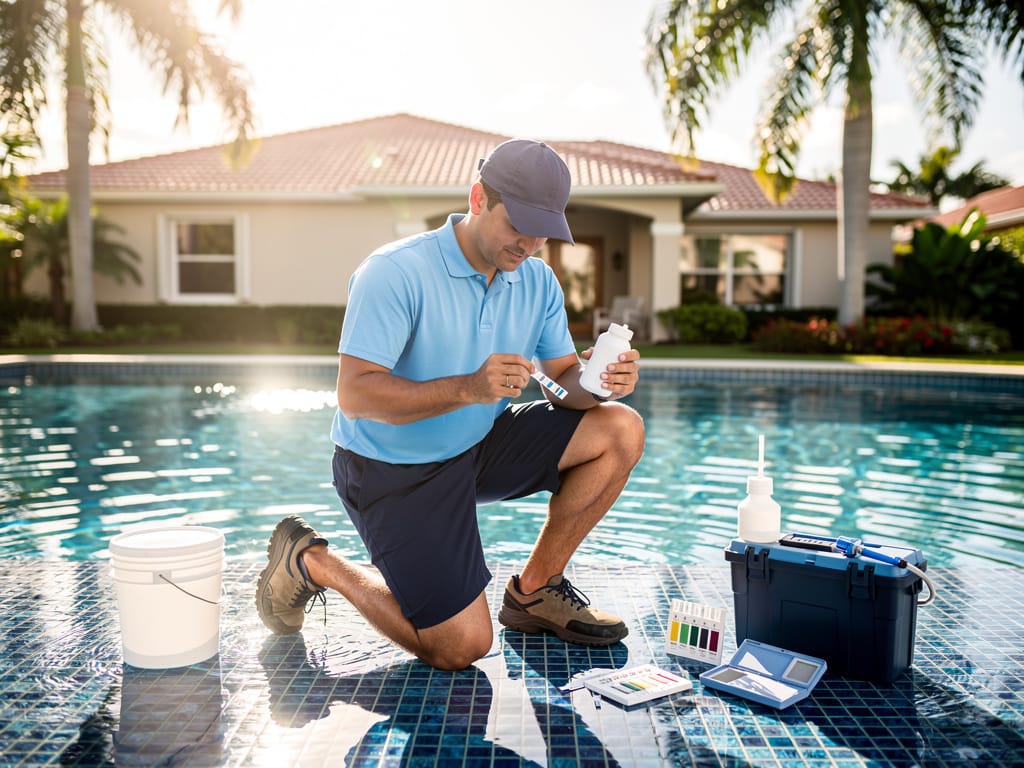
Standard pool test kits and test strips don’t measure phosphates. A phosphate test requires a separate reagent-based test kit or digital photometer. Professional pool service companies carry phosphate test kits as standard equipment; many homeowner test kits don’t include them.
Phosphate level interpretation:
- Below 100 ppb: Ideal. Algae growth strongly inhibited.
- 100–500 ppb: Acceptable with consistent chlorination. No immediate treatment needed, but monitor.
- 500–1,000 ppb: Elevated. Algae risk increases, especially during chemistry disruptions. Treatment recommended.
- Above 1,000 ppb: High. Algae outbreaks likely even with normal chlorine maintenance. Treat promptly.
In our experience servicing Coral Springs pools, untreated pools that rely on tap water frequently test above 1,000 ppb by mid-summer. Testing once per month during May–October and twice during the cooler season is appropriate for this market.
How Phosphate Remover Works and What to Expect
Phosphate removers use lanthanum chloride or lanthanum carbonate — rare earth compounds that bind to phosphate ions in solution and precipitate them out of the water as a fine white powder that the filter captures. The chemistry is effective and fast: phosphate levels drop within 24–48 hours of treatment.
Application process: add the phosphate remover (dosed by pool volume and current phosphate ppm) directly to the pool with the pump running. The water may temporarily turn milky as the lanthanum-phosphate precipitate forms. Run the filter continuously and backwash or clean the filter 24 hours after treatment to remove the captured phosphate material. Test phosphate levels 48 hours after treatment to confirm the result.
Cost: phosphate remover for a 15,000-gallon pool at 1,000 ppb runs $20–$50 in product. At higher levels (3,000+ ppb), you may need multiple doses, bringing the total to $60–$120 for initial correction. Once levels are below 100 ppb, maintenance doses every 60–90 days cost $15–$30 per treatment.
Preventing Phosphate Buildup Between Treatments
Ongoing phosphate management is easier than periodic correction from high levels. Practices that slow phosphate accumulation in Coral Springs pools:
- Use a phosphate-sequestering product as a maintenance dose every 4–6 weeks during the rainy season
- Net out leaves and organic debris before they decompose in the water
- Run pool chemistry consistently to prevent low-phosphate periods from alternating with spike periods
- Consider a pre-filter for fill water if your pool requires very frequent top-offs
- Rinse off sunscreen before swimming (this also extends your pool’s overall chemistry balance)
For pools that receive heavy organic input from surrounding trees and landscaping, monthly phosphate testing and quarterly treatment are more realistic maintenance targets than once-per-season treatment.
Our team at Pool Service Fort Lauderdale includes phosphate testing as part of our regular service protocol for Coral Springs pools. To discuss your pool’s phosphate situation or schedule service, call (954) 501-2754.
Frequently Asked Questions
Will phosphate remover hurt my pool’s water chemistry?
Phosphate remover doesn’t significantly affect chlorine, pH, alkalinity, or other parameters. The only impact on clarity is the temporary milky appearance as the precipitate forms, which clears within 24 hours as the filter captures the particles. Always backwash or clean the filter after treatment to avoid a clogged filter reducing circulation.
My chlorine is always correct but I keep getting algae — could phosphates be the cause?
Yes, this is the classic high-phosphate symptom. When algae persist despite adequate chlorine, phosphates are usually the explanation. Test your phosphate level; if it’s above 500 ppb, treat with phosphate remover and see if the algae pattern changes. This resolves the recurring algae problem in the majority of Coral Springs pools where it’s the underlying cause.
Can I buy phosphate remover at a pool supply store and treat my own pool?
Yes. Products like Natural Chemistry’s Pool Perfect + Phosfree, BioGuard’s Pool Complete, or Lo-Chlor Phosphate Remover are available at pool supply retailers and online. Follow the dosing instructions based on pool volume and test results. Over-dosing can temporarily clog filters more aggressively; dose accurately.
How quickly do phosphates return after treatment?
In a Coral Springs pool that’s adding tap water regularly and has organic debris input, phosphates can climb from below 100 ppb back to 500+ ppb in 4–8 weeks during summer. This is normal for this market. Monthly or bi-monthly testing and quarterly maintenance doses are more effective than one annual treatment followed by inattention.
Are phosphates dangerous for swimmers?
Phosphates at pool concentrations are not a health risk for swimmers. The concern is entirely about water quality and algae control, not human safety. The algae they enable — and the low-chlorine conditions that allow algae to grow — are the actual concern, not the phosphates themselves.