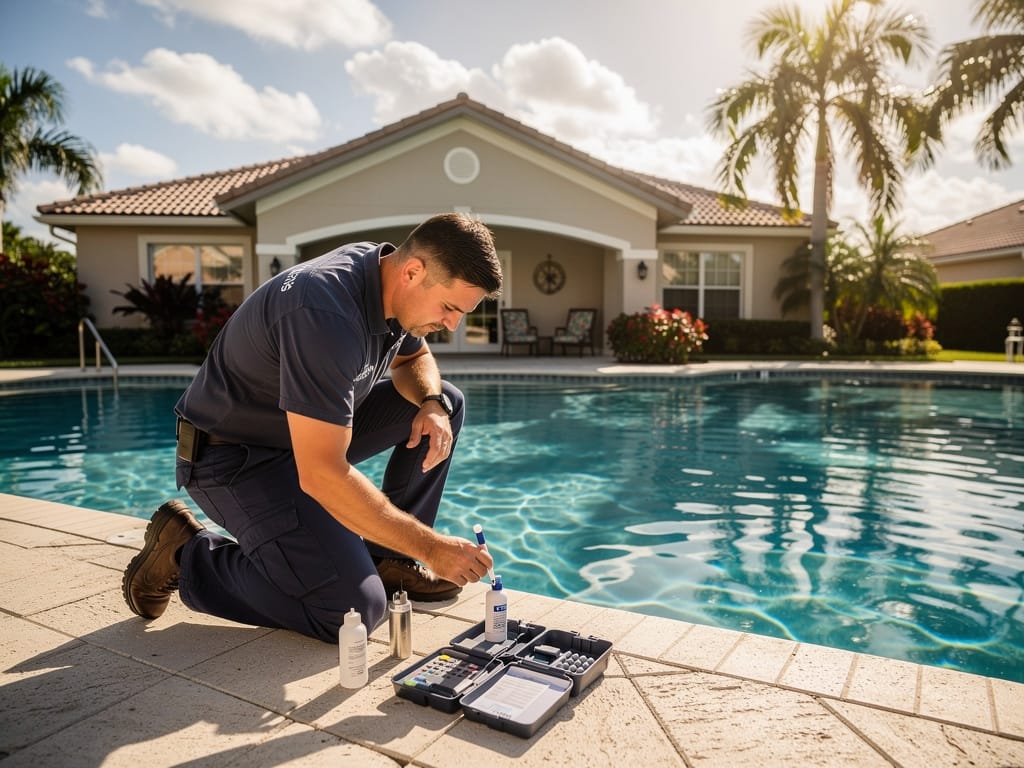
Calcium hardness is one of the five core water chemistry parameters in pool maintenance, alongside chlorine, pH, total alkalinity, and cyanuric acid. In most of the country it’s a secondary concern — something technicians check periodically but rarely need to treat. In Coral Springs, it’s a front-line issue that needs regular attention.
The reason: Broward County’s tap water is naturally hard. The geology of South Florida’s limestone aquifer means the water supply picks up significant calcium carbonate before it reaches your tap. Add South Florida’s evaporation rates — pools here can lose 2–3 inches per week in peak summer heat — and calcium concentrates steadily through the season.
What Is Calcium Hardness and Why Does It Matter?
Calcium hardness measures the total dissolved calcium in your pool water, expressed in parts per million (ppm). The ideal range for most pools is 200–400 ppm.
Water with too little calcium (soft water, below 200 ppm) becomes “hungry” — it seeks calcium to reach equilibrium and finds it by pulling calcium from your pool’s plaster surfaces and grout. This causes etching and pitting of pool surfaces, shortening their lifespan. It’s less common as a problem in Coral Springs given the naturally hard source water.
Water with too much calcium (above 400–500 ppm) deposits excess calcium as calcium carbonate scale — the white crusty buildup you see on tile waterlines, inside pipes, on equipment, and on pool surfaces. At high levels it also causes cloudy water that filters cannot clear regardless of how long the pump runs.
In Coral Springs, high calcium is the routine problem, not low calcium.
How Calcium Concentrates in Coral Springs Pools
The math is straightforward but the impact is significant. If your tap water arrives at 300 ppm calcium hardness, and your pool evaporates water while leaving the minerals behind, calcium concentration rises with every inch of evaporation.
A 15,000-gallon pool in Coral Springs loses roughly 2 inches per week to evaporation and splash-out during peak summer. That’s approximately 1,200–1,500 gallons per week that evaporates and is replaced with fresh tap water. The calcium in the replacement water adds to what was left behind by evaporation. Over 90 days of summer without dilution management, calcium hardness can climb from an initial 300 ppm to 600–800 ppm.
At 600 ppm calcium hardness, scale formation on pool surfaces and equipment accelerates. At 800 ppm, cloudy water becomes persistent even with perfect pH and chlorine, because the calcium carbonate precipitates out of solution as fine suspended particles that make water hazy.
Signs Your Coral Springs Pool Has a Calcium Problem
White or off-white deposits on tile waterlines are the most visible symptom. This calcium carbonate scale typically appears as a rough, chalky crust at the water surface level. In Coral Springs, most pool owners assume it’s just hard water deposits and scrub it off manually — which works temporarily but doesn’t address the underlying concentration.
Cloudy water that doesn’t clear with chlorine treatment or filter operation is a secondary sign. When calcium precipitates out of solution due to supersaturation, the resulting fine particles pass through sand and cartridge filters and make the water permanently hazy until the calcium is brought back into range.
Scale inside pool equipment — particularly visible as white mineral deposits inside the filter body, on heater heat exchanger fins, and on the electrolytic cell of salt systems — indicates that your calcium hardness has been elevated for an extended period.
How to Lower Calcium Hardness in Your Coral Springs Pool
There is no chemical that removes dissolved calcium from pool water the way shock removes algae or acid lowers pH. The only reliable method of reducing calcium hardness is dilution — removing some of the high-calcium water and replacing it with lower-calcium water.
Partial drain and refill: The most effective approach. Drain 1/4 to 1/3 of the pool volume (typically 3,000–5,000 gallons for a standard Coral Springs pool) and refill with fresh tap water. This dilutes the concentrated calcium. Starting at 700 ppm, a 1/3 drain-and-refill brings levels to approximately 470 ppm — much more manageable. Multiple partial drains can bring high levels into range without fully draining the pool.
Important Coral Springs precaution: Broward County’s high water table means pool shells should not be fully drained without proper precautions (hydrostatic valve open, consultation with a pool professional). Partial drains of 1/3 or less are generally safe for properly constructed shells. Never fully drain a pool without professional guidance in South Florida.
Calcium sequestrant: Sequestrants like Jack’s Magic or Natural Chemistry’s Scale Free bind to dissolved calcium ions and keep them in suspension rather than allowing them to deposit as scale. This doesn’t lower calcium hardness — it masks the problem by preventing scale formation temporarily. Effective as a short-term management tool when dilution isn’t immediately practical, but not a long-term solution. Reapply monthly.
RO (reverse osmosis) water treatment: Available in Broward County through mobile pool water treatment services, RO treatment processes pool water on-site through a membrane system that removes calcium and other dissolved minerals. It’s more expensive than partial drain-and-refill (typically $350–$600 for a standard pool) but allows treatment without losing pool water — useful during drought restrictions or for pools where drainage logistics are challenging.
Preventing Calcium Buildup: Ongoing Management
In Coral Springs, calcium management is ongoing, not a one-time correction. Practices that keep it manageable:
- Test calcium hardness monthly May–October, every 6 weeks November–April
- Perform a partial drain-and-refill when calcium exceeds 500 ppm
- Use a calcium sequestrant as a monthly additive during peak evaporation months
- Maintain pH at 7.4–7.6 — higher pH causes calcium to precipitate more readily
- Clean salt cell scaling quarterly (salt pools in Coral Springs hard water need more frequent cell maintenance)
Pool Service Fort Lauderdale tests calcium hardness as part of our standard service protocol for all Coral Springs pools. Call us at (954) 501-2754 if you’re seeing scale or persistent cloudiness in your pool.
Frequently Asked Questions
How often should I test calcium hardness in my Coral Springs pool?
Monthly during the May–October evaporation season, every 6 weeks during the cooler months. In Coral Springs’s hard water environment, quarterly testing is not sufficient — calcium climbs faster than that during summer when evaporation and refilling rates are highest.
Can I just add more acid to fix calcium problems?
No. Muriatic acid lowers pH and total alkalinity but doesn’t reduce dissolved calcium hardness. While lower pH temporarily reduces scale formation tendency (by changing the Langelier Saturation Index), running pH below 7.2 to manage calcium creates new problems — etching of pool surfaces and equipment corrosion. Address calcium directly through dilution, not pH manipulation.
Will a water softener help my pool’s calcium hardness?
Household water softeners exchange calcium ions for sodium ions through ion exchange. Adding softened water reduces calcium hardness but increases sodium content. For pools, this can affect chemistry balance and — for saltwater pools — interfere with salinity readings. Softened water can be used for pool fill but should be done judiciously and with chemistry testing afterward.
How long does it take for calcium scale to damage pool surfaces?
Calcium scale at 600–800 ppm causes visible tile line deposits within weeks. Surface etching and equipment damage develop over months to years of sustained high-calcium operation. The earlier you manage calcium levels, the less accumulated damage you’ll face at your next resurfacing.
What is the Langelier Saturation Index and should I care about it?
The LSI is a formula that combines pH, temperature, calcium hardness, total alkalinity, and TDS to predict whether pool water will scale (positive LSI) or etch (negative LSI). A balanced pool has an LSI between -0.3 and +0.3. In Coral Springs summer conditions with hard water, pools often trend toward positive LSI (scaling tendency). Your service technician’s goal is to keep all parameters in balance so the LSI stays in the safe zone.