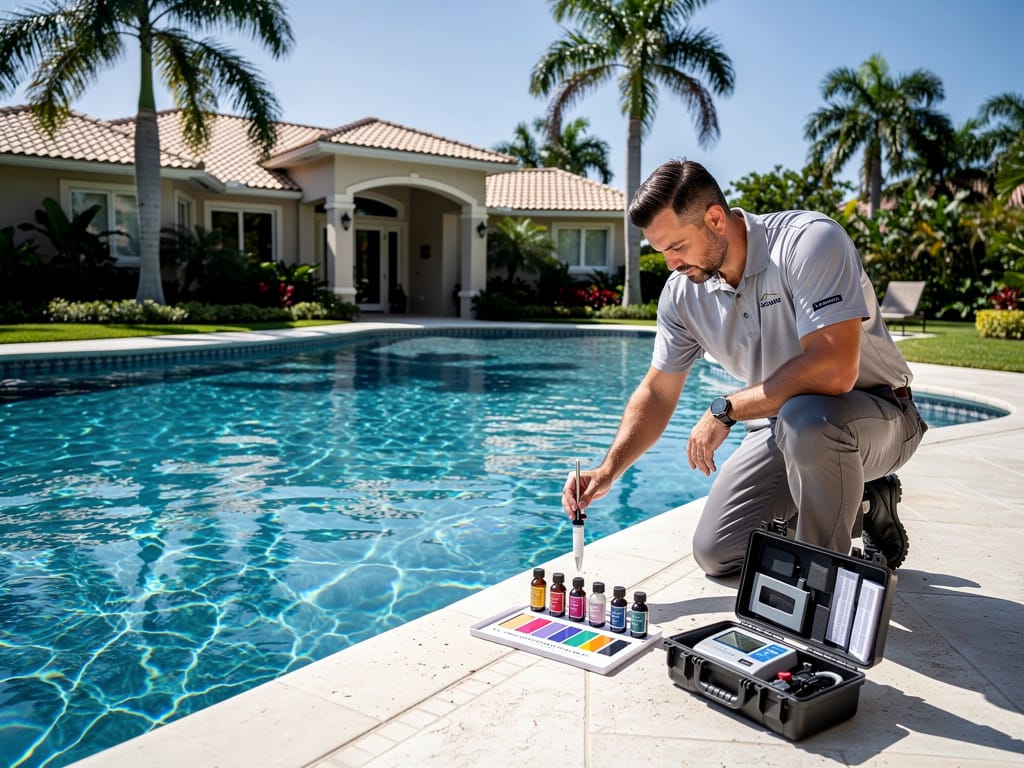
Walk around almost any older pool in Pompano Beach — in Palm Aire, Crystal Lake, Ramblewood Estates, or along the Atlantic Blvd corridor — and you’ll see it: a white or off-white crust coating the tile at the waterline. It’s one of the most common visual complaints from Pompano Beach pool owners, and it’s almost entirely driven by the specific mineral composition of Broward County’s water supply.
Calcium scale isn’t just cosmetic. Left unaddressed, it progresses from a light film to a thick mineral crust that’s increasingly difficult to remove, can trap dirt and algae, and eventually causes physical damage to grout lines and tile surfaces. Here’s what you need to know about tile scale in Pompano Beach and how it’s properly treated.
Why Pompano Beach Pools Scale So Badly
Three compounding factors make calcium scale a Pompano Beach-specific issue:
Hard source water: Broward County municipal water arrives at 200–350 ppm calcium hardness. That’s at the upper edge of the ideal pool range (200–400 ppm) before any evaporation or concentration occurs. Unlike cities served by softer mountain or surface water, Pompano Beach pools start with a high calcium baseline from the very first fill.
Year-round evaporation: Pompano Beach pools evaporate year-round — a pool loses 1/4 to 1/2 inch per day in summer, and while the rate slows in winter, it never stops. Every gallon that evaporates leaves its dissolved calcium behind. Every gallon of tap water added to compensate brings more calcium in. Over a season without proactive management, calcium concentrates steadily.
The waterline concentration zone: The tile waterline is where evaporation is most visible and most active. As water evaporates at the surface level, calcium precipitates onto the tile at the waterline first. This is why scale appears there before it appears on the pool floor — the waterline is the zone of highest evaporation-driven concentration.
Tile Cleaning Methods: Which One Is Right for Your Pool
Pumice stone cleaning (manual): The most conservative approach, appropriate for light-to-moderate calcium film. A wet pumice stone is rubbed against the tile surface to abrade away the scale without chemical treatment. Effective on ceramic and porcelain tile; should not be used on natural stone or glass tile. Labor-intensive for extensive scale. Best for annual maintenance cleaning when scale hasn’t had years to accumulate.
Bead blasting (pressure blasting with media): A specialized approach using glass beads, crushed glass, or baking soda propelled through a low-pressure nozzle at the tile surface. Removes heavy calcium deposits without acid exposure and without damaging tile surfaces when done correctly. Requires a professional with proper equipment. Pool water is typically drained slightly below the tile line for this process. Cost: $200–$500 for a standard pool. Most effective for moderate-to-heavy scale on pools that haven’t been cleaned in several years.
Acid washing the tile line: Muriatic acid applied to heavily scaled tile dissolves calcium carbonate quickly. Most effective for severe, multi-year calcium buildup. Requires careful application to avoid acid damage to surrounding pool plaster or aggregate surfaces, and proper neutralization and rinsing. Not a DIY project — professional application, appropriate dilution, and protective gear are required. Cost: $150–$350 for tile line acid treatment.
Calcium sequestrant treatment (in-water): For mild surface scale, adding a sequestrant product to the pool water helps keep calcium in suspension and can gradually soften and reduce existing light deposits over several weeks. Not a replacement for physical cleaning of established scale, but useful as part of an ongoing prevention protocol.
How Often Should Pompano Beach Pools Have Tile Cleaned?
For most Pompano Beach pools, annual tile cleaning is the practical standard. Waiting longer allows scale to build to the point where more aggressive (and expensive) methods are required.
Pools with particularly hard water (calcium hardness testing consistently above 500 ppm), pools near busy landscaping that add mineral-laden water through irrigation overspray, or pools that are filled from well water should consider cleaning every 6 months.
The easiest indicator: when you can feel texture on the tile at the waterline with your fingertip, it’s time to clean. Smooth tile should feel like smooth ceramic — any roughness is scale.
Preventing Scale Between Professional Cleanings
Prevention is more effective and less expensive than remediation. Calcium management in Pompano Beach pools:
- Test calcium hardness monthly May–October; dilute (partial drain and refill) when it exceeds 450–500 ppm
- Maintain pH at 7.4–7.6 — high pH accelerates calcium precipitation onto tile surfaces
- Add a calcium sequestrant monthly during peak evaporation months (June–September) to keep calcium in solution rather than depositing on tile
- Brush the tile waterline weekly — your service technician should include tile brushing in each visit to prevent early scale from hardening
For tile cleaning and calcium scale removal throughout Pompano Beach, contact Pool Service Fort Lauderdale at (954) 501-2754.
Frequently Asked Questions
Is the white stuff on my pool tile calcium or something else?
In Pompano Beach pools, white or off-white deposits at the waterline are almost always calcium carbonate scale. Algae at the waterline is typically green or brown and has a slimy texture; calcium scale is chalky, hard, and white. If in doubt, touch it — scale feels gritty and solid; algae smears. A drop of muriatic acid (diluted) on a small test area that fizzes confirms calcium carbonate.
Can I remove calcium scale from my pool tile myself?
Light calcium film can be addressed with a wet pumice stone, which is available at pool supply stores. Apply only to ceramic or porcelain tile — never on glass tile or natural stone. For anything beyond light film, professional cleaning is more effective and less risky for tile integrity. DIY acid application risks etching tile, damaging grout, and affecting pool water chemistry if not properly neutralized.
Will calcium scale damage my pool tile permanently?
Mild-to-moderate scale is completely removable without permanent tile damage. Heavy, multi-year scale that has penetrated grout joints or created a thick mineral crust can be harder to remove fully, and the removal process itself (aggressive bead blasting or acid) carries some risk of grout damage. The earlier you address scale, the lower the risk of lasting damage. Annual cleaning prevents this scenario.
Why does my tile scale faster than my neighbor’s pool?
Factors that cause one pool to scale faster than another: higher calcium hardness in the fill water (if you’re on a different water main section), less frequent pool service (chemistry allowed to drift toward high pH), higher water temperature (heated pools or pools with spa spillovers scale faster), or more frequent water additions (a pool losing more to evaporation or splash-out adds more tap water, which adds more calcium).
How do I protect glass mosaic or natural stone tile from calcium damage?
Natural stone and glass tile require gentler cleaning approaches than ceramic tile — neither pumice stone nor acid treatment is safe for these materials. Professional bead blasting with appropriate media pressure is the safest physical method. Chemical scale removers specifically formulated for natural stone or glass tile are available. Inform your pool service provider of your tile type before any cleaning service to ensure the appropriate method is used.