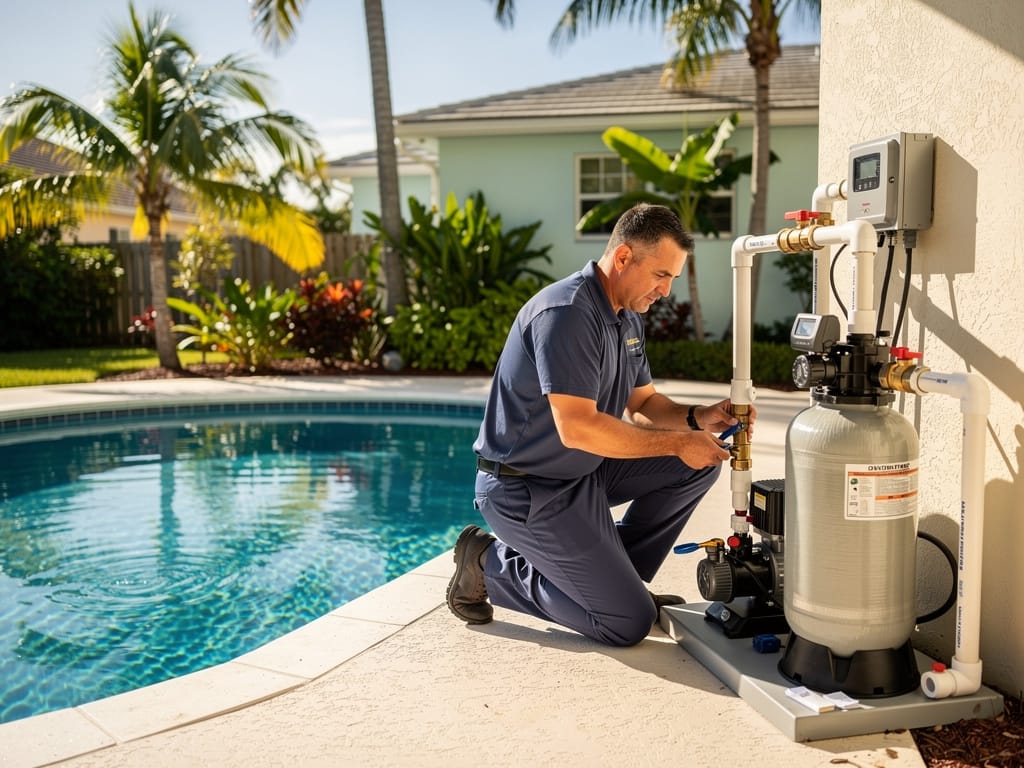
Pompano Beach pools operate 12 months a year, and pool pumps account for the largest single share of pool electricity consumption — often 50–70% of total pool operating costs. In Florida’s electricity rate environment, the choice between a single-speed and variable speed pump isn’t just about equipment preference; it’s a straightforward financial calculation.
This guide breaks down the actual energy math for Pompano Beach, the upfront cost vs. long-term savings, and the utility incentives that make the upgrade economics even more compelling.
How Variable Speed Pumps Save Money
The physics behind variable speed pump savings is the affinity law for centrifugal pumps: power consumption drops with the cube of speed reduction. This means:
- A pump running at 50% speed uses only 12.5% of the power of the same pump at full speed
- A pump running at 75% speed uses approximately 42% of the power at full speed
Most pool circulation tasks — filtration, maintaining water movement, running a cleaner — can be accomplished at 1,500–2,500 RPM rather than the 3,450 RPM a standard single-speed pump runs at continuously. Only specific functions (spa jets, waterfalls, certain cleaners) need full speed.
A variable speed pump runs slow for routine filtration and ramps up only when needed. The result: dramatically lower electricity consumption for the same filtration outcome.
The Pompano Beach Energy Savings Calculation
Real numbers for a standard Pompano Beach residential pool (15,000–20,000 gallons, running 10 hours/day, Florida Power & Light residential rate ~$0.13/kWh):
Single-speed 1.5 HP pump: Draws approximately 1,800–2,000 watts. At 10 hours/day, 365 days/year: 657–730 kWh/month = approximately $85–$95/month in electricity for the pump alone = $1,020–$1,140/year.
Variable speed pump (same 1.5 HP equivalent): Running at 1,750 RPM for 10 hours/day draws approximately 350–500 watts. At 365-day operation: 128–183 kWh/month = approximately $17–$24/month = $200–$290/year.
Annual savings: $720–$850. Over 5 years: $3,600–$4,250 in electricity savings from the pump alone.
A quality variable speed pump (Hayward TriStar VS, Pentair IntelliFlo3, or similar) installed in Pompano Beach runs $800–$1,500. At $800 in annual savings, payback period: 12–22 months. After payback, the savings are pure return on investment for the remaining 10–12 year pump lifespan.
Florida Power & Light Rebates in Pompano Beach
FPL has historically offered residential efficiency rebates for qualifying variable speed pool pump installations in their service territory. The rebate program has varied over the years — amounts typically $75–$200 per pump, subject to application and qualifying equipment requirements.
Check the current FPL energy efficiency rebate program before your pump installation to confirm available incentives. Your pool service technician or installing contractor can provide the necessary equipment documentation for rebate applications. Even without a rebate, the payback period for a variable speed upgrade in Pompano Beach is compelling — rebates just improve the math further.
Florida Building Code: Variable Speed Is Now the Minimum Standard
Since 2017, Florida Building Code (Section 424) has required variable speed pumps on all new residential pool pump installations. This means:
- Any new pool built in Pompano Beach after 2017 already has a variable speed pump
- Any pump replacement or new installation requiring a permit must use a variable speed pump
- Single-speed pumps can no longer be installed as replacements on permitted work
If you have a single-speed pump on a pool built before 2017, you’re grandfathered in — you don’t have to replace it yet. But when that pump fails and needs replacement, you’ll be installing a variable speed pump regardless. The question is whether to wait for failure or replace proactively before the 24-month payback window can benefit you.
When to Upgrade: Proactive vs. Waiting for Failure
For Pompano Beach homeowners with single-speed pumps that are still functioning:
If the pump is under 8 years old: Monitor and maintain. The savings from early replacement may not justify the upfront cost if the existing pump has several years of reliable service left.
If the pump is 8–12 years old: Evaluate whether to upgrade now or wait. If any repair is needed, upgrade rather than repair — the repair cost narrows the economic gap, and you’re getting savings immediately rather than waiting 2–4 more years for failure.
If the pump is over 12 years old: Proactive replacement is worth considering. A 12-year-old single-speed pump is in the late stages of its service life. Replacing now rather than after a sudden failure gives you a controlled installation timeline and immediate savings — better than a rush replacement after a summer pump failure.
For variable speed pump installation and pool equipment service in Pompano Beach, contact Pool Service Fort Lauderdale at (954) 501-2754.
Frequently Asked Questions
Will a variable speed pump work with my existing pool automation system?
Most modern variable speed pumps are compatible with major pool automation systems (Pentair IntelliTouch, Hayward OmniLogic, Jandy iAquaLink, etc.). Compatibility depends on the specific pump model and automation system version. When purchasing, verify compatibility with your existing automation system — your pool service provider can check this before the installation.
Do I need to reprogram my timer when I install a variable speed pump?
Yes. A variable speed pump needs to be programmed with speed profiles for different functions — a low speed for routine filtration, a medium speed for cleaning cycles, and high speed for spa jets or water features. Most variable speed pumps include a built-in control panel for this programming. Your installer should program the pump at installation and confirm appropriate run speeds for your pool’s specific configuration.
Can I install a variable speed pump myself?
Variable speed pump installation involves electrical connections (the pump is hardwired, not plug-in), plumbing union connections, and programming. In Florida, pool equipment replacement requiring electrical work technically requires licensed contractor work if it needs a permit. For most straightforward pump replacements in Pompano Beach, a professional installation takes 2–4 hours and ensures correct wiring, programming, and warranty validity.
Does a variable speed pump filter water as effectively as a single-speed pump?
Yes, and in some ways better. A variable speed pump running for more hours at lower speed actually moves more total water volume through the filter per day than a single-speed pump running fewer hours at high speed. Longer, slower circulation tends to produce cleaner water than short, high-speed cycles. Lower RPM also produces less turbulence, allowing finer particles to settle and be captured by the filter.
My electricity bill seems high even with a variable speed pump. What should I check?
First, verify the pump is actually running at lower speeds during filtration — check the display or app settings. If the pump is programmed to run at high speed continuously, you won’t see the savings. Second, check total run time — running 16 hours at low speed costs more than 10 hours at low speed. Third, confirm no other pool equipment (heater, cleaner booster pump) is contributing to unexpected consumption.