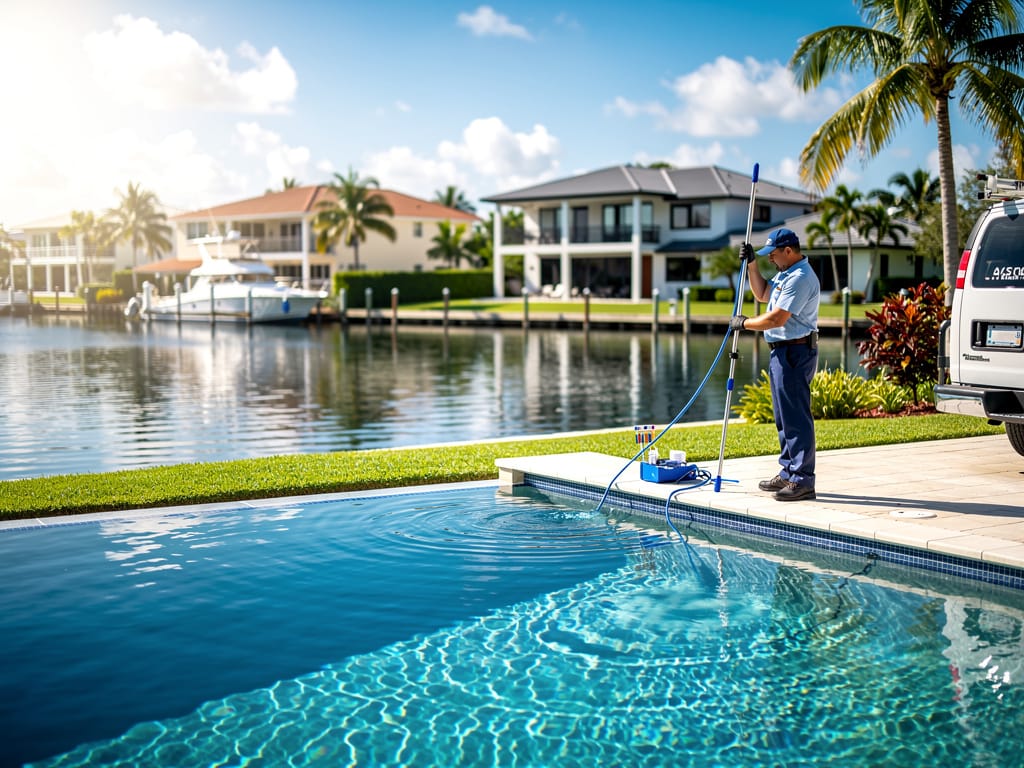
Pompano Beach sits roughly 10 miles north of Fort Lauderdale, and its eastern neighborhoods — Pompano Isles, beachfront condo communities, and areas east of A1A — experience consistent salt-laden air off the Atlantic. Even in western communities like Palm Aire and Crystal Lake, the sea breeze regularly carries enough salt aerosol to accelerate corrosion on outdoor equipment left unprotected.
Most homeowners don’t think about salt air until something fails. By then, the damage is done and the repair bill is real. At Pool Service Fort Lauderdale, we service pools throughout Pompano Beach and see the same failure patterns repeatedly — nearly all of them predictable and preventable.
Why Salt Air Is Different from Saltwater Pools
There’s a common misconception: homeowners with chlorine pools (rather than salt systems) assume salt corrosion isn’t their problem. It is. Salt air corrosion affects equipment regardless of what’s in your pool water. The corrosive agent is atmospheric salt deposition — salt particles that settle on metal surfaces, attract moisture, and create an electrolytic environment that accelerates oxidation.
A saltwater pool has higher salt concentrations in the water itself (around 3,000 ppm vs. roughly 500 ppm in a standard chlorine pool), which creates additional corrosion risk at the water line and on underwater components. But even a standard chlorine pool in Pompano Beach’s coastal air environment will experience accelerated equipment corrosion on above-ground components.
Equipment That Fails First in Pompano Beach’s Coastal Environment
Pump Motor Windings and Bearings
The pump motor is typically the first major casualty of coastal salt air exposure. Motor windings — the internal copper coils that generate the electromagnetic field driving the pump — are sensitive to moisture intrusion. Salt aerosol deposits on motor housing vents, draws humidity, and creates the wet environment that allows corrosion to attack winding insulation.
The early sign is a motor that runs loud (failing bearings making a grinding or whining noise) before it eventually seizes. In eastern Pompano Beach, pump motors that might last 8-10 years in Coral Springs or Plantation often fail at the 4-6 year mark without protective measures. Motor replacements run $300-$600 for most residential pump units.
Control Boards and Automation Panel Contacts
Pool automation controllers — units from Pentair, Hayward, Jandy, and others — contain circuit boards, relay contacts, and transformer components that corrode aggressively in salt air. The typical failure mode is intermittent: the system works normally, then randomly fails to execute timer commands, loses programmed schedules, or develops stuck relays that leave the pump running continuously.
Control boards are expensive to replace ($400-$1,200 depending on the system) and the failure often appears sudden even though salt corrosion has been building for months or years. Keeping automation panels in covered, enclosed outdoor equipment areas dramatically extends their lifespan. If your control panel is fully exposed to weather, this is the first thing to address.
Timer Mechanisms and Electrical Contacts
Mechanical timers and electrical contactors on non-automated systems are similarly vulnerable. The sliding contacts inside mechanical timer units oxidize, creating resistance that causes contact arcing — which then accelerates corrosion further. The result is a timer that skips cycles, fails to start the pump, or runs continuously past the off point.
Replacing a mechanical timer costs $50-$150. But if the failure isn’t caught promptly, a pump running continuously during a timer malfunction creates energy waste and can accelerate wear on the pump itself.
Electrical Conduit and Junction Box Connectors
The conduit that runs between your equipment pad and the pool’s underwater light fixture, bonding grid, and main panel is another common corrosion failure point. Junction box connectors — the threaded fittings where conduit sections join — loosen over time and allow salt air to infiltrate. Wire nuts inside those junction boxes then corrode, increasing resistance and eventually causing circuit failures.
This failure often presents as a pool light that works intermittently or a GFCI that trips repeatedly without an obvious cause. An electrician or pool tech who opens the junction box typically finds green-tinged or black corroded wire nut connections inside.
Gas Heater Heat Exchangers and Burner Components
If you have a gas pool heater, the heat exchanger — the internal component that transfers combustion heat to pool water — is susceptible to corrosion from both pool water chemistry and salt air infiltration through the heater cabinet’s air intake. Low pH in the pool water accelerates this from the water side; salt air attacks the external cabinet and venting connections.
Heat exchanger replacement is one of the most expensive pool equipment repairs ($700-$2,000 depending on model), and in many cases it makes more financial sense to replace the entire heater unit. Maintaining pool pH above 7.4 and keeping the heater cabinet sealed and protected significantly extends heat exchanger lifespan.
Protective Measures That Actually Work
Anti-Corrosion Coating Sprays
Products like CRC Heavy Duty Corrosion Inhibitor, Fluid Film, and Boeshield T-9 are wax-based or lanolin-based sprays that displace moisture and coat metal surfaces with a thin protective film. Applied to motor housings, terminal blocks, electrical connections, and panel enclosures every 6-12 months, they significantly slow the rate of salt air corrosion.
This is inexpensive preventive maintenance — a can of corrosion inhibitor costs $10-$20 and takes 15 minutes to apply. Professional pool techs who service coastal properties in Pompano Beach should be doing this routinely as part of quarterly or semi-annual equipment inspections.
Equipment Enclosures and Covers
A proper equipment enclosure — a covered, ventilated structure that houses the pump, filter, heater, and automation panel — is the most effective protection for coastal pool equipment. The enclosure blocks direct salt air deposition while allowing ventilation for heat dissipation. In Pompano Isles and other waterfront communities where salt air is most concentrated, an enclosure can double or triple equipment lifespan.
Prefabricated equipment sheds designed for pool use are available from pool supply distributors and run $300-$800 installed. Custom wood or composite enclosures built to match the home’s exterior cost more but last longer and provide better aesthetics. Either is a worthwhile investment in a coastal environment.
More Frequent Inspection Cycles
Standard pool service contracts include equipment inspection at each weekly visit — but for Pompano Beach’s eastern and waterfront neighborhoods, quarterly hands-on equipment checks are worth adding. A tech who opens the automation panel, checks terminal connections, applies anti-corrosion spray, and tests relay function every three months can catch developing problems before they become failures.
What to Do If You Notice Early Corrosion Signs
Common early indicators: white crystalline deposits on motor housing vents, green oxidation on copper wiring in junction boxes, rust streaking on conduit fittings, or an automation panel that requires multiple attempts to respond to commands. These are warning signs, not emergencies — but they should be addressed at the next service visit, not deferred indefinitely.
Pool Service Fort Lauderdale serves Pompano Beach, Pompano Isles, Palm Aire, Crystal Lake, and surrounding neighborhoods. If your equipment is showing signs of salt air damage, call us at (954) 501-2754 or see our Pompano Beach service page. More details on all of our Broward County locations are on our homepage.
Frequently Asked Questions
{
“@context”: “https://schema.org”,
“@type”: “FAQPage”,
“mainEntity”: [
{
“@type”: “Question”,
“name”: “Does salt air from the ocean damage pool equipment in Pompano Beach?”,
“acceptedAnswer”: {
“@type”: “Answer”,
“text”: “Yes. Salt aerosol from the Atlantic deposits on metal components, attracts moisture, and accelerates oxidation. Pump motors, control boards, timer contacts, and electrical connections are all vulnerable, especially in neighborhoods east of US-1 and in waterfront communities like Pompano Isles.”
}
},
{
“@type”: “Question”,
“name”: “Which pool equipment fails first due to salt air corrosion?”,
“acceptedAnswer”: {
“@type”: “Answer”,
“text”: “Pump motor windings and bearings typically fail first, followed by automation control board contacts and relay components. Timer mechanisms, electrical conduit connections, and gas heater heat exchangers are also common casualties in Pompano Beach’s coastal air environment.”
}
},
{
“@type”: “Question”,
“name”: “How can I protect my pool equipment from salt air corrosion?”,
“acceptedAnswer”: {
“@type”: “Answer”,
“text”: “Three main approaches: apply anti-corrosion coating spray (like Fluid Film or CRC) to metal components every 6-12 months; install a covered equipment enclosure to block direct salt air deposition; and schedule quarterly equipment inspections to catch corrosion before it causes failures.”
}
},
{
“@type”: “Question”,
“name”: “Does a saltwater pool make salt air corrosion worse in Pompano Beach?”,
“acceptedAnswer”: {
“@type”: “Answer”,
“text”: “Yes. A saltwater pool adds corrosion risk at the water line and on underwater components in addition to the atmospheric salt air risk. Saltwater pools also accelerate corrosion on pool light fixtures, bonding components, and deck hardware exposed to splash and spray.”
}
},
{
“@type”: “Question”,
“name”: “How much faster does pool equipment fail in coastal Pompano Beach vs. inland areas?”,
“acceptedAnswer”: {
“@type”: “Answer”,
“text”: “In direct coastal exposure east of US-1, unprotected pool pump motors and control boards often fail at 40-60% of their expected inland lifespan. A motor that lasts 8-10 years in Plantation or Sunrise may fail in 4-6 years in eastern Pompano Beach without protective maintenance.”
}
}
]
}
Does salt air damage pool equipment? Yes — motors, control boards, and electrical connections corrode faster in Pompano Beach’s coastal air, especially east of US-1.
What fails first? Pump motor windings and control board relay contacts are typically the first casualties of salt air exposure.
How do I protect equipment? Anti-corrosion spray every 6-12 months, covered equipment enclosures, and quarterly inspection cycles are the most effective defenses.
Does a salt pool make it worse? Yes — saltwater adds corrosion risk at the waterline and on underwater components on top of the atmospheric risk.
How much faster does equipment fail? East of US-1 in Pompano Beach, unprotected equipment often fails at 40-60% of its expected inland lifespan.