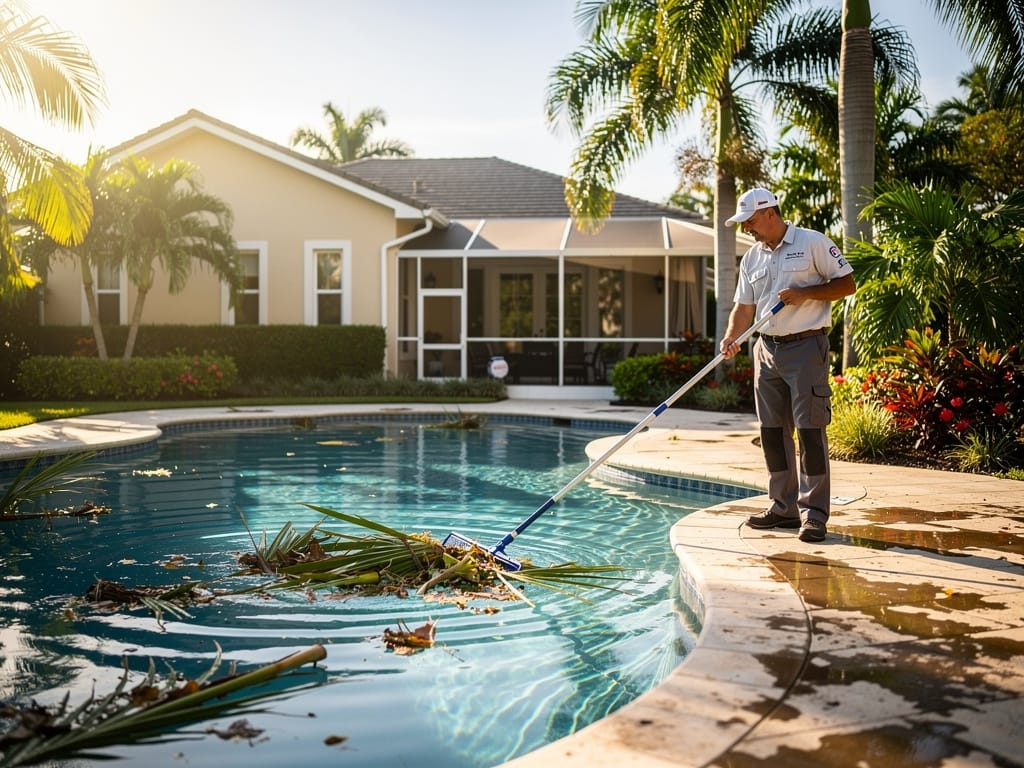
Pompano Beach is in Broward County’s hurricane impact zone. Storms that make landfall between Miami and Palm Beach bring everything into a pool — palm fronds, roof material, fence sections, standing water from flooding, and the organic load of a major weather event. The recovery process requires more than pouring in a jug of chlorine and hoping for the best.
At Pool Service Fort Lauderdale, we respond to post-storm service calls throughout Pompano Beach, Palm Aire, Crystal Lake, Pompano Isles, and surrounding neighborhoods. This checklist reflects what we actually do during hurricane recovery service calls — not generic advice.
Step Zero: Equipment and Electrical Safety Check
Before touching the water, assess your equipment pad and electrical connections. After a major storm:
- Confirm power is off at the breaker to all pool equipment before inspecting anything electrical.
- Check for flooding at the equipment pad. If your pump, filter, or automation panel were submerged or had standing water contact, do not restore power until a licensed pool tech or electrician inspects the equipment. Water intrusion into a pump motor or control board can cause a short-circuit fire when power is restored.
- Inspect conduit fittings and junction boxes for water entry. Open accessible junction boxes and look for standing water or moisture inside.
- Check the pool light fixture. If the lens seal was compromised by storm pressure or debris impact, do not power the pool light until the fixture has been inspected.
This safety check takes 20-30 minutes and can prevent an equipment fire or electrical injury. Do not skip it.
Step 1: Large Debris Removal — Before Running Equipment
The single most common mistake after a hurricane is immediately turning the filter pump back on before removing large debris. Palm fronds, roof shingles, tree branches, and other large material will clog your pump basket and impeller within minutes, potentially burning out the motor trying to push through the blockage.
Remove all large debris manually first:
- Use a long-handled leaf rake (not just a net — a rake skims and captures large pieces better)
- Work the bottom of the pool with a pool brush to dislodge settled debris before vacuuming
- Remove the pump basket and manually clean it; repeat every 15-20 minutes during heavy debris vacuuming
- If the pool is heavy with fine sediment from storm runoff, consider vacuuming to waste (bypassing the filter) to avoid overwhelming the filter media
Only after large debris is cleared should you restore pump power and begin filtration.
Step 2: Super-Chlorination Shock Treatment
Hurricane flooding introduces a significant organic load into your pool: rainwater, debris, soil runoff, insects, animal waste, and in some cases actual floodwater containing bacteria. Standard chlorination levels (1-3 ppm) are completely inadequate to address this. You need to super-chlorinate.
Target range: 10 to 20 ppm free chlorine. This requires calcium hypochlorite shock (pool shock granules, typically 68-78% available chlorine) dosed at approximately 1 lb per 10,000 gallons to raise chlorine by roughly 7-8 ppm. Most Pompano Beach residential pools run 15,000-25,000 gallons, so expect to use 2-4 lbs of shock for the initial treatment.
Apply shock in the evening or at night (UV radiation destroys unstabilized chlorine rapidly in Florida sunlight). Broadcast it around the pool perimeter while the pump runs. Do not add it to the skimmer — this concentrates hypochlorite in the pump basket and can corrode the basket housing.
If the water is severely green or black, a second shock treatment 24 hours after the first may be needed. Test chlorine levels before the second treatment — if you’re still above 10 ppm, wait before adding more.
Step 3: Run the Filter Continuously
After a hurricane, run your filter pump 24 hours per day until the water is clear. For a typical Pompano Beach residential pool, this takes 3 to 7 days depending on storm contamination severity. Do not reduce filter run time to save electricity during this period.
Clean the filter media aggressively:
- Sand filters: Backwash when pressure gauge reads 8-10 psi above clean baseline. After a major storm, you may need to backwash every 12-24 hours for the first few days.
- DE (Diatomaceous Earth) filters: Backwash and recharge DE once the pressure rises. After storm recovery, a full filter breakdown and grid cleaning is recommended — DE filters trap fine organic material that backwashing doesn’t fully clear.
- Cartridge filters: Remove and rinse cartridges every 24-48 hours during recovery. Have a second cartridge available so you can swap and clean without downtime.
Step 4: Chemistry Rebalancing
Once the water has cleared visually, perform a full chemistry test and rebalance. Hurricane dilution and organic load will typically affect multiple parameters simultaneously:
- pH: Rain is acidic (pH 5.5-6.5 in South Florida), so pH commonly drops after heavy rain. Target: 7.4-7.6. Use sodium carbonate (soda ash) to raise pH.
- Total Alkalinity: Target 80-120 ppm. Use sodium bicarbonate (baking soda) to raise if needed.
- Calcium Hardness: Target 200-400 ppm. Use calcium chloride to raise if dilution brought hardness below minimum.
- Cyanuric Acid (Stabilizer): Rain dilution reduces CYA. Target 30-50 ppm for outdoor pools. Use stabilizer granules if CYA drops below 30.
- Chlorine: Maintain at 1-3 ppm free chlorine after super-chlorination phase concludes.
When Is It Safe to Swim After a Hurricane?
Two criteria must both be met before swimming:
- Free chlorine must be below 5 ppm. Chlorine above 5 ppm causes skin and eye irritation. At super-chlorination levels, the water will bleach swimwear and irritate eyes significantly.
- Water must be visually clear with balanced pH (7.2-7.8) and alkalinity (80-120 ppm). Murky water indicates incomplete cleanup even if chemistry appears acceptable.
For most Pompano Beach pools after a significant hurricane, the 5-to-7-day window is realistic for reaching swim-safe conditions. Very heavy contamination can extend this to 10 days.
Professional Post-Storm Service in Pompano Beach
If the storm has left your pool severely contaminated, your equipment needs electrical inspection, or you simply don’t want to manage the recovery process yourself, Pool Service Fort Lauderdale offers post-hurricane pool recovery service throughout Pompano Beach and Broward County. Call (954) 501-2754 or visit our Pompano Beach pool service page. See all our Broward County coverage areas on our homepage.
Frequently Asked Questions
{
“@context”: “https://schema.org”,
“@type”: “FAQPage”,
“mainEntity”: [
{
“@type”: “Question”,
“name”: “How long does pool recovery take after a hurricane in Pompano Beach?”,
“acceptedAnswer”: {
“@type”: “Answer”,
“text”: “Most Pompano Beach pools require 5 to 10 days for full recovery after a major hurricane, depending on contamination severity. Super-chlorination, continuous filtration, and debris removal are the key steps. Very heavy contamination or floodwater intrusion can extend recovery to 10-14 days.”
}
},
{
“@type”: “Question”,
“name”: “Should I drain my pool after a hurricane in Pompano Beach?”,
“acceptedAnswer”: {
“@type”: “Answer”,
“text”: “No — draining a pool is rarely recommended in South Florida. Empty pools can pop out of the ground due to hydrostatic pressure from the high water table in Broward County. Treat and filter the existing water rather than draining, unless a professional assesses structural need to drain.”
}
},
{
“@type”: “Question”,
“name”: “How much chlorine shock do I add to my pool after a hurricane?”,
“acceptedAnswer”: {
“@type”: “Answer”,
“text”: “Target 10 to 20 ppm free chlorine for post-hurricane super-chlorination. For a typical 20,000-gallon Pompano Beach pool, this requires approximately 3-4 lbs of calcium hypochlorite shock (68-78% available chlorine). Apply at night to prevent UV degradation.”
}
},
{
“@type”: “Question”,
“name”: “When is it safe to swim after hurricane pool treatment?”,
“acceptedAnswer”: {
“@type”: “Answer”,
“text”: “Wait until free chlorine drops below 5 ppm AND the water is visually clear with balanced pH (7.2-7.8) and alkalinity (80-120 ppm). Both conditions must be met. Swimming at super-chlorination levels will cause skin and eye irritation and bleach swimwear.”
}
},
{
“@type”: “Question”,
“name”: “Is it safe to run my pool pump immediately after a hurricane?”,
“acceptedAnswer”: {
“@type”: “Answer”,
“text”: “Not until you complete an equipment safety check. If your equipment pad was flooded or had standing water contact, do not restore power until a licensed pool tech or electrician inspects for water intrusion. Water in a pump motor or control board can cause a short-circuit fire when power is restored.”
}
}
]
}
How long does recovery take? Typically 5-10 days with proper super-chlorination and continuous filtration.
Should I drain the pool? No. In South Florida, hydrostatic pressure can pop an empty pool out of the ground. Treat and filter in place.
How much shock do I add? Target 10-20 ppm — about 3-4 lbs of 68-78% calcium hypochlorite shock for a 20,000-gallon pool.
When can I swim? When chlorine is below 5 ppm AND water is visually clear with balanced chemistry.
Is it safe to run the pump immediately? Not until you’ve done an electrical safety check — water intrusion in a motor or control board can cause a fire when power is restored.