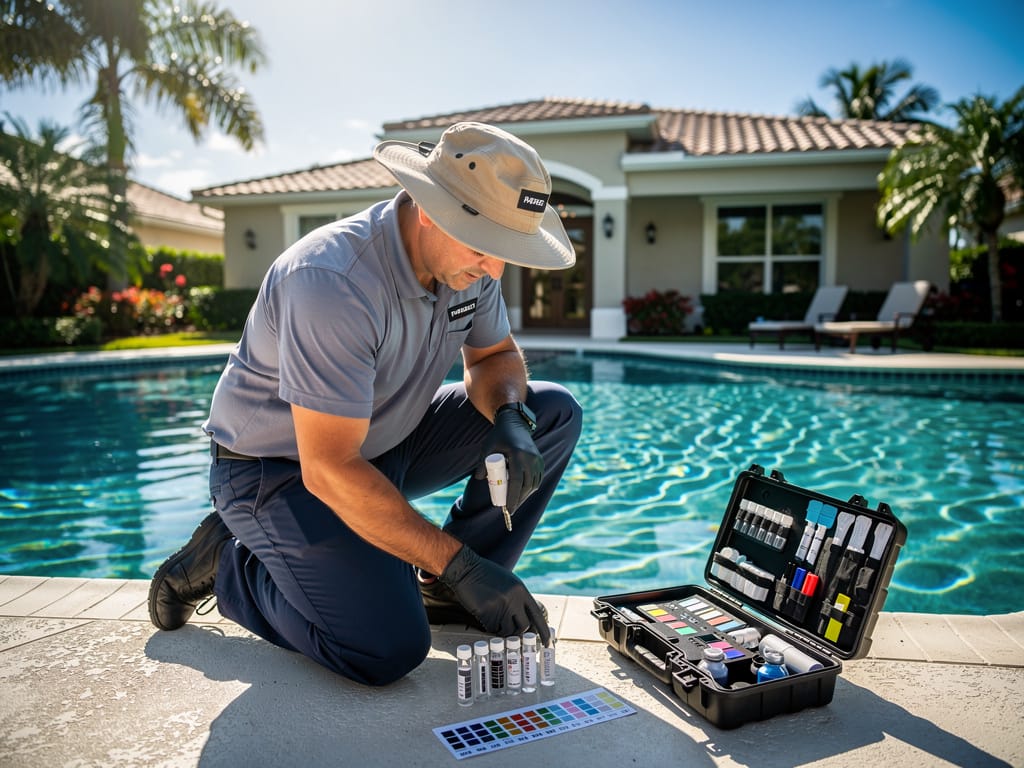
Walk up to almost any established residential pool in Pompano Beach — Palm Aire, Crystal Lake, McNab, Ramblewood — and look at the tile band at the waterline. Odds are you’ll see a white, grey, or tan mineral crust somewhere along that line. That’s calcium carbonate scale, and it’s the direct result of Broward County’s water chemistry combined with South Florida’s evaporation rate.
Calcium scaling is one of the most common water chemistry problems we see at Pool Service Fort Lauderdale when servicing pools throughout Pompano Beach. This guide explains why it happens, where it causes damage beyond cosmetic tile deposits, and what actually works to prevent and remove it.
Why Pompano Beach Pools Scale Faster Than Pools in Other Markets
The calcium scaling problem in Broward County has three compounding causes that make it more severe than in most pool markets:
Hard Municipal Supply Water
Broward County’s water supply draws from the Biscayne Aquifer, which is naturally high in calcium and magnesium minerals. The water delivered to Pompano Beach homes typically arrives at 200-350 ppm calcium hardness. The target range for pool water is 200-400 ppm — meaning Broward fill water starts you near the midpoint of the acceptable range before you even add any pool chemicals.
Compare this to pools in markets served by mountain snowmelt or surface reservoirs (typical calcium hardness 50-100 ppm), where homeowners deliberately add calcium chloride to raise hardness above 200 ppm. Pompano Beach homeowners start well above that baseline and never need to add calcium.
South Florida’s Evaporation Rate
An uncovered residential pool in Pompano Beach loses 1 to 2 inches of water per week to evaporation during summer — more in hot, dry months. Evaporation removes only water molecules; calcium, magnesium, and other dissolved minerals stay behind. This means mineral concentrations climb continuously in South Florida pools.
A pool starting at 250 ppm calcium hardness can climb to 400-500 ppm within 4-8 weeks during Pompano Beach’s summer without water dilution or chemical intervention. At those levels, calcium carbonate spontaneously precipitates out of solution wherever water contacts a hard surface — the tile line, pool plaster, jet fittings, light lens edges, and heater heat exchanger fins.
The pH-Scaling Relationship
Calcium carbonate’s tendency to precipitate from solution is governed by the Langelier Saturation Index (LSI) — a calculation incorporating pH, total alkalinity, calcium hardness, water temperature, and total dissolved solids. When the LSI is positive, water is scale-forming. When it’s negative, water is corrosive.
In Pompano Beach, where calcium hardness is already elevated, even a modest pH rise above 7.8 pushes the LSI into scale-forming territory. And pH rises naturally in outdoor pools — aeration from waterfalls, jets, and rain drives off CO2, raising pH continuously. Without regular acid additions, Pompano Beach pool water naturally trends toward scaling conditions.
Where Calcium Scale Appears and the Damage It Causes
Tile Band at the Waterline
The most visible deposit location. White or greyish mineral crust accumulates where evaporation is most concentrated. Mild deposits are cosmetic. Heavy deposits become physically rough, creating an abrasive edge at the waterline and trapping algae and bacteria in their porous surface. Professional tile cleaning cost: $200-$600 for a standard residential pool.
Pool Plaster Surfaces
Calcium carbonate precipitating onto plaster creates a roughening effect — deposits fill the natural microscopic pores of the plaster, then continue building until the surface develops a visible rough, chalky texture. Unlike etched plaster (caused by corrosive low-pH water), scale buildup comes from the opposite chemistry direction but produces the same rough surface result. Heavy surface scaling often indicates a chronic high-pH history.
Gas Heater Heat Exchanger Fins
Gas pool heater heat exchangers operate at temperatures well above pool water temperature. High-temperature surfaces accelerate calcium carbonate precipitation dramatically — scale formation that takes months in the main pool body can occur in weeks on heater heat exchanger fins. Heavy scale buildup reduces heat transfer efficiency, increases gas consumption, and can eventually block water flow through the exchanger, triggering overtemperature shutdowns. Heat exchanger replacement: $700-$2,000.
Salt Cell Electrodes in Saltwater Pools
Chlorine generators produce chlorine through electrolysis at high-temperature electrode surfaces where calcium scale builds up faster than almost anywhere else in the pool system. Salt cell manufacturers recommend inspection every 3 months and acid cleaning when deposits are visible. Neglected cells fail prematurely — replacement costs $500-$1,200.
How to Prevent Calcium Scaling in a Pompano Beach Pool
Maintain pH at the Lower End of Target Range
Target pH 7.4-7.6 rather than 7.6-7.8 for Pompano Beach pools with high calcium hardness. At 7.4 with calcium hardness of 350 ppm, the LSI typically remains in balance; at 7.8 with the same hardness, the water is significantly scale-forming. Keeping pH in the 7.4-7.5 range requires regular acid additions (muriatic acid or dry acid) to counteract the natural pH rise from aeration.
Use a Sequestering Agent or Scale Inhibitor Monthly
Phosphonate-based scale inhibitors (products like Jack’s Magic Blue Stuff, Natural Chemistry Scale Free, or similar) bind to calcium ions in solution and prevent them from bonding to hard surfaces. They don’t reduce calcium hardness — the calcium remains in the water — but they keep it suspended rather than letting it precipitate onto tile and surfaces.
Monthly dosing with a quality scale inhibitor is the most practical preventive measure for Pompano Beach pools with elevated calcium hardness. The cost is typically $15-$30 per month and largely eliminates ongoing tile cleaning labor when applied consistently from the start.
Partial Drain and Refill When CH Exceeds 500 ppm
When calcium hardness climbs above 500 ppm, scale-forming potential becomes very difficult to manage chemically. A partial drain and refill — draining 25-35% of pool water and replacing with fresh Broward County supply — dilutes hardness back into a manageable range. In South Florida, this is typically needed once every 12-24 months for most pools.
How to Remove Existing Calcium Scale
Tile scale: Professional tile cleaning using calcium scale remover paste and pumice stone, or acid bead blasting for heavy buildup. This is labor-intensive work — expect $200-$600 for a full tile cleaning on a standard residential pool.
Surface scaling: Mild to moderate surface scale often responds to dilute muriatic acid applied by a licensed pool contractor as part of an acid wash service. Severe scaling may indicate that resurfacing is the more practical option.
Heat exchanger scale: Qualified pool heater technicians can descale heat exchangers using circulated acid solution, extending heater life significantly when done proactively every 2-3 years.
Pool Service Fort Lauderdale provides water chemistry management, scale prevention services, and tile cleaning for Pompano Beach pools throughout Palm Aire, Crystal Lake, Cypress Head, Pompano Isles, and surrounding neighborhoods. Call (954) 501-2754 or visit our Pompano Beach pool service page. All service locations are listed at poolservicefortlauderdale.us.
Frequently Asked Questions
{
“@context”: “https://schema.org”,
“@type”: “FAQPage”,
“mainEntity”: [
{
“@type”: “Question”,
“name”: “Why does my Pompano Beach pool tile have white mineral deposits?”,
“acceptedAnswer”: {
“@type”: “Answer”,
“text”: “The white deposits are calcium carbonate scale, caused by Broward County’s naturally hard water supply (200-350 ppm calcium hardness) combined with South Florida’s high evaporation rate, which concentrates minerals rapidly. When the Langelier Saturation Index rises above zero, calcium precipitates onto hard surfaces like tile, plaster, and equipment fittings.”
}
},
{
“@type”: “Question”,
“name”: “How often should I have calcium scale cleaned off my pool tile in Pompano Beach?”,
“acceptedAnswer”: {
“@type”: “Answer”,
“text”: “Without preventive scale inhibitor treatment, most Pompano Beach pools need tile cleaning once every 6-18 months. With consistent monthly scale inhibitor dosing, many pools can extend this to 2-3 years between professional tile cleanings.”
}
},
{
“@type”: “Question”,
“name”: “What is the ideal calcium hardness for a Pompano Beach pool?”,
“acceptedAnswer”: {
“@type”: “Answer”,
“text”: “Target 200-350 ppm calcium hardness. Given that Broward County tap water already comes in at 200-350 ppm, you typically should not add calcium chloride to local pools. Focus instead on preventing hardness from climbing further through evaporation concentration.”
}
},
{
“@type”: “Question”,
“name”: “Does a saltwater pool have worse calcium scaling in Pompano Beach?”,
“acceptedAnswer”: {
“@type”: “Answer”,
“text”: “Yes. Saltwater pool chlorine generators produce chlorine at high-temperature electrode surfaces where calcium deposits accumulate rapidly. Salt cell plates require inspection every 3 months and cleaning when scale is visible. Unmanaged calcium scaling in a saltwater pool can destroy a salt cell prematurely — replacement costs $500-$1,200.”
}
},
{
“@type”: “Question”,
“name”: “Can I use muriatic acid myself to remove calcium scale from my pool tile?”,
“acceptedAnswer”: {
“@type”: “Answer”,
“text”: “Dilute muriatic acid can remove light calcium deposits from pool tile, but it requires proper PPE (gloves, eye protection, respirator), careful dilution, and safe disposal. For heavy or extensive tile scale buildup, professional tile cleaning or acid bead blasting is safer and more effective. Always add acid to water — never water to acid.”
}
}
]
}
Why is there white crust on my pool tile? Calcium carbonate scale from Broward’s hard water + Florida’s high evaporation rate concentrating minerals at the tile line.
How often does tile need cleaning? Without scale inhibitor: every 6-18 months. With consistent monthly inhibitor dosing: every 2-3 years.
What’s the ideal calcium hardness? Target 200-350 ppm. Broward tap water starts in that range — don’t add calcium chloride; focus on preventing further concentration.
Does a salt pool scale worse? Yes — salt cell electrodes scale rapidly and need inspection every 3 months to prevent premature failure.
Can I use muriatic acid myself? For light deposits, yes with proper PPE. Heavy buildup is better handled by professional tile cleaning or acid bead blasting.