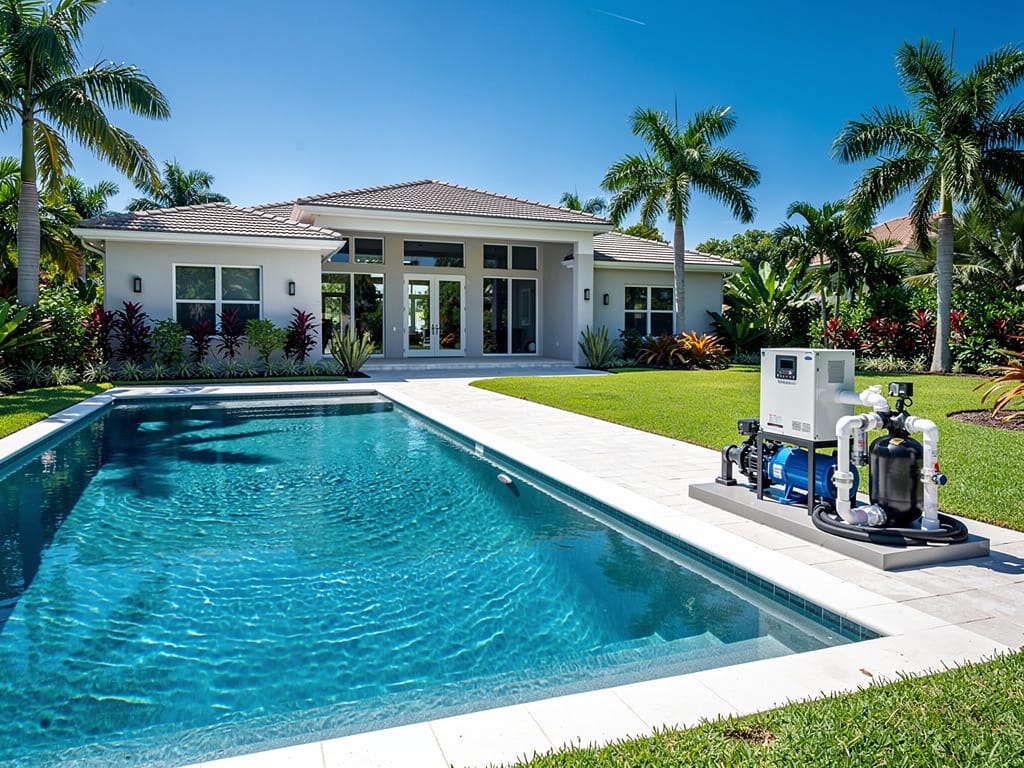
Saltwater pool conversions are one of the most common service requests we receive at Pool Service Fort Lauderdale from Pompano Beach homeowners. The appeal is real: reduced chlorine handling, softer-feeling water, and lower ongoing chemical costs once the system is established. But in Pompano Beach, the coastal location adds considerations that inland pool owners don’t face.
This guide covers what a conversion actually involves, the honest cost picture including ongoing maintenance, and the specific factors that matter for pools in Pompano Beach, Pompano Isles, Palm Aire, and other coastal and near-coastal communities.
How Saltwater Pools Actually Work
A saltwater pool is not a pool filled with ocean water — it contains about 3,200 ppm of dissolved salt (sodium chloride), which is roughly 12 times less salty than seawater. You’d have difficulty tasting the salt at this concentration. The salt chlorine generator (SCG) runs pool water past titanium electrodes, using electrolysis to convert dissolved salt into hypochlorous acid — the same active sanitizer as conventional chlorine.
The pool still uses chlorine for sanitation. The difference is that the chlorine is generated continuously from the salt in the water rather than added manually as liquid chlorine, granules, or pucks. The salt isn’t consumed in the process — it’s regenerated and recirculates. You only need to add salt to replace what’s lost through backwashing, splashout, and occasional dilution from rain.
What the Conversion Process Involves
Converting an existing chlorine pool to salt requires:
- Salt chlorine generator selection and installation: The SCG is sized to your pool volume. For a typical 15,000-20,000 gallon Pompano Beach residential pool, a unit rated for 20,000-30,000 gallons provides comfortable capacity. Popular brands include Hayward AquaRite, Pentair IntelliChlor, and Jandy TruClear.
- Initial salt addition: You’ll need to add approximately 400-600 lbs of pool-grade NaCl (40-lb bags available at pool supply stores) to achieve the target 3,200 ppm concentration.
- Chemistry rebalancing: Salt systems operate best at pH 7.4-7.6 and require cyanuric acid at 70-80 ppm (higher than standard chlorine pools) to stabilize the generated chlorine against UV degradation. Your existing chemistry will need adjustment.
- Electrical installation: The SCG requires a dedicated 120V or 240V circuit at the equipment pad. If your equipment doesn’t have available capacity, an electrician may need to add a circuit.
Total conversion cost for a typical Pompano Beach residential pool: $800-$2,500 depending on the SCG unit selected and whether electrical work is needed.
The Coastal Corrosion Consideration
Here’s what makes the Pompano Beach salt conversion question more nuanced than it would be in Plantation or Coral Springs: you’re adding 3,200 ppm of dissolved salt to a pool system that’s already experiencing accelerated corrosion from atmospheric salt air.
Standard saltwater pool corrosion concerns — accelerated degradation of copper fixtures, underwater lighting components, bonding wire connections, and deck hardware — are real in any location. In Pompano Beach’s coastal environment, these concerns compound with the ambient salt air effects we’ve discussed elsewhere.
Components that deserve extra attention after a salt conversion in Pompano Beach:
- Underwater light fixtures: Salt water is more corrosive to light fixture housings and lens gaskets than standard chlorine water. Inspect annually for gasket degradation and corrosion of the fixture body.
- Copper heating elements: If you have a heat pump or gas heater, the copper heat exchanger components are more vulnerable to saltwater corrosion than in a chlorine pool. pH management becomes more critical — sustained low pH accelerates this significantly.
- Deck hardware (anchors, rails, ladders): Stainless steel handrails and ladder anchors corrode faster in saltwater pools. 316 marine-grade stainless is preferable to standard 304 grade if replacement is needed.
- Bonding connections: The bonding grid that connects all metal pool components electrically must be inspected annually. Saltwater increases conductivity, which can accelerate electrolytic corrosion at bonding connections.
None of these concerns should dissuade a Pompano Beach homeowner from converting — they simply require awareness and more frequent inspection intervals than the same conversion would require in a non-coastal inland location.
Ongoing Maintenance: What Changes After You Convert
Salt systems reduce some maintenance tasks and add others:
What you no longer do: Weekly liquid chlorine additions, managing chlorine puck feeders, handling high-concentration sanitizer chemicals.
What you still need: Weekly chemistry testing (pH, alkalinity, salt level, free chlorine). The SCG’s output must be adjusted seasonally — higher in summer when bather load and temperature drive chlorine demand up, lower in winter.
What’s new: Salt cell inspection every 3 months for calcium scale buildup on the electrodes (a particular concern in Broward County’s hard water — see our separate guide on calcium scaling). Salt level testing monthly. Cell cleaning with dilute muriatic acid solution when scaling is found.
Salt cells have a finite lifespan — typically 5-7 years depending on usage and water chemistry management. Replacement cost: $500-$1,200 for the cell alone. This is the primary ongoing capital cost that chlorine pool owners don’t face.
Is Salt Conversion Worth It in Pompano Beach?
For most Pompano Beach homeowners: yes, with the caveats noted above. The water feel improvement is real and meaningful — saltwater at 3,200 ppm is noticeably softer and less irritating to eyes and skin than a conventionally chlorinated pool maintained at typical residential service standards. The reduction in chemical handling is genuinely convenient. And the ongoing chemical cost savings (you’re buying salt rather than liquid chlorine) are real, though they’re partially offset by the cell replacement cycle.
The coastal corrosion consideration is a monitoring task, not a reason to avoid conversion. Pool Service Fort Lauderdale includes salt cell inspection and cleaning, bonding connection checks, and fixture corrosion monitoring as part of routine service for Pompano Beach salt pool customers.
Call (954) 501-2754 or visit our Pompano Beach pool service page to discuss salt conversion for your pool. Full service area coverage at poolservicefortlauderdale.us.
Frequently Asked Questions
{
“@context”: “https://schema.org”,
“@type”: “FAQPage”,
“mainEntity”: [
{
“@type”: “Question”,
“name”: “How much does it cost to convert a Pompano Beach pool to saltwater?”,
“acceptedAnswer”: {
“@type”: “Answer”,
“text”: “Converting a typical Pompano Beach pool to a saltwater system costs $800 to $2,500, including the salt chlorine generator, initial salt, installation, and chemistry rebalancing. Cost varies based on pool size, SCG brand, and whether electrical work is needed at the equipment pad.”
}
},
{
“@type”: “Question”,
“name”: “Does a saltwater pool cause more corrosion in Pompano Beach’s coastal environment?”,
“acceptedAnswer”: {
“@type”: “Answer”,
“text”: “Yes, to a degree. Saltwater (3,200 ppm) adds corrosion risk to underwater fixtures, copper heating components, deck hardware, and bonding connections — on top of the atmospheric salt air corrosion that all Pompano Beach coastal properties experience. More frequent equipment inspection is recommended for saltwater pools in the coastal zone.”
}
},
{
“@type”: “Question”,
“name”: “How long do salt cells last in Pompano Beach pools?”,
“acceptedAnswer”: {
“@type”: “Answer”,
“text”: “Salt cells typically last 5-7 years. In Broward County’s hard water, calcium scale on cell electrodes is a significant concern and requires inspection every 3 months with acid cleaning when buildup is found. Neglected calcium scaling is the primary cause of premature cell failure in the Pompano Beach area.”
}
},
{
“@type”: “Question”,
“name”: “Is a saltwater pool the same as a pool filled with ocean water?”,
“acceptedAnswer”: {
“@type”: “Answer”,
“text”: “No. A saltwater pool contains about 3,200 ppm of dissolved salt — roughly 12 times less than seawater. You would have difficulty tasting the salt at this concentration. The salt chlorine generator uses electrolysis to convert the dissolved salt into chlorine for sanitation, then the chlorine converts back to salt and the cycle repeats.”
}
},
{
“@type”: “Question”,
“name”: “Do saltwater pools still require regular chemical maintenance?”,
“acceptedAnswer”: {
“@type”: “Answer”,
“text”: “Yes. Saltwater pools still require weekly testing of pH, alkalinity, salt level, and free chlorine. pH management is especially important — the SCG naturally raises pH slightly, so regular acid additions are needed to keep pH in the 7.4-7.6 target range and prevent calcium scaling on the cell electrodes.”
}
}
]
}
How much does conversion cost? $800-$2,500 total including the salt chlorine generator, salt, installation, and chemistry setup.
Does it cause more corrosion here? It adds to the existing coastal salt air corrosion risk — more frequent equipment inspection is warranted for Pompano Beach coastal pools.
How long do salt cells last? 5-7 years typical. Broward’s hard water causes calcium scaling on electrodes — inspect every 3 months and acid-clean when needed.
Is it the same as ocean water? No — about 3,200 ppm salt, 12x less than seawater. You can’t taste it.
Still need maintenance? Yes — weekly testing still required, and pH management is more active with a salt system.