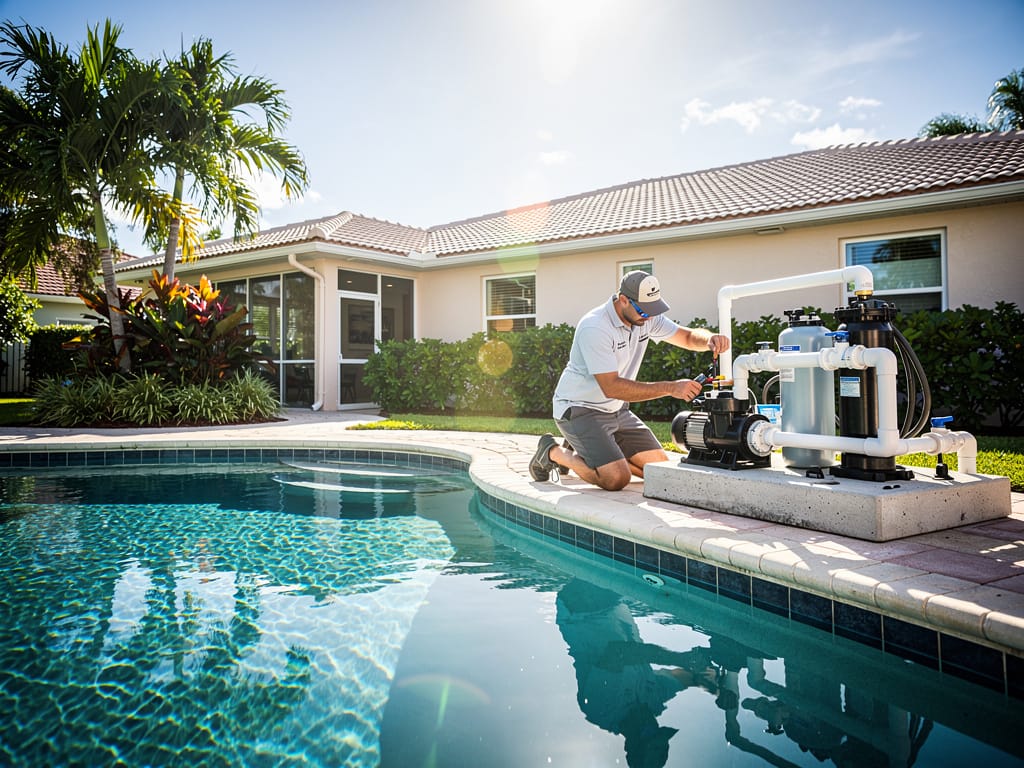
Pool pumps are among the top energy consumers in Florida homes — in many Pompano Beach households, the pool pump accounts for more electricity than any single appliance. Single-speed pumps run at full power regardless of the circulation task at hand, which is wasteful given that 95% of pump run time is spent on low-demand filtration, not high-demand backwashing or water feature operation.
At Pool Service Fort Lauderdale, we’ve seen variable speed pump upgrades make a meaningful difference in energy costs for Pompano Beach homeowners, and the combination of FPL’s residential electricity rates and Florida’s year-round pump operation makes the ROI particularly compelling in this market.
Why Single-Speed Pumps Waste Electricity
A standard single-speed pool pump rated at 1.5 HP draws approximately 1,100-1,500 watts of power constantly during operation. For a Pompano Beach pool running 10 hours per day (a common schedule for adequate filtration in South Florida’s warm water), that’s 11-15 kWh per day, or roughly 330-450 kWh per month.
At FPL’s current residential rate of approximately $0.13-$0.15 per kWh (plus fuel adjustments and base charges), running a single-speed 1.5 HP pump for 10 hours daily costs approximately $43-$68 per month, or $515-$815 annually — just for the pump.
The inefficiency comes from basic fluid dynamics: the power required to move water through a pipe increases as the cube of flow rate. Cutting pump speed in half doesn’t cut energy use in half — it cuts it to one-eighth. A variable speed pump running at 1,750 RPM (half of its 3,450 RPM maximum) uses about 12% of the electricity of the same pump running at full speed. This is why the energy savings are so dramatic.
How Variable Speed Pumps Work
Variable speed pumps (sometimes called VS pumps) use permanent magnet motors with electronic speed controllers that allow the RPM to be programmed independently for different operations:
- Low-speed filtration mode (1,100-1,750 RPM): Runs 16-24 hours per day for basic circulation and filtration. Uses 100-300 watts — a fraction of a single-speed pump’s consumption. This is the money-saving mode.
- Medium speed (2,000-2,500 RPM): Used for running water features (fountains, waterfalls, deck jets) or during periods of higher bather load when additional circulation is needed.
- High speed (3,000-3,450 RPM): For backwashing filters, operating pressure cleaners, or running high-output water features. Used infrequently.
The energy savings come almost entirely from the low-speed filtration mode. Because a Pompano Beach pool can achieve adequate turnover rate running the pump 20+ hours per day at low speed (vs. 8-10 hours at full speed), the total daily energy use drops dramatically even though the pump runs longer.
Energy Savings Calculation for a Typical Pompano Beach Pool
Using realistic FPL rates and a 20,000-gallon residential pool as the baseline:
Single-speed 1.5 HP pump: 1,300 watts × 10 hours/day = 13 kWh/day × 365 days × $0.14/kWh = $664/year
Variable speed pump (same pool): ~200 watts average × 20 hours/day = 4 kWh/day × 365 days × $0.14/kWh = $204/year
Annual savings: approximately $460 — and that’s a conservative estimate using modest FPL rates. Homeowners with older single-speed 2 HP pumps, which draw significantly more power, often see savings of $800-$1,200 annually.
Cost and Payback Period
A quality variable speed pool pump for a typical Pompano Beach residential pool costs:
- Hayward MaxFlo VS or TriStar VS: $700-$900 for the pump; $900-$1,200 installed
- Pentair IntelliFlo Variable Speed Pump: $800-$1,100 for the pump; $1,000-$1,400 installed
- Jandy VS FloPro: $750-$950 for the pump; $950-$1,300 installed
At the conservative $460/year savings estimate above, payback on a $1,100 installed Pentair IntelliFlo is approximately 29 months. At the higher $800/year savings on a larger pump replacement, payback is under 18 months. Variable speed pumps carry 3-5 year manufacturer warranties and typically last 8-12 years, meaning you’re looking at 6-10 years of savings after the payback period.
FPL offers rebates for variable speed pump upgrades — typically $75-$150 depending on the current program. Check the FPL website or ask your pool service provider about current rebate availability at the time of installation.
Why This Is Required on New Installations Anyway
The U.S. Department of Energy’s 2021 pool pump efficiency rule requires that most new pool pump installations above 1 HP use variable speed or two-speed motors. This applies to replacement pumps as well as new construction. If your current single-speed pump fails and needs replacement, you’ll be installing a variable speed pump regardless — making the upgrade consideration straightforward: evaluate the energy savings rather than the mandate.
The Automation Connection
Variable speed pumps deliver maximum value when integrated with a pool automation system. Automation controllers allow you to program distinct speed profiles for specific time windows and conditions — low-speed 24-hour circulation during weekdays, medium-speed operation before scheduled weekend swim sessions, automatic full-speed backwash cycles triggered by timer. Without automation, you’re manually adjusting speed profiles on the pump’s local panel, which most homeowners do infrequently.
Pool Service Fort Lauderdale installs and programs variable speed pumps throughout Pompano Beach, Palm Aire, Crystal Lake, Pompano Isles, and surrounding neighborhoods. For an energy audit of your current pool setup or a quote on a variable speed pump upgrade, call (954) 501-2754. Our Pompano Beach service page has more detail, and all our coverage areas are at poolservicefortlauderdale.us.
Frequently Asked Questions
{
“@context”: “https://schema.org”,
“@type”: “FAQPage”,
“mainEntity”: [
{
“@type”: “Question”,
“name”: “How much can I save on electricity by upgrading to a variable speed pool pump in Pompano Beach?”,
“acceptedAnswer”: {
“@type”: “Answer”,
“text”: “Most Pompano Beach homeowners save $400-$900 annually by replacing a single-speed pump with a variable speed unit. The exact savings depend on your current pump size, daily run hours, and FPL rate. Larger pumps (2 HP+) and longer run schedules produce the most dramatic savings.”
}
},
{
“@type”: “Question”,
“name”: “How long until a variable speed pool pump pays for itself in Pompano Beach?”,
“acceptedAnswer”: {
“@type”: “Answer”,
“text”: “For most Pompano Beach installations, payback period is 12 to 30 months depending on current pump size and energy costs. After payback, you’re in pure savings mode for the remaining 6-10 years of the pump’s lifespan. FPL rebates ($75-$150) reduce the payback period further.”
}
},
{
“@type”: “Question”,
“name”: “Are variable speed pool pumps required in Florida?”,
“acceptedAnswer”: {
“@type”: “Answer”,
“text”: “Yes, for new installations above 1 HP. The U.S. Department of Energy’s 2021 pool pump efficiency rule requires variable speed or two-speed motors on most new and replacement pool pump installations above 1 HP. Single-speed pumps above this threshold are no longer sold for new residential installations.”
}
},
{
“@type”: “Question”,
“name”: “What are the best variable speed pool pumps for Pompano Beach pools?”,
“acceptedAnswer”: {
“@type”: “Answer”,
“text”: “The Pentair IntelliFlo, Hayward MaxFlo VS, and Jandy VS FloPro are the most commonly installed variable speed pumps in Pompano Beach. All three integrate with their respective automation systems for full remote scheduling. For pools with existing Pentair or Hayward equipment, staying within the same brand ecosystem simplifies integration.”
}
},
{
“@type”: “Question”,
“name”: “Does a variable speed pump work with a salt chlorine generator?”,
“acceptedAnswer”: {
“@type”: “Answer”,
“text”: “Yes, but with one consideration: salt chlorine generators require minimum flow rate to operate properly. When running the pump at very low speeds (below the SCG’s minimum flow threshold), the cell may go offline and display a low-flow fault. Program low-speed circulation cycles above the SCG’s minimum rated flow rate, which your pool technician can confirm during installation.”
}
}
]
}
How much can I save? Most Pompano Beach homeowners save $400-$900 annually after switching from single-speed to variable speed.
How long is payback? Typically 12-30 months. FPL rebates ($75-$150) reduce this further.
Are they required in Florida? Yes — the DOE 2021 rule requires variable speed motors on new/replacement installations above 1 HP.
Which pumps are best? Pentair IntelliFlo, Hayward MaxFlo VS, and Jandy VS FloPro are the primary options for Pompano Beach pools.
Does it work with my salt system? Yes — but program low-speed cycles above the SCG’s minimum flow threshold to prevent low-flow faults on the salt cell.