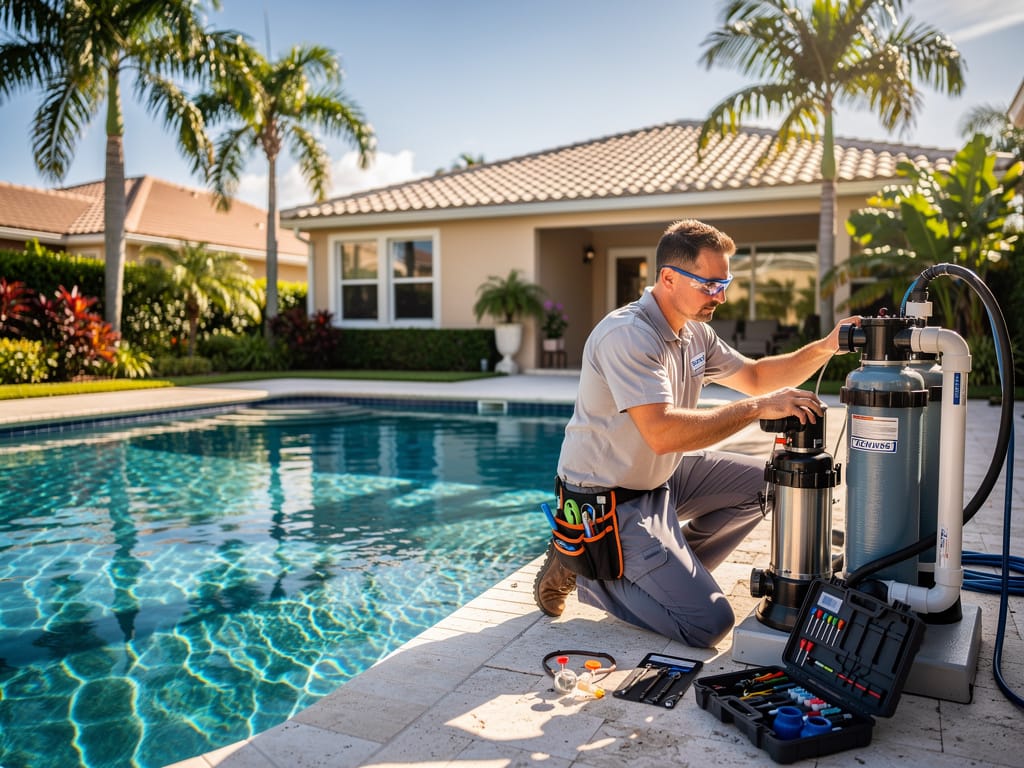
Buying a home in Pompano Beach often means buying a pool — and that pool may be decades old. Crystal Lake, Rock Island, Palm Aire, and neighborhoods near the Lighthouse Point border contain significant housing stock from the 1960s through 1980s, with pools of comparable age. The general home inspector your buyer’s agent recommends is unlikely to have the specific knowledge needed to evaluate pool equipment, surface conditions, or bonding systems properly.
At Pool Service Fort Lauderdale, we perform pre-purchase pool inspections for buyers throughout Pompano Beach and Broward County. This guide covers what a qualified inspection should include and what findings commonly appear in Pompano Beach’s older housing stock.
Why You Need a Pool Specialist, Not Just a General Home Inspector
General home inspectors in Florida are licensed to inspect a pool as part of a whole-home inspection, but most limit their pool evaluation to a visual walk-around: “pump runs, filter appears functional, pool is full.” They typically don’t test water chemistry, evaluate surface integrity, check bonding continuity, or assess equipment for salt air corrosion.
For a Pompano Beach home purchase, that surface-level inspection can miss:
- A pool surface that looks acceptable but is 2 years from needing $8,000-$12,000 in resurfacing
- A pump motor that’s running but showing early bearing failure from salt air corrosion
- Bonding system deficiencies that create electrical safety risk in the pool
- A gas heater heat exchanger that leaks combustion gases into pool water (a safety issue)
- VGB drain cover non-compliance (a federal safety requirement)
- Active structural leaks that the seller hasn’t disclosed
What a Comprehensive Pool Inspection Covers
Structural Shell Assessment
The inspector should examine the pool shell for cracks — both surface-level plaster cracks (cosmetic) and structural cracks that penetrate through the gunite shell (significant). Structural cracks allow water loss and may indicate ground movement issues. In Pompano Beach’s coastal geology, where the water table is close to the surface, minor ground movement is not uncommon over a pool’s 40-50 year lifespan.
The inspector should also perform or schedule a leak detection evaluation if there are any indications of unusual water loss. Losing more than 1/4 inch of water per day (beyond normal evaporation) indicates a structural or plumbing leak. Leak detection uses pressure testing of the plumbing circuit and sometimes electronic detection methods to locate the source.
Surface Condition and Age Assessment
A qualified pool inspector can estimate the remaining useful life of the pool surface by evaluating texture, staining pattern, presence of pitting or crazing, and surface hardness. For Crystal Lake and older Pompano Beach pools with unknown surface history, this assessment determines whether you’re buying a pool that needs resurfacing now, in 2-3 years, or has significant useful life remaining.
The difference between a pool that needs resurfacing this year versus in 5 years is $7,000-$12,000 in deferred capital expense. Knowing this before you close gives you negotiating leverage.
Equipment Inspection
All major equipment should be operated and evaluated during the inspection:
- Pump: Run the pump and listen for bearing noise (grinding, whining). Check for air leaks at the pump lid o-ring and unions. Inspect motor housing for salt air corrosion, oxidation, and debris clogging motor vents.
- Filter: Check pressure gauge, inspect for housing cracks or deteriorated o-rings. DE filters should be backwashed and the grids inspected for tears.
- Heater or heat pump: Run to operating temperature. Gas heaters should be inspected for heat exchanger corrosion and proper venting. Heat exchanger replacement cost is $700-$2,000 — a significant finding that warrants negotiation.
- Automation system: Test all automation functions and check for control board corrosion in the panel enclosure. Older Pentair and Hayward systems (10+ years) approaching end of supported life are a consideration for future upgrade budgeting.
- Salt chlorine generator (if present): Check salt cell for scaling and evaluate remaining electrode life.
Electrical and Bonding System
This is the most commonly overlooked component in general home inspections and the one with the most significant safety implications. Florida requires pool electrical systems to be bonded — all metal components (pump motor, light fixture, handrails, ladder anchors, heat exchanger, and the water itself) must be electrically connected and grounded to prevent voltage differences that can cause electric shock drowning (ESD).
Bonding system failures are common in older Pompano Beach pools where corrosion has degraded bonding connections over 30-40 years. A pool tech with a bonding tester or millivolt meter can check for proper equipotential bonding. This is not a check that general inspectors typically perform.
GFCI protection at the pool circuit breakers should also be verified. VGB Act-compliant drain covers (anti-entrapment covers) should be present and in good condition on all main drains.
Salt Air Corrosion Assessment
Specific to Pompano Beach and other coastal Broward communities: the inspector should specifically evaluate all above-ground equipment for salt air corrosion damage. This includes the pump motor housing, electrical conduit fittings, junction box interiors, timer and automation panel internals, and heater cabinet. A pool in Pompano Isles or east of US-1 with 10-year-old equipment may have significantly more corrosion-related wear than the same equipment age would produce in a western suburb.
How to Find a Qualified Pool Inspector in Pompano Beach
Ask your buyer’s agent for a pool specialty inspector or look for Certified Pool Operator (CPO) certified inspectors who specifically list pre-purchase pool inspections as a service. The inspection should include a written report with photos documenting all findings. Expect to pay $150-$300 — a small investment against the potential for discovering $5,000-$25,000 in deferred maintenance before you close.
Pool Service Fort Lauderdale performs pre-purchase pool assessments for buyers throughout Pompano Beach and provides detailed written reports suitable for use in purchase negotiations. Call (954) 501-2754 or visit our Pompano Beach service page. All service areas are listed at poolservicefortlauderdale.us.
Frequently Asked Questions
{
“@context”: “https://schema.org”,
“@type”: “FAQPage”,
“mainEntity”: [
{
“@type”: “Question”,
“name”: “Do I need a separate pool inspection when buying a home in Pompano Beach?”,
“acceptedAnswer”: {
“@type”: “Answer”,
“text”: “Yes. General home inspectors typically perform only a superficial visual pool check. A qualified pool inspector evaluates structural integrity, surface condition and remaining life, all equipment function and wear, electrical bonding, safety compliance, and salt air corrosion — none of which is covered adequately in a standard home inspection.”
}
},
{
“@type”: “Question”,
“name”: “How much does a pool inspection cost in Pompano Beach?”,
“acceptedAnswer”: {
“@type”: “Answer”,
“text”: “A qualified pre-purchase pool inspection in Pompano Beach typically costs $150-$300. This is a small investment against the potential for discovering deferred maintenance costs of $3,000-$25,000+ before closing — and providing negotiating leverage on the purchase price.”
}
},
{
“@type”: “Question”,
“name”: “What are the most common pool problems found in older Pompano Beach homes?”,
“acceptedAnswer”: {
“@type”: “Answer”,
“text”: “The most common findings in Pompano Beach’s older housing stock: aging plaster surfaces needing resurfacing ($5,000-$12,000), pump motor bearing failure from salt air corrosion, bonding system deterioration in 30-40 year old pools, gas heater heat exchanger corrosion, and VGB-non-compliant drain covers requiring replacement.”
}
},
{
“@type”: “Question”,
“name”: “What is electric shock drowning and how does a pool inspection catch it?”,
“acceptedAnswer”: {
“@type”: “Answer”,
“text”: “Electric shock drowning (ESD) occurs when a voltage difference in the water causes AC current to flow through a swimmer’s body. It results from failed bonding or grounding in the pool electrical system. A qualified pool inspector tests for proper equipotential bonding using a millivolt meter, verifying that all metal components are properly connected and no voltage differential exists in the water.”
}
},
{
“@type”: “Question”,
“name”: “Should I ask for repairs or a price reduction if the pool inspection finds problems?”,
“acceptedAnswer”: {
“@type”: “Answer”,
“text”: “For safety-related findings (bonding deficiencies, non-compliant drain covers, gas heater venting issues), request repair as a closing condition. For deferred maintenance items (aging surface, worn equipment), a price reduction or seller credit is typically the more practical negotiation approach — you control the repair timeline and contractor selection.”
}
}
]
}
Do I need a separate pool inspection? Yes — general home inspectors don’t cover equipment condition, bonding safety, surface life, or salt air corrosion adequately.
How much does it cost? $150-$300 — against potential findings of $5,000-$25,000+ in deferred costs.
What are the most common findings in older Pompano Beach homes? Aging plaster needing resurfacing, pump corrosion, bonding deterioration, heat exchanger wear, and non-compliant drain covers.
What is electric shock drowning? An AC current risk from failed bonding. A qualified inspector tests bonding continuity with a millivolt meter.
Repairs or price reduction? Safety items: require repair before closing. Deferred maintenance: negotiate a price reduction or seller credit.