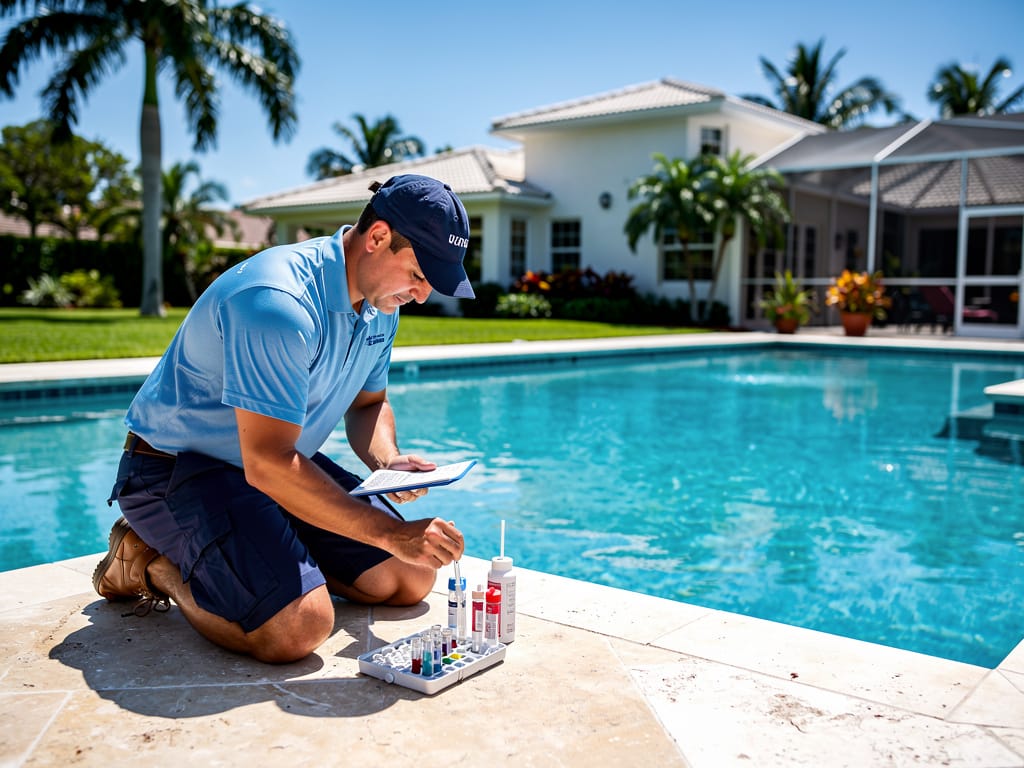
Walk the perimeter of almost any Pompano Beach pool that hasn’t been professionally cleaned in the past 12-24 months, and you’ll find it: a white or greying mineral band along the tile at the waterline. In Palm Aire, Crystal Lake, Cypress Head, and even newer construction near Pompano Beach’s western developments, calcium carbonate scale is the near-universal pool tile condition.
At Pool Service Fort Lauderdale, tile line cleaning is one of the most requested add-on services from Pompano Beach pool owners. This guide covers why it happens, which removal methods are appropriate for different deposit severities, and how to prevent it from building back up after cleaning.
What the Calcium Line Is and Why Pompano Beach Pools Get It Worse
Calcium carbonate is a naturally occurring mineral compound — the same substance that forms limestone, marble, and seashells. When it deposits on pool tile, it forms a white-to-grey crust that bonds strongly to the tile surface and is extremely resistant to ordinary cleaning products like pool tile cleaner sprays or household bathroom cleaners.
The waterline tile band is where calcium scale concentrates because it’s the zone of highest evaporation. As water evaporates from the pool surface, minerals don’t evaporate with it — they stay behind. The tile at the waterline is in a constant wet-dry cycle, and each time the water evaporates from that zone, it leaves behind a thin layer of mineral residue. Over months, those layers accumulate into visible scale.
Pompano Beach pools accumulate this scale faster than pools in most U.S. markets for reasons we cover in our calcium scaling guide: Broward County tap water arrives pre-loaded with 200-350 ppm calcium hardness, and South Florida’s year-round heat drives evaporation rates of 1-2 inches per week. The result is faster mineral concentration and more rapid tile line buildup.
Cleaning Methods — Matched to Deposit Severity
Light Deposits: Pumice Stone and Calcium Remover Paste
For deposits that have been forming for less than 12-18 months, a pumice stone (pool-grade, designed for wet use) combined with a calcium dissolving paste (products like Tile-X, Jack’s Magic Tile & Vinyl Pre-Treat, or similar acid-based pastes) is often effective.
The process: apply the paste to wet tile, let it dwell 2-3 minutes, then scrub with the pumice stone using circular motion. The acid in the paste breaks down the calcium carbonate chemically; the pumice provides mild abrasive action to remove the dissolved residue. Work in small sections, rinse thoroughly, and repeat for stubborn spots.
This can be done with the pool full — you’re working at the waterline, reaching down from the deck. It’s physically intensive work for a full pool perimeter, but it’s accessible to motivated homeowners with light to moderate deposits.
Do not use pumice stone on stone tile, travertine, or textured pool tiles — the abrasive will scratch softer stone surfaces. Standard pool tile is ceramic or porcelain and handles pumice without damage.
Moderate Deposits: Professional Acid Wash
For deposits that have been accumulating 18 months to 3 years, the mechanical approach alone may not be sufficient. A professional tile cleaning typically involves:
- Draining the pool 6-12 inches below the waterline (or to the tile band)
- Applying diluted muriatic acid directly to the calcium deposits
- Letting the acid dwell and react with the calcium carbonate (visible fizzing indicates the reaction)
- Scrubbing with stiff brushes or a rotary tool
- Neutralizing with baking soda solution and rinsing
- Refilling and chemistry rebalancing
This approach is more aggressive than pumice-only cleaning and effectively removes deposits that have bonded deeply to the tile surface. It should not be DIY’d without proper protective equipment (respirator, chemical-resistant gloves and eye protection) and knowledge of acid handling — muriatic acid fumes are hazardous in enclosed pool deck environments.
Professional cost: $250-$500 for a typical residential pool.
Heavy Deposits: Bead Blasting
For pools where calcium scale has been building for 3+ years without removal, deposits can harden to the point where acid and scrubbing alone aren’t fully effective. Bead blasting uses pressurized glass beads or crushed glass media to mechanically blast the deposits off the tile surface — effectively sandblasting the calcium away without damaging the tile glazing.
Bead blasting can be performed with the pool full using specialized underwater equipment, which makes it practical for heavily scaled pools where partial draining isn’t convenient. The process is faster and more thorough than manual scrubbing for severe deposits, though it requires specialized equipment that most general pool service companies don’t carry.
Professional cost: $400-$700 for a typical residential pool with heavy deposits.
Preventing Calcium Scale from Rebuilding After Cleaning
Getting the tile clean is the easy part — keeping it clean requires addressing the chemistry conditions that create scale in the first place.
Monthly Scale Inhibitor Treatment
Phosphonate-based scale inhibitors applied monthly keep calcium in solution rather than allowing it to precipitate onto tile and surfaces. Products like Jack’s Magic Blue Stuff, Natural Chemistry Scale Free, or Orenda CV-600 are effective when used consistently. Cost: $15-$30/month. This is the most practical ongoing prevention measure for Pompano Beach pools.
pH Management Below 7.6
The higher the pH, the faster calcium precipitates from solution. Maintaining pH in the 7.4-7.6 range (rather than allowing it to drift to 7.8-8.0) significantly slows scale formation. Pompano Beach pools naturally trend toward higher pH due to aeration from jets and waterfalls, so regular acid additions are part of proper chemistry management in this market.
Periodic Partial Dilution
When calcium hardness climbs above 500 ppm from evaporation concentration, a partial drain and refill dilutes hardness back into range. This doesn’t eliminate tile line formation but reduces the rate significantly. Most Pompano Beach pools benefit from 25-35% dilution once every 12-18 months.
Pool Service Fort Lauderdale provides professional tile cleaning and ongoing scale prevention chemistry management for Pompano Beach pools throughout Palm Aire, Crystal Lake, Cypress Head, Pompano Isles, and surrounding communities. Call (954) 501-2754 or visit our Pompano Beach service page. All our Broward County locations are at poolservicefortlauderdale.us.
Frequently Asked Questions
{
“@context”: “https://schema.org”,
“@type”: “FAQPage”,
“mainEntity”: [
{
“@type”: “Question”,
“name”: “What is the white line on my Pompano Beach pool tile?”,
“acceptedAnswer”: {
“@type”: “Answer”,
“text”: “The white or grey line at the waterline is calcium carbonate scale — mineral deposits left behind when pool water evaporates at the tile band. It is caused by Broward County’s hard water supply combined with South Florida’s high evaporation rate, which concentrates minerals rapidly at the waterline.”
}
},
{
“@type”: “Question”,
“name”: “Can I remove calcium scale from pool tile myself?”,
“acceptedAnswer”: {
“@type”: “Answer”,
“text”: “For light deposits (less than 12-18 months of accumulation), yes — a pool-grade pumice stone combined with a calcium remover paste is effective on standard ceramic and porcelain pool tile. For heavy or longstanding deposits, professional acid washing or bead blasting is more effective and safer.”
}
},
{
“@type”: “Question”,
“name”: “How much does professional pool tile cleaning cost in Pompano Beach?”,
“acceptedAnswer”: {
“@type”: “Answer”,
“text”: “Professional pool tile cleaning in Pompano Beach costs $200-$500 for acid wash treatment on a standard residential pool with moderate deposits. Heavy deposit bead blasting runs $400-$700. Annual or twice-annual professional cleaning is typical for pools with high calcium hardness and no preventive scale inhibitor treatment.”
}
},
{
“@type”: “Question”,
“name”: “How do I prevent calcium scale from coming back after my pool tile is cleaned?”,
“acceptedAnswer”: {
“@type”: “Answer”,
“text”: “Three steps: (1) Apply a phosphonate-based scale inhibitor monthly — this keeps calcium suspended in water rather than depositing on tile. (2) Maintain pH at 7.4-7.6 rather than allowing it to drift higher. (3) Perform a partial drain and refill once every 12-18 months when calcium hardness exceeds 500 ppm.”
}
},
{
“@type”: “Question”,
“name”: “Is calcium scale on pool tile a sign of a bigger problem?”,
“acceptedAnswer”: {
“@type”: “Answer”,
“text”: “Light tile scale is normal for Pompano Beach pools given Broward County’s hard water supply and is primarily cosmetic. Heavy scaling that has also appeared on pool surfaces, equipment fittings, and heat exchanger components indicates a chronic high-pH or high-calcium history that may have caused accelerated surface and equipment wear worth inspecting more thoroughly.”
}
}
]
}
What is the white line on my tile? Calcium carbonate scale from Broward hard water concentrating at the waterline through evaporation.
Can I remove it myself? Light deposits: yes, with pumice stone and calcium remover paste on ceramic/porcelain tile. Heavy deposits: professional acid wash or bead blasting is more effective.
How much does professional cleaning cost? $200-$500 for acid wash; $400-$700 for bead blasting on heavy deposits.
How do I prevent it from coming back? Monthly scale inhibitor, pH at 7.4-7.6, and partial drain-and-refill when calcium hardness exceeds 500 ppm.
Is it a sign of a bigger problem? Light scale is normal here. Heavy scale on surfaces and equipment indicates a chronic chemistry imbalance worth a professional assessment.