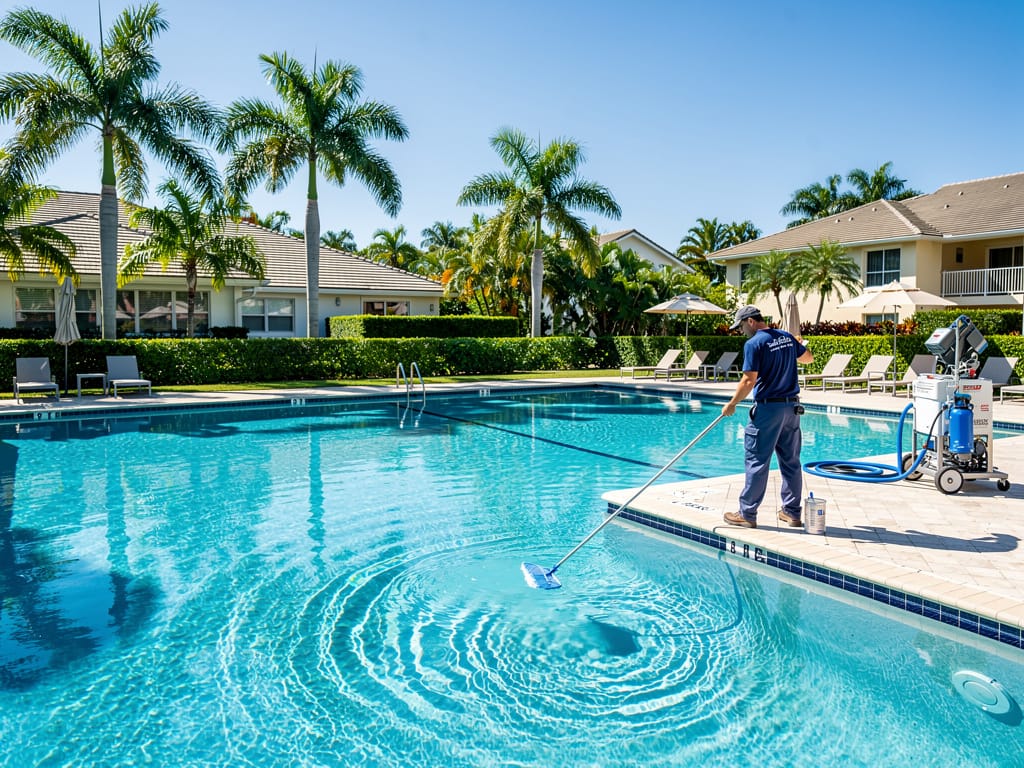
Hallandale Beach’s skyline is defined by its high-rise residential towers — buildings lining A1A and the US-1 corridor between Hollywood and Aventura that collectively house tens of thousands of residents. Nearly every one of those buildings has a pool. And every one of those pools operates under a completely different regulatory framework than the private backyard pools that make up most of Broward County’s residential pool stock.
At Pool Service Fort Lauderdale, we service shared pools throughout Hallandale Beach’s condo communities and understand the compliance requirements that separate commercial pool operation from residential service. This guide covers what condo residents and HOA board members need to understand about shared pool rules in Hallandale Beach.
Commercial vs. Residential Pool Classification
Under Florida Statutes Chapter 514 and Broward County health regulations, a pool is classified as a “public” (commercial) pool if it’s available for use by more than the immediate household. This includes all condo association pools, HOA community pools, apartment pools, and hotel pools — regardless of whether access is restricted to building residents only.
Private residential pools — the backyard pool at a single-family home — are not subject to public pool regulations. They have no mandatory inspection schedule, no required chemical log, and no licensed operator requirement beyond general safety code.
The moment a pool is shared by multiple households in a building or community, it crosses into commercial territory. For Hallandale Beach’s condo residents, this means your building’s pool is inspected, licensed, and maintained to a higher regulatory standard than you might expect — and your HOA fees cover the cost of that compliance infrastructure.
What Florida and Broward County Require for Condo Pools
Licensed Pool Operator (CPO or AFO)
Florida requires that public pools be supervised by a person who holds a Certified Pool Operator (CPO) credential from the Pool & Hot Tub Alliance or an Aquatic Facility Operator (AFO) certification from the National Recreation and Park Association. This person doesn’t need to be physically present at the pool 24/7, but must be responsible for chemical testing, treatment, and record-keeping.
For Hallandale Beach condo buildings, this requirement is typically fulfilled by the pool service contractor — the company the HOA pays for weekly or twice-weekly service. When your HOA hires a pool service company for a residential building, the service company’s CPO-certified technicians fulfill this regulatory requirement on behalf of the building.
Chemical Testing and Log Requirements
Commercial pool operators in Broward County are required to test pool chemistry (at minimum pH and chlorine) at least twice daily when the pool is available for use. These results must be recorded in a chemical log kept on-site at the pool facility — typically in a weatherproof binder or box at the pump room or pool deck. Broward County Health Department inspectors check these logs during routine inspections.
Many Hallandale Beach HOAs supplement their professional pool service (typically once or twice per week from the service company) with a building staff member designated to perform and log the twice-daily chemical checks. This is a common compliance structure for high-rise buildings where the pool deck is staffed during open hours.
Annual County Health Inspection
The Broward County Health Department inspects commercial pools annually and issues operating permits. An inspection typically covers chemical readings, equipment condition, drain cover compliance, fence and barrier requirements, bather load limits, and signage. Failed inspections can result in temporary pool closure until deficiencies are corrected.
For condo HOA boards in Hallandale Beach, maintaining passing inspection status is an ongoing operational requirement — not a one-time event. A good pool service company will alert the HOA well in advance of the inspection cycle and ensure the facility is inspection-ready.
VGB Compliant Drain Covers
The Virginia Graeme Baker Pool and Spa Safety Act (VGB Act) requires anti-entrapment drain covers on all public pools and spas. These covers must meet ASME/ANSI A112.19.8 standards, and in many jurisdictions must be replaced every five years or when they show visible wear — whichever comes first. Hallandale Beach condo pools have this requirement enforced during county health inspections.
Non-compliant drain covers on a condo pool in Hallandale Beach can result in an immediate closure order from the health department. If your HOA hasn’t verified drain cover compliance and replacement date recently, this is worth raising at the next board meeting.
Bather Load Limits and Signage
Commercial pools must post maximum bather load (number of swimmers allowed simultaneously), pool rules, emergency contact information, and depth markers. These signs must be legible, properly positioned, and meet specific size requirements under county code. Missing or deteriorated signage is a common inspection deficiency.
What This Means for Condo Residents in Hallandale Beach
As a condo owner or renter in Hallandale Beach, you’re not managing these compliance requirements directly — your HOA is. But understanding what’s required helps you ask the right questions if the pool is closed unexpectedly, if chemical levels seem off, or if you’re reviewing a new building’s pool condition before purchasing.
When evaluating a condo purchase in Hallandale Beach, ask the HOA for the pool’s current operating permit and the date of the last Broward County Health Department inspection. A well-run building can produce both within hours. A building that can’t should prompt additional due diligence about overall HOA management quality.
Pool Service Fort Lauderdale provides commercial pool service to HOA-managed properties throughout Hallandale Beach. Call (954) 501-2754 or visit our Hallandale Beach pool service page. All service areas are at poolservicefortlauderdale.us.
Frequently Asked Questions
{
“@context”: “https://schema.org”,
“@type”: “FAQPage”,
“mainEntity”: [
{
“@type”: “Question”,
“name”: “Is my Hallandale Beach condo pool regulated differently than a private backyard pool?”,
“acceptedAnswer”: {
“@type”: “Answer”,
“text”: “Yes. Condo and HOA shared pools in Hallandale Beach are classified as commercial (public) pools under Florida Statute Chapter 514, regulated by the Broward County Health Department. They require annual operating permits, twice-daily chemical logging, licensed operator oversight, VGB-compliant drain covers, and specific safety signage — none of which applies to private residential pools.”
}
},
{
“@type”: “Question”,
“name”: “How often does Broward County inspect condo pools in Hallandale Beach?”,
“acceptedAnswer”: {
“@type”: “Answer”,
“text”: “Broward County Health Department inspects commercial pools including condo pools annually. Inspections cover chemistry, equipment condition, drain cover compliance, bather load limits, and required signage. Failed inspections can result in temporary pool closure until deficiencies are corrected.”
}
},
{
“@type”: “Question”,
“name”: “Who is responsible for the chemical log at my Hallandale Beach condo pool?”,
“acceptedAnswer”: {
“@type”: “Answer”,
“text”: “The HOA is ultimately responsible. Most Hallandale Beach condo buildings fulfill the twice-daily chemical log requirement through a combination of their professional pool service company (weekly visits) and designated building staff who perform and record daily chemical checks during pool open hours.”
}
},
{
“@type”: “Question”,
“name”: “What are VGB-compliant drain covers and why does my condo pool need them?”,
“acceptedAnswer”: {
“@type”: “Answer”,
“text”: “VGB-compliant drain covers meet the federal Virginia Graeme Baker Pool Safety Act requirements for anti-entrapment protection. All commercial pools including Hallandale Beach condo pools must have these covers installed and replaced when worn or every five years. Non-compliant covers can result in an immediate closure order from the Broward County Health Department.”
}
},
{
“@type”: “Question”,
“name”: “Does Pool Service Fort Lauderdale service condo and HOA pools in Hallandale Beach?”,
“acceptedAnswer”: {
“@type”: “Answer”,
“text”: “Yes. Pool Service Fort Lauderdale provides CPO-certified commercial pool service to condo associations and HOA communities throughout Hallandale Beach. We maintain required chemical logs, coordinate with Broward County Health Department inspection cycles, and provide the documentation HOA boards need for compliance. Call (954) 501-2754.”
}
}
]
}
Is a condo pool regulated differently? Yes — it’s classified as a commercial pool requiring annual permits, daily chemical logs, licensed operator oversight, and VGB drain cover compliance.
How often are they inspected? Annually by the Broward County Health Department. Failed inspections can trigger temporary closure.
Who maintains the chemical log? The HOA, typically through their pool service company plus designated building staff for daily readings.
What are VGB drain covers? Anti-entrapment covers required by federal law on all commercial pools. Must be replaced when worn or every 5 years.
Do you service condo pools? Yes — call (954) 501-2754. We provide CPO-certified service and all required compliance documentation.