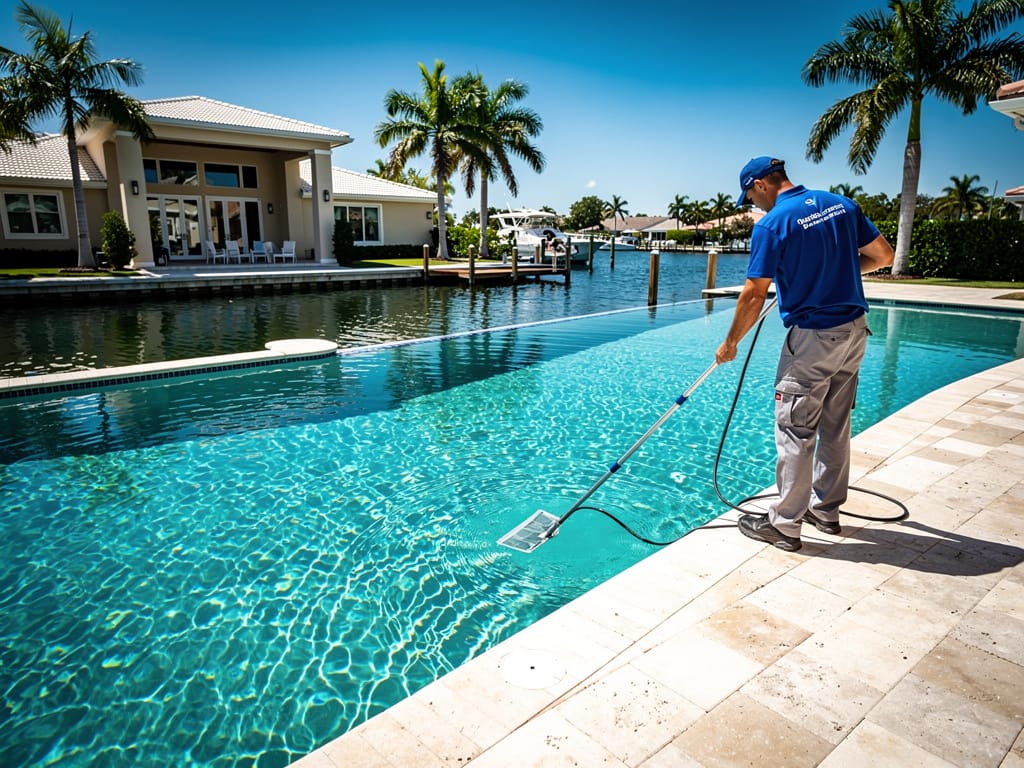
Hallandale Beach is one of the most oceanside cities in Broward County. Its eastern boundary is the Atlantic Ocean, and the sea breeze that moves west off the water carries salt aerosol across the entire city — past the A1A high-rises, over US-1, and into the western residential neighborhoods that border Hollywood to the north and Aventura to the south.
At Pool Service Fort Lauderdale, we service pools throughout Hallandale Beach and see the full spectrum of salt air damage — from the severe corrosion on equipment pads at beachfront towers to the moderate but accelerated wear at single-family homes near Gulfstream Park. The exposure gradient is real, and so is the damage.
Hallandale Beach’s Salt Air Exposure Is More Intense Than Most of Broward
The Atlantic sea breeze reaching a pool equipment pad in Hallandale Beach carries significantly higher salt aerosol concentration than the same breeze reaching an identical pad in Deerfield Beach (18 miles north, same coastline) or Pompano Beach (10 miles north). The reason is geography: Hallandale Beach has virtually no buffer between the ocean and its developed residential and commercial areas. The barrier island is narrow at this point, and the prevailing easterly winds bring ocean air directly into the mainland neighborhoods.
At beachfront tower properties — the high-rises along Ocean Drive and the buildings directly facing A1A — the corrosion environment is the most severe in the county. Equipment serving rooftop or terrace pools at these buildings may require annual component replacement of items that would last 8-10 years in a western Broward installation.
Even properties in Hallandale’s western sectors, closer to the Diplomat Golf Course and the Hollywood Hills border, experience measurable elevated salt air corrosion compared to truly inland Broward cities. The entire city sits in an elevated-risk zone.
Equipment That Fails First at Hallandale Beach Properties
Pump Motor Assemblies
Pool pump motors are sealed units with ventilation openings in the housing — necessary for cooling, but those same vents are the entry point for salt-laden air. In Hallandale Beach’s coastal environment, salt particles deposit on motor winding insulation, draw moisture, and accelerate oxidation of the copper coils. The failure signature is progressive: noise first (bearing whine or grinding), then intermittent starting failure, then complete seizure.
At east Hallandale Beach beachfront properties, expect pump motor lifespan of 3-5 years without protective measures. At western Hallandale Beach properties, 5-7 years. Compare this to 8-12 years for the same motor in a western Broward installation. Motor replacement: $300-$600 typically for residential; higher for commercial pool pumps serving condo facilities.
Automation Control Boards
Pool automation controllers contain relay contacts, circuit board traces, and transformer components that corrode aggressively when salt aerosol infiltrates the panel enclosure. The failure mode is intermittent — the system randomly misses timer events, loses programming, or fails to respond to commands — before eventually failing completely.
Control board replacement is expensive ($400-$1,200 for residential; $800-$3,000+ for commercial condo pool automation systems) and often requires the system manufacturer’s technician. Prevention through sealed, covered enclosures is far less expensive than repeated board replacements.
Electrical Conduit and Bonding Connections
The electrical infrastructure connecting the pool’s pump, light, bonding grid, and main panel is vulnerable at every junction point. Salt-induced corrosion at conduit fitting threads and wire nut connections inside junction boxes creates increasing resistance that manifests as nuisance GFCI trips, intermittent pool lights, or bonding system degradation. For condo pool facilities where the electrical infrastructure serves commercial-scale pump and filtration systems, these failures can affect the entire building’s pool operation.
Heater and Heat Pump Components
Gas heater heat exchangers and heat pump refrigerant coils are both vulnerable to salt air corrosion in Hallandale Beach. Heat pump refrigerant coils — the outdoor unit that exchanges heat with ambient air — are directly exposed to the salt-laden air that a heat pump must draw through to function. All-aluminum coil construction (vs. copper coil in older units) provides significantly better salt resistance and is recommended for any heat pump replacement or new installation at Hallandale Beach properties.
Protective Strategies for Hallandale Beach Pool Equipment
Equipment Enclosures
For beachfront and near-beach properties in Hallandale Beach, an equipment enclosure is the most impactful protective measure. A ventilated, covered structure that keeps direct salt air from depositing on motor housings, electrical connections, and panel interiors can extend equipment lifespan by 2-3x. For condo pool facilities, purpose-built pump room enclosures (often already part of the building’s infrastructure) should have their gaskets and weather seals inspected annually.
Anti-Corrosion Spray Treatment
Phosphonate or lanolin-based corrosion inhibitor sprays (Fluid Film, CRC Heavy Duty Corrosion Inhibitor, Boeshield T-9) applied to motor housing vents, electrical terminal blocks, conduit fittings, and panel interiors every 6 months significantly extend component lifespan. At Hallandale Beach beachfront properties, quarterly application is appropriate.
All-Aluminum Construction for Heat Pump Replacements
When replacing a heat pump at a Hallandale Beach property, specify all-aluminum (or coated aluminum) coil construction — not the standard copper/aluminum fin combination used in most inland installations. Brands like AquaCal manufacture coastal-rated units specifically designed for elevated salt air environments. The unit cost premium is typically $200-$500, far less than a premature coil replacement from salt corrosion on a standard unit.
Pool Service Fort Lauderdale serves pools throughout Hallandale Beach — beachfront towers, Gulfstream Park neighborhoods, Hollywood Hills border communities, and the western residential areas near Aventura. Call (954) 501-2754 or visit our Hallandale Beach service page. All locations at poolservicefortlauderdale.us.
Frequently Asked Questions
{
“@context”: “https://schema.org”,
“@type”: “FAQPage”,
“mainEntity”: [
{
“@type”: “Question”,
“name”: “Is salt air corrosion worse in Hallandale Beach than in other Broward County cities?”,
“acceptedAnswer”: {
“@type”: “Answer”,
“text”: “Yes. Hallandale Beach sits directly on the Atlantic coast with minimal buffer between the ocean and residential areas. The entire city experiences elevated salt air exposure, with beachfront and A1A-adjacent properties seeing the most severe corrosion — pump motors, control boards, and electrical components may fail 2-4 times faster than equivalent equipment in inland Broward cities.”
}
},
{
“@type”: “Question”,
“name”: “How long do pool pump motors last at Hallandale Beach beachfront properties?”,
“acceptedAnswer”: {
“@type”: “Answer”,
“text”: “Without protective measures, pump motor lifespan at east Hallandale Beach beachfront properties is typically 3-5 years. Western Hallandale Beach neighborhoods (farther from A1A) see 5-7 year motor lifespans. With proper enclosures and anti-corrosion treatment, these can be extended significantly.”
}
},
{
“@type”: “Question”,
“name”: “What is the best heat pump for Hallandale Beach’s salt air environment?”,
“acceptedAnswer”: {
“@type”: “Answer”,
“text”: “Specify all-aluminum or coated aluminum coil construction for any heat pump installation in Hallandale Beach. Brands like AquaCal manufacture coastal-rated units designed for elevated salt air environments. Standard copper/aluminum coil units corrode significantly faster in direct coastal exposure.”
}
},
{
“@type”: “Question”,
“name”: “Does salt air affect condo and HOA pool equipment more than residential pools?”,
“acceptedAnswer”: {
“@type”: “Answer”,
“text”: “The corrosion risk is the same per unit of equipment, but condo pools often have larger, more expensive commercial-grade equipment — larger pump motors, complex automation systems, commercial filtration. When this equipment fails from salt air corrosion, replacement costs are proportionally higher. Prevention is especially valuable for condo associations managing shared equipment budgets.”
}
},
{
“@type”: “Question”,
“name”: “How often should pool equipment be inspected for salt air corrosion in Hallandale Beach?”,
“acceptedAnswer”: {
“@type”: “Answer”,
“text”: “Quarterly for east Hallandale Beach properties near A1A. Twice annually for western Hallandale Beach properties. Each inspection should include anti-corrosion spray on motor housings and electrical connections, plus internal check of automation panel and junction box interiors for developing oxidation.”
}
}
]
}
Is Hallandale Beach worse for corrosion than other Broward cities? Yes — it’s directly on the Atlantic with minimal buffer. Equipment fails 2-4x faster than inland Broward at beachfront properties.
How long do pump motors last? 3-5 years at east Hallandale beachfront without protection; 5-7 years in western neighborhoods. Enclosures and coatings extend this significantly.
Best heat pump for this location? All-aluminum or coated coil construction — AquaCal and similar coastal-rated brands. Standard copper/aluminum units corrode fast in direct coastal exposure.
Does condo pool equipment face higher risk? Same corrosion rate, but commercial equipment is more expensive to replace — making prevention especially valuable for HOA budget planning.
How often to inspect? Quarterly at east Hallandale / A1A properties; twice yearly at western neighborhoods.