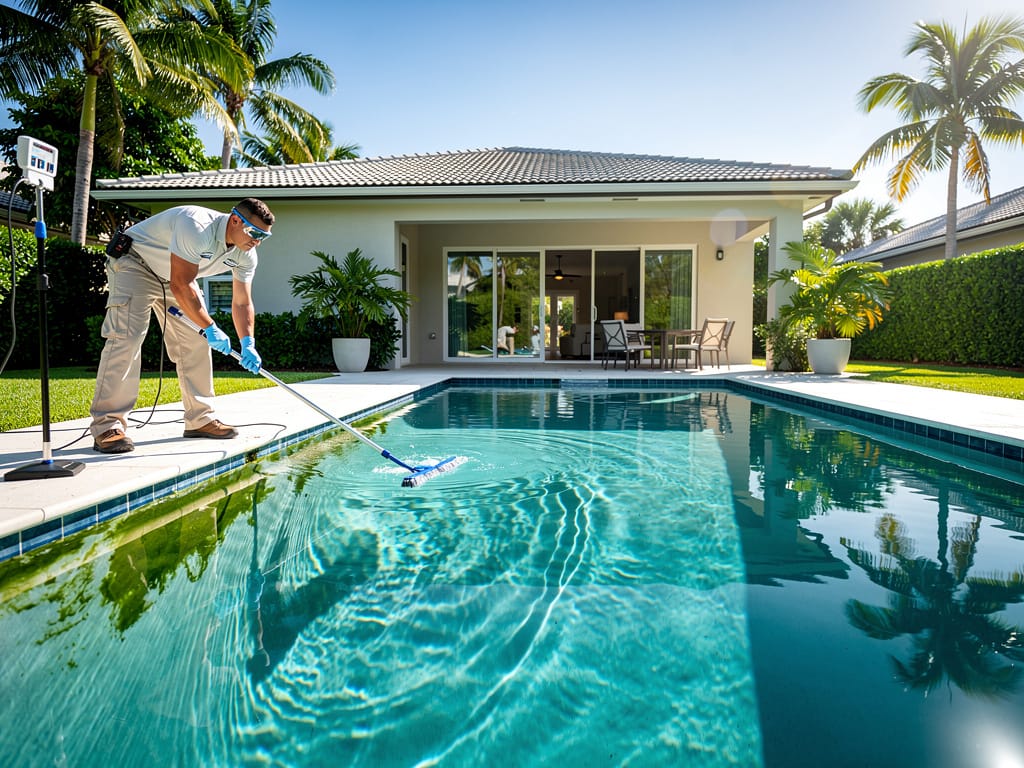
Hallandale Beach sits in one of Florida’s most algae-favorable climates: coastal humidity, water temperatures that routinely reach 88-90°F in summer, and heavy organic input from the rainy season that runs June through October. Algae prevention is not a passive chemistry check — it’s an active, multi-layer management strategy that distinguishes pools that stay clear all summer from ones that turn green after every heavy rain.
At Pool Service Fort Lauderdale, we service pools throughout Hallandale Beach year-round and have refined the prevention protocol that works in this specific climate. This guide covers what actually prevents algae — not what sounds logical but what coastal Broward pool data shows is effective.
Why Hallandale Beach Pools Are High-Risk During Rainy Season
Four factors converge during Hallandale Beach’s rainy season to maximize algae growth pressure:
Water temperature: Pool water in Hallandale Beach reaches 85-90°F from June through September without any heating. This temperature range is the optimal growth zone for green algae (Chlorophyta), which can double its population every few hours under these conditions.
UV radiation and chlorine depletion: South Florida’s summer sun is intense. Unstabilized chlorine (free chlorine unprotected by cyanuric acid) can be completely depleted by UV radiation within 24 hours on a clear summer day. Even with adequate stabilizer, chlorine consumption rates spike in summer heat.
Phosphate loading from rain: Florida summer rain washes phosphates from lawn fertilizers, bird droppings, decaying organic matter, and road runoff into pools. Phosphate is algae’s primary nutrient — at elevated levels (above 500 ppb), it fuels rapid algae establishment even when chlorine appears adequate.
Organic load from debris: Storm systems bring leaves, pollen, airborne soil, and bird matter into pools. Each organic particle introduces both phosphates and chlorine-consuming organic material that depletes sanitizer rapidly.
The Four-Layer Prevention Protocol
Layer 1: Maintain Free Chlorine at 2-4 ppm — Not the Minimum
The minimum free chlorine level for sanitation (1 ppm) is appropriate as a floor, not a target. In Hallandale Beach’s summer conditions, maintaining a standing reserve of 2-4 ppm free chlorine provides the buffer needed to handle sudden demand spikes from rain events, heavy bather load, or temperature spikes without dropping below sanitation threshold.
Weekly service visits that leave the pool at 1.0-1.5 ppm chlorine are leaving no margin for the days between visits. A pool dosed to 3.5 ppm on Monday has meaningful reserve against Tuesday’s rainstorm. A pool dosed to 1.2 ppm on Monday may not make it to Thursday’s service visit without turning.
Layer 2: Maintain CYA at 40-60 ppm
Cyanuric acid (CYA / conditioner / stabilizer) forms a reversible bond with chlorine molecules that temporarily protects them from UV degradation. Without CYA, free chlorine in an outdoor Hallandale Beach pool is depleted by UV within a few hours of direct summer sunlight. With CYA at 40-60 ppm, chlorine’s effective UV lifetime extends dramatically.
CYA above 80 ppm creates its own problem: the chlorine molecules it bonds with are also slower to release for sanitation. At very high CYA levels (100+ ppm), chlorine becomes so bound that you can show 3 ppm free chlorine on a test strip while algae grows unchallenged — this is sometimes called “chlorine lock.” The target range of 40-60 ppm balances UV protection with chlorine availability.
Because CYA doesn’t evaporate and is only removed by dilution, it tends to accumulate in pools. Test CYA every 6-8 weeks and partial drain-and-refill if it exceeds 80 ppm.
Layer 3: Phosphate Management Monthly
This is the prevention step most commonly skipped by homeowners — and the one that makes the biggest difference in algae prevention outcomes during Hallandale Beach’s rainy season.
Phosphate levels above 500 ppb (parts per billion) in pool water act as direct algae fertilizer. When phosphate is abundant, algae can establish and bloom even in the presence of adequate chlorine, because the nutrient supply overwhelms the sanitizer’s ability to kill organisms fast enough.
Monthly phosphate removal treatment — using a lanthanum-based phosphate remover (Natural Chemistry PHOSfree, Orenda PR-10,000, or similar) — keeps phosphate below 200 ppb and removes the primary nutrient that fuels algae blooms in summer. This is an add-on treatment most standard weekly service contracts don’t include by default; ask your service provider about adding it during rainy season months.
Layer 4: 10-12 Hours Minimum Daily Circulation
Algae preferentially establishes in low-flow zones — corners, steps, behind ladders, in return jet dead-spots. Adequate daily circulation disrupts algae’s ability to settle and establish in these areas. In Hallandale Beach’s summer, 10-12 hours of pump run time is the minimum for a standard residential pool. Variable speed pumps running 16-20 hours at low speed are even more effective at preventing algae than 8-10 hours at high speed — more total water movement with lower energy cost.
After a Heavy Rain: The 24-Hour Response Window
Hallandale Beach’s summer rainstorms can drop 2-3 inches of rain in a few hours — diluting chlorine, loading phosphates, and introducing organic material simultaneously. The 24 hours after a heavy storm is the critical window for algae prevention:
- Test free chlorine immediately after the storm ends
- If chlorine is below 2 ppm, add chlorine shock to restore reserves — don’t wait for the scheduled service visit
- Run the pump 24 hours for the day following a heavy storm to maximize circulation
- If significant debris entered the pool, skim and brush aggressively before running the filter
Homeowners who perform this 24-hour post-storm response reliably maintain clear pools through Hallandale Beach’s worst storm periods. Homeowners who wait for the weekly service visit after a major rain event frequently find algae establishing in the interim.
Pool Service Fort Lauderdale provides preventive chemistry management throughout Hallandale Beach, including phosphate removal programs and post-storm response service. Call (954) 501-2754 or visit our Hallandale Beach pool service page. All locations at poolservicefortlauderdale.us.
Frequently Asked Questions
{
“@context”: “https://schema.org”,
“@type”: “FAQPage”,
“mainEntity”: [
{
“@type”: “Question”,
“name”: “Why does my Hallandale Beach pool keep turning green in summer even with chlorine added?”,
“acceptedAnswer”: {
“@type”: “Answer”,
“text”: “The most common causes: chlorine is depleted faster than it is replenished (UV radiation and high temperatures consume chlorine rapidly), cyanuric acid is too low (allowing UV to burn off chlorine), phosphate levels are elevated from rainy season runoff (fueling algae growth despite adequate chlorine), or circulation is insufficient (algae establishes in low-flow zones).”
}
},
{
“@type”: “Question”,
“name”: “How do phosphates get into Hallandale Beach pools and why do they cause algae?”,
“acceptedAnswer”: {
“@type”: “Answer”,
“text”: “Phosphates enter pools through rain runoff from lawns (lawn fertilizers), bird droppings, decaying organic debris, and municipal fill water. Phosphate above 500 ppb is the primary nutrient for algae growth — it allows algae to establish and bloom even when chlorine levels appear adequate. Monthly phosphate removal treatment during rainy season keeps levels below the threshold where algae can flourish.”
}
},
{
“@type”: “Question”,
“name”: “What should I do after a heavy rainstorm to prevent my Hallandale Beach pool from turning green?”,
“acceptedAnswer”: {
“@type”: “Answer”,
“text”: “Test free chlorine within 24 hours after the storm. If below 2 ppm, shock the pool immediately. Run the pump 24 hours for the day following heavy rain. Remove debris by skimming and brushing before running the filter. Acting within the 24-hour window prevents algae from establishing during the post-storm vulnerability period.”
}
},
{
“@type”: “Question”,
“name”: “What is the ideal cyanuric acid level for a Hallandale Beach outdoor pool in summer?”,
“acceptedAnswer”: {
“@type”: “Answer”,
“text”: “Target 40-60 ppm CYA for outdoor pools in Hallandale Beach during summer. Below 40 ppm, UV radiation depletes chlorine too rapidly. Above 80 ppm, the bound chlorine becomes less available for sanitation, reducing effective sanitizer activity even when free chlorine tests read adequate levels.”
}
},
{
“@type”: “Question”,
“name”: “How many hours per day should I run my pool pump during Hallandale Beach’s rainy season?”,
“acceptedAnswer”: {
“@type”: “Answer”,
“text”: “A minimum of 10-12 hours daily during summer rainy season (June through October). Variable speed pumps running 16-20 hours at low speed provide superior algae prevention compared to 8-10 hours at high speed, with lower energy consumption. Adequate daily circulation prevents algae from settling in low-flow areas.”
}
}
]
}
Why does my pool keep going green despite chlorine? Usually: CYA too low (UV burns off chlorine fast), elevated phosphates from rain (algae fertilizer), or insufficient circulation leaving dead zones.
Where do phosphates come from? Rain runoff from lawn fertilizers, bird droppings, organic debris, and fill water. Above 500 ppb they fuel algae growth even with adequate chlorine.
What to do after heavy rain? Test chlorine within 24 hours. If below 2 ppm, shock immediately. Run pump 24 hours. Skim and brush before filtering.
Ideal CYA level in summer? 40-60 ppm — UV protection without the chlorine lock that occurs above 80 ppm.
How many hours to run the pump? 10-12 hours minimum in summer; 16-20 hours at low speed on a variable speed pump is even better for algae prevention.