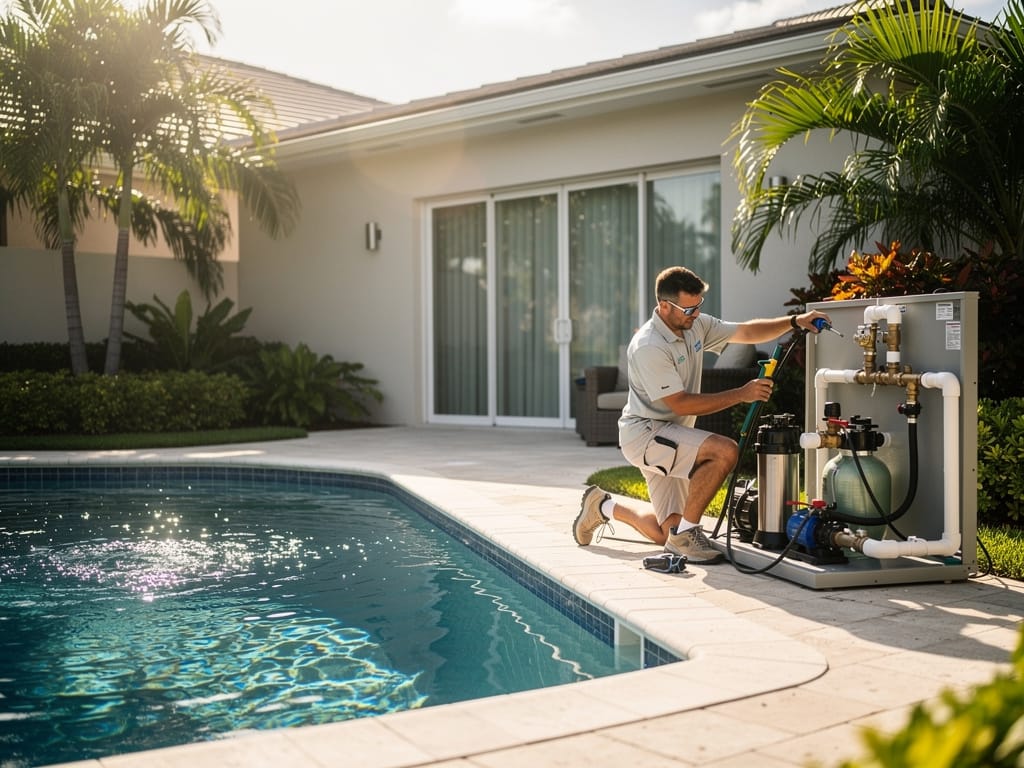
Hallandale Beach’s pool season is effectively year-round — the city’s subtropical climate rarely produces temperatures that make outdoor pool use impossible. But “possible” and “comfortable” are different standards. From late November through late February, ambient air temperatures drop into the mid-60s overnight, and pool water — which lags behind air temperature — cools to the mid-to-upper 60s°F by midwinter.
For many of Hallandale Beach’s year-round and seasonal residents, this is too cold for regular use — particularly for the city’s substantial senior population and the snowbird contingent that comes to Hallandale specifically to enjoy outdoor swimming during the winter months. Pool heating extends comfortable swimming from a potential 7 months to effectively 12 months.
At Pool Service Fort Lauderdale, we service, install, and advise on pool heating systems throughout Hallandale Beach. This guide covers how the two main pool heating technologies — heat pumps and gas heaters — compare in Hallandale Beach’s specific climate and for the mix of residential and condo pool applications common in the city.
How Pool Heat Pumps Work in Hallandale Beach
A pool heat pump is an air-to-water heat exchanger — it extracts heat energy from ambient air and transfers it to pool water. Heat pumps don’t generate heat; they move it, making them dramatically more efficient than systems that produce heat through combustion (gas) or electrical resistance. For every 1 kWh of electricity consumed, a modern heat pump transfers 5-6 kWh of heat energy to the pool water (a Coefficient of Performance of 5-6).
In Hallandale Beach’s climate, heat pumps work efficiently throughout the winter heating season because the ambient air temperature rarely drops below 55°F — the threshold below which most heat pumps begin losing efficiency. During cold fronts when temperatures drop to the mid-50s overnight, heat pump output decreases somewhat, but Hallandale Beach doesn’t experience the sustained cold snaps that would make a heat pump ineffective.
Annual operating cost for a heat pump maintaining 82°F in a 15,000-gallon Hallandale Beach pool: approximately $300-$600, depending on how many months of heating are required and how cold the winter is.
The Coastal Caveat: Specify All-Aluminum Coils
Standard pool heat pumps use copper or copper-aluminum combination coils in the outdoor refrigerant heat exchanger. In Hallandale Beach’s coastal salt air environment, standard copper coils corrode at significantly accelerated rates — heat pump coil failures at beachfront and near-beach Hallandale properties are a recurring pattern.
When specifying a heat pump for any Hallandale Beach installation, require all-titanium heat exchangers (for the water-side heat exchanger) and all-aluminum or epoxy-coated refrigerant coils (for the outdoor air-side unit). AquaCal, Hayward, and Pentair all offer coastal-rated models. The premium over standard models is typically $200-$500 — far less than an early coil replacement at $600-$1,200.
Gas Heaters in Hallandale Beach
Gas pool heaters (natural gas or propane) generate heat through combustion, making them independent of ambient air temperature — they heat at full output regardless of whether it’s 55°F or 85°F outside. This makes gas heaters attractive for:
- Rapid warm-up: a gas heater can raise pool temperature by 3-5°F per hour vs. 1-3°F per hour for a heat pump
- Heating to high temperatures (spa applications or pools that need to reach 90°F+)
- Pools used infrequently — a gas heater heating a pool for weekend use only costs less in upfront equipment than a heat pump running continuously
Operating cost comparison for Hallandale Beach: A gas heater maintaining 82°F through a Hallandale Beach winter runs approximately $1,500-$2,500 per season at current natural gas rates — 4-6x more expensive than the equivalent heat pump operating cost. For a pool that runs heated year-round, the heat pump pays back its higher upfront cost within 2-3 seasons of avoided gas expense.
Condo and Shared Pool Heating: Heat Pump + Gas Backup
For Hallandale Beach condo associations managing shared pools — where resident expectations require maintaining consistent water temperature regardless of weather conditions and rapid recovery from cold fronts is expected — the professional recommendation is a primary heat pump with gas backup.
The heat pump handles the baseline heating cost-efficiently through normal winter operations. The gas heater activates during cold fronts when the heat pump’s output drops and rapid temperature recovery is needed. This configuration minimizes annual operating cost while ensuring the responsiveness residents expect from a managed facility.
Pool Service Fort Lauderdale advises on heat pump selection and installation for residential and condo pools throughout Hallandale Beach. Call (954) 501-2754 or visit our Hallandale Beach service page. All coverage at poolservicefortlauderdale.us.
Frequently Asked Questions
{
“@context”: “https://schema.org”,
“@type”: “FAQPage”,
“mainEntity”: [
{
“@type”: “Question”,
“name”: “What temperature does pool water reach in Hallandale Beach during winter?”,
“acceptedAnswer”: {
“@type”: “Answer”,
“text”: “Without heating, Hallandale Beach pool water typically cools to 68-74°F during December through February. During cold fronts, it can drop to the mid-60s. Many residents — particularly seniors and the seasonal snowbird population — find these temperatures too cold for comfortable swimming without supplemental heating.”
}
},
{
“@type”: “Question”,
“name”: “Is a heat pump or gas heater better for a Hallandale Beach pool?”,
“acceptedAnswer”: {
“@type”: “Answer”,
“text”: “For pools heated regularly through the winter months, a heat pump is far more cost-efficient — annual operating cost of $300-$600 vs. $1,500-$2,500 for gas. Gas heaters are better for pools used infrequently or needing rapid temperature recovery. For condo shared pools, a heat pump with gas backup provides the best combination of efficiency and responsiveness.”
}
},
{
“@type”: “Question”,
“name”: “Do heat pumps work well in Hallandale Beach’s winter climate?”,
“acceptedAnswer”: {
“@type”: “Answer”,
“text”: “Yes. Heat pumps operate efficiently down to ambient temperatures of about 55°F. Hallandale Beach rarely sees temperatures below this threshold even in winter, making heat pumps effective throughout the local heating season. Efficiency drops modestly during cold fronts but remains far better than gas heating on an annual cost basis.”
}
},
{
“@type”: “Question”,
“name”: “Why do heat pump coils corrode at Hallandale Beach beachfront properties?”,
“acceptedAnswer”: {
“@type”: “Answer”,
“text”: “Standard heat pump refrigerant coils use copper or copper-aluminum construction that corrodes in Hallandale Beach’s coastal salt air environment. The outdoor refrigerant coil draws ambient air through its fins — pulling salt-laden coastal air directly through the coil with every operating hour. Specify all-aluminum or epoxy-coated outdoor coils and titanium water-side heat exchangers for any Hallandale Beach installation.”
}
},
{
“@type”: “Question”,
“name”: “How much does a pool heat pump cost installed in Hallandale Beach?”,
“acceptedAnswer”: {
“@type”: “Answer”,
“text”: “Residential pool heat pumps for Hallandale Beach pools (15,000-25,000 gallons) cost $2,000-$4,500 installed for a standard unit, or $2,500-$5,500 for a coastal-rated all-aluminum coil unit recommended for beachfront and near-beach properties. The coastal premium is typically $200-$500 above equivalent standard units.”
}
}
]
}
How cold does pool water get in winter? 68-74°F December through February without heating — cooler during cold fronts.
Heat pump or gas heater? Heat pump for regular use ($300-$600/season). Gas for infrequent use or rapid warm-up. Heat pump + gas backup for condo shared pools.
Do heat pumps work in Hallandale Beach winters? Yes — the city rarely sees temps below 55°F, the heat pump efficiency threshold.
Why do coils corrode at beachfront properties? Standard copper coils degrade in coastal salt air. Specify all-aluminum or coated coils + titanium water-side heat exchangers for Hallandale Beach installations.
How much installed? $2,000-$4,500 standard; $2,500-$5,500 for coastal-rated units. The $200-$500 coastal premium is worth it.