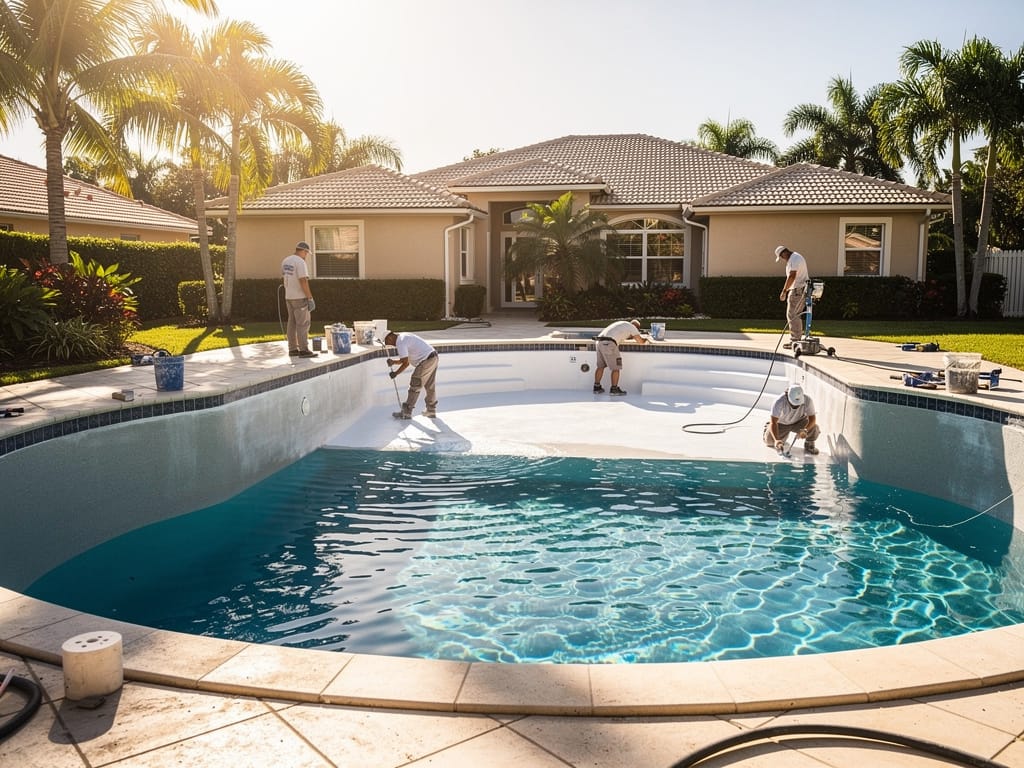
Lauderdale Lakes’s residential pool stock reflects the city’s development history — pools built during the 1960s and 1970s Broward boom that have been through multiple resurfacing cycles and now face the question of what surface material makes the most sense for the next 15 years.
At Pool Service Fort Lauderdale, we maintain pools throughout Lauderdale Lakes and regularly help homeowners evaluate whether a pool surface needs immediate resurfacing, has another season or two left, or should be scheduled for renovation this cycle.
How to Identify End-of-Life Pool Plaster in Lauderdale Lakes
Surface Roughness
The most reliable homeowner test for plaster condition is simple: run your hand firmly along the pool wall below the waterline. New plaster feels smooth — similar to a ceramic tile surface. End-of-life plaster feels rough, with calcium deposits, pitting, and surface degradation that catches skin and swimwear.
If your pool’s surface is rough enough to cut feet, scratch children’s legs, or catch and pill swimwear fabric, the surface is past its service life and needs resurfacing. Not just because it’s uncomfortable — because a degraded surface is chemically active, consuming alkalinity and making pH management significantly harder. Rough plaster causes chronic chemistry problems that no amount of chemical adjustment fully resolves.
Surface Staining That Brushing Doesn’t Remove
Plaster surfaces accumulate staining from iron (orange or brown), copper (blue-green), and organic matter (black or grey) over time. Early staining can often be treated with ascorbic acid (vitamin C), sequestrants, or localized chelation treatments. When staining is severe and persistent despite treatment, or when the staining is actually surface erosion revealing the aggregate layer beneath the plaster topping, the surface needs replacement rather than treatment.
Hollow Spots Behind the Surface
Walk around your pool deck and knock firmly on the plaster surface above the waterline using your knuckle. Sections where the plaster has delaminated from the gunite shell beneath produce a hollow, drum-like sound rather than the solid thud of well-bonded plaster. Hollow spots mean the surface has separated — it won’t improve and will eventually spall off in chunks. When hollow spotting is widespread, resurfacing is imminent.
Calcium Nodules
White raised bumps on pool plaster surfaces — calcium nodules — form when calcium carbonate deposits push up from behind the plaster surface or precipitate onto it from the water column. They’re more common in Broward County’s hard water environment and indicate chemistry management history that has allowed calcium scaling. When nodule density is high, the surface texture and chemical behavior have deteriorated beyond effective management without resurfacing.
Surface Material Options for Lauderdale Lakes Pool Renovations
White Plaster (Marcite)
The most affordable resurfacing option. White plaster in Lauderdale Lakes’s hard water and year-round operation typically lasts 10-13 years — shorter than manufacturer estimates for cooler or softer-water markets. Typical installed cost: $4,500-$7,500.
For Lauderdale Lakes homeowners who may sell in the next 5-8 years or who maintain excellent water chemistry consistently, plaster is a reasonable value choice. For long-term owners who want to minimize the frequency of resurfacing cycles, the premium options below provide better value over time.
Quartz Aggregate (Diamond Brite, Sunstone)
Quartz aggregate finishes embed crushed quartz in a Portland cement matrix, producing a surface significantly harder and more chemically resistant than basic plaster. In Lauderdale Lakes’s hard water environment, quartz aggregate handles the chronic calcium scaling pressure better, resisting both etching from low pH and calcium bonding from high pH more effectively than plain plaster.
Expected lifespan in Lauderdale Lakes: 13-16 years. Typical installed cost: $6,500-$10,000. For most Lauderdale Lakes homeowners resurfacing an older pool, quartz aggregate is the recommended value choice — meaningful durability improvement at a manageable premium over plaster.
Pebble Aggregate (Pebble Tec, Pebble Sheen)
Pebble aggregate embeds natural river pebbles or glass beads in a cement matrix. The natural stone aggregate is the hardest and most chemically resistant surface available for residential pool applications. UV-stable color, natural non-slip texture, and resistance to Broward County’s hard water chemistry make it the long-term ownership choice.
Expected lifespan in Lauderdale Lakes: 18-22 years. Typical installed cost: $9,000-$15,000+. For Lauderdale Lakes homeowners who plan to own for another 20+ years and don’t want to resurface again during that period, pebble aggregate is the recommended choice.
The Post-Resurfacing Chemistry Period
Every resurfacing project requires a startup chemistry management period of 14-30 days following application. During this period, the new surface is chemically active — curing concrete leaches calcium and alkalinity into the water, raising pH and requiring frequent chemical adjustments. In Lauderdale Lakes’s hard water environment, this curing period requires particularly careful management to prevent permanent calcium deposits from forming on the new surface before it has fully set.
Plan for 3x weekly chemistry checks during the first 30 days after any resurfacing project, and ensure your pool service provider is specifically informed that a new surface startup protocol is required — it differs from regular maintenance chemistry management.
Pool Service Fort Lauderdale provides pool resurfacing startup chemistry management and post-renovation maintenance throughout Lauderdale Lakes. Call (954) 501-2754 or visit our Lauderdale Lakes pool service page. Full coverage at poolservicefortlauderdale.us.
Frequently Asked Questions
{
“@context”: “https://schema.org”,
“@type”: “FAQPage”,
“mainEntity”: [
{
“@type”: “Question”,
“name”: “How do I know if my Lauderdale Lakes pool needs resurfacing?”,
“acceptedAnswer”: {
“@type”: “Answer”,
“text”: “Run your hand along the pool wall below the waterline. End-of-life plaster feels rough and scratchy — new plaster is smooth. Also check for: persistent staining that treatment doesn’t remove, hollow spots (knocking produces a drum sound vs. a solid thud on bonded plaster), raised calcium nodules, or visible surface loss exposing the gunite shell beneath.”
}
},
{
“@type”: “Question”,
“name”: “How long does pool plaster last in Lauderdale Lakes?”,
“acceptedAnswer”: {
“@type”: “Answer”,
“text”: “10-13 years for standard white plaster in Lauderdale Lakes’s hard water, year-round operation, and subtropical UV exposure. Quartz aggregate lasts 13-16 years. Pebble aggregate lasts 18-22 years. All are shorter than estimates for softer-water or non-year-round markets.”
}
},
{
“@type”: “Question”,
“name”: “What is the best pool surface for an older home in Lauderdale Lakes?”,
“acceptedAnswer”: {
“@type”: “Answer”,
“text”: “Quartz aggregate (Diamond Brite and similar) is the recommended value choice for most Lauderdale Lakes homeowners. It outperforms plaster by 3-4 years in lifespan in this environment at a cost premium of $2,000-$3,000. Pebble aggregate is recommended for owners planning to stay 20+ years who want to minimize resurfacing frequency.”
}
},
{
“@type”: “Question”,
“name”: “Why does pool plaster cause chemistry problems in Lauderdale Lakes?”,
“acceptedAnswer”: {
“@type”: “Answer”,
“text”: “Degraded plaster is chemically active — it consumes alkalinity from the water as its calcium carbonate matrix continues to dissolve. This makes pH management harder and forces higher chemical consumption to maintain balance. Resurfacing resolves this; no amount of chemistry adjustment fully compensates for a degraded surface.”
}
},
{
“@type”: “Question”,
“name”: “How long does the startup period take after pool resurfacing in Lauderdale Lakes?”,
“acceptedAnswer”: {
“@type”: “Answer”,
“text”: “14-30 days of startup chemistry management are required after any resurfacing. In Lauderdale Lakes’s hard water, 3x weekly chemistry checks during the first 30 days prevent calcium deposits from permanently bonding to the new surface during curing. The pool is swimable within 24-48 hours of fill, but startup protocol continues for the full curing period.”
}
}
]
}
How to know if resurfacing is needed? Rough surface that scratches skin, persistent staining, hollow spots (drum sound when knocked), calcium nodules, or visible gunite exposure.
How long does plaster last in Lauderdale Lakes? Plaster: 10-13 years. Quartz: 13-16 years. Pebble: 18-22 years. All shorter than non-Florida estimates.
Best surface for an older Lauderdale Lakes home? Quartz aggregate for most — 3-4 year lifespan advantage over plaster for $2,000-$3,000 more. Pebble for long-term owners wanting to minimize resurfacing frequency.
Why does bad plaster cause chemistry problems? Degraded plaster consumes alkalinity, making pH management harder. No chemistry adjustment fully compensates — resurfacing resolves it.
How long is the startup period after resurfacing? 30 days of startup chemistry management, with 3x weekly checks in Lauderdale Lakes’s hard water environment.