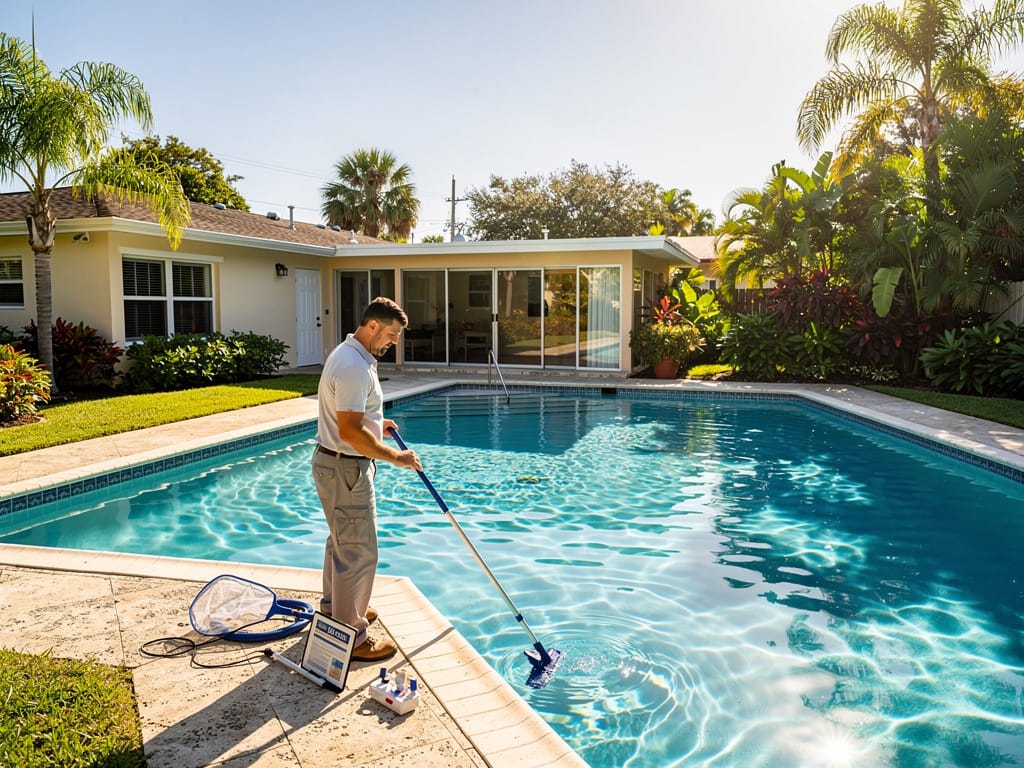
A pool built in Lauderdale Lakes in the 1960s or early 1970s has been through multiple complete equipment replacement cycles already. The pump your pool runs today is almost certainly the 3rd or 4th pump the pool has had. The filter may be the second. The automation controller (if any exists) was added as a retrofit years after the pool was built.
At Pool Service Fort Lauderdale, we maintain pools throughout Lauderdale Lakes’s established neighborhoods and observe clear patterns in equipment failure timing. This guide provides the replacement timeline and failure sequence for Lauderdale Lakes pool equipment based on what we see in the field.
Component-by-Component Replacement Timeline
Pool Pump Motor — Fails First (8-12 Years)
The pump motor is the highest-stress component in a pool system. It operates daily, contains moving parts (shaft, bearings, impeller), and is exposed to the elements. Lauderdale Lakes’s year-round operation means a pump accumulates operational hours faster than a pool that closes for winter — a Lauderdale Lakes pump running 8-10 hours daily accumulates the same hours in 10 years that a northern pool pump accumulates in 15-20 years.
Failure warning signs: Increasing noise (bearing whine, grinding, or screech), difficulty starting (motor hums but doesn’t turn, or requires a push-start), intermittent operation, tripped breakers. Don’t ignore these — a pump that draws full current while not moving water is burning out fast and may trip GFCI breakers, potentially masking an electrical fault.
Current replacement landscape: All replacement pumps above 1 HP are now variable speed (DOE 2021 rule). Budget $1,000-$1,800 installed for a quality variable speed unit. Annual energy savings of $380-$900 pay back the investment in 18-36 months.
Pool Heater or Heat Pump — Fails Second (8-15 Years)
Pool heaters (gas or propane) and heat pumps share a 8-15 year lifespan depending on fuel type and usage frequency. Gas heater heat exchangers corrode progressively from combustion byproducts; heat pump refrigerant systems and compressors wear over time. In Lauderdale Lakes’s urban setting — farther from the coast than beachfront communities — heat pump refrigerant coils face lower salt air exposure than beachfront Broward properties, typically achieving closer to the 12-15 year end of the lifespan range.
Failure warning signs: Heater ignites but doesn’t maintain temperature, unusual noises from heat pump outdoor unit, visible corrosion or discoloration on heater housing, error codes on digital displays.
Replacement cost: Gas heater $1,200-$2,500 installed; heat pump $2,500-$5,000 installed. If replacing a gas heater with another gas heater, consider whether the natural gas infrastructure is still adequate — gas line sizing that was acceptable for original equipment may be undersized if other appliances have been added to the property.
Automation Controller — Fails Third (10-15 Years)
Automation controllers contain circuit boards, relays, and transformers vulnerable to moisture and corrosion. In Lauderdale Lakes’s humid subtropical climate, automation panel enclosures that aren’t perfectly sealed allow moisture infiltration that progressively corrodes circuit boards. The failure pattern is typically intermittent — the system randomly misses schedules, loses programming, or fails to respond to inputs before failing completely.
Failure warning signs: Pump runs outside scheduled times or doesn’t run at scheduled times, lights don’t respond to commands, display shows error codes, frequent loss of programming.
Replacement cost: $800-$2,500 for residential automation controllers. Replacing an older system is an opportunity to upgrade to a current smart-home-compatible platform (Pentair IntelliCenter, Hayward OmniLogic) that enables smartphone monitoring and control — valuable for Lauderdale Lakes homeowners who may travel or have seasonal residents next door who monitor their own properties remotely.
Filter Tank — Fails Fourth (15-20 Years)
Sand and DE filter tanks are pressure vessels with a long lifespan — typically 15-20 years for a quality fiberglass or molded plastic tank. Failure modes: tank cracks (visual inspection reveals fissures in the tank body), excessive pressure differential across the filter indicating channeling or collapsed grids, and mechanical seal failures at the multiport valve.
Filter media also degrades: Filter sand should be replaced every 5-7 years (sand becomes rounded through use and loses filtering efficiency). DE grids should be inspected annually and replaced when torn or damaged. Many Lauderdale Lakes pools run filter media that is well past its change interval — fresh media dramatically improves water clarity and reduces backwash frequency.
Replacement cost: Sand filter $800-$1,800 installed; DE filter $1,200-$2,500 installed; cartridge filter $600-$1,500 installed.
Plumbing Fittings and Valves — Longest-Lived but Degrading (20-30+ Years)
PVC plumbing installed in 1980s-1990s pool renovations may now be approaching 30-40 years of age. PVC itself is long-lived, but fittings, union connections, and especially the plastic slide valves (diverter valves, backwash valves) degrade — valve seats crack, diverters stick, and union O-rings harden and leak.
Valve and fitting replacement is typically triggered by specific failures rather than age alone — but during any equipment pad replacement project, replacing all valves and union connections prevents service calls for minor plumbing leaks in the years following the major equipment work.
Pool Service Fort Lauderdale provides equipment assessment and replacement services for aging pools throughout Lauderdale Lakes. Call (954) 501-2754 or visit our Lauderdale Lakes pool service page. Full coverage at poolservicefortlauderdale.us.
Frequently Asked Questions
{
“@context”: “https://schema.org”,
“@type”: “FAQPage”,
“mainEntity”: [
{
“@type”: “Question”,
“name”: “What pool equipment fails first in an older Lauderdale Lakes home?”,
“acceptedAnswer”: {
“@type”: “Answer”,
“text”: “The pump motor fails first in most Lauderdale Lakes pool systems, with an 8-12 year lifespan due to daily operation and moving parts. Heaters and heat pumps follow (8-15 years), then automation controllers (10-15 years), filter tanks (15-20 years), and finally plumbing valves and fittings (20-30+ years).”
}
},
{
“@type”: “Question”,
“name”: “What are the warning signs that a Lauderdale Lakes pool pump is failing?”,
“acceptedAnswer”: {
“@type”: “Answer”,
“text”: “Increasing noise (bearing whine, grinding, screech), difficulty starting (hums but won’t turn), intermittent operation, and tripped GFCI breakers. Don’t ignore early warning signs — a pump drawing full current while not moving water fails fast and may mask electrical faults.”
}
},
{
“@type”: “Question”,
“name”: “How long does pool filter sand last in Lauderdale Lakes?”,
“acceptedAnswer”: {
“@type”: “Answer”,
“text”: “Filter sand should be replaced every 5-7 years. Sand becomes rounded through use and loses filtering efficiency, which reduces water clarity and increases backwash frequency. Many Lauderdale Lakes pools run sand well past this interval — fresh sand dramatically improves filter performance.”
}
},
{
“@type”: “Question”,
“name”: “When replacing a pool pump in Lauderdale Lakes, should I also replace the filter?”,
“acceptedAnswer”: {
“@type”: “Answer”,
“text”: “If the filter is within 3-5 years of needing replacement, doing both at the same time saves a service mobilization cost and allows the plumbing and electrical work to be coordinated once. If the filter has been recently serviced or replaced, it can typically wait for its own natural replacement cycle.”
}
},
{
“@type”: “Question”,
“name”: “How much does a complete pool equipment replacement cost in Lauderdale Lakes?”,
“acceptedAnswer”: {
“@type”: “Answer”,
“text”: “Full equipment pad replacement (variable speed pump, filter, heater or heat pump, automation controller, valves) for a Lauderdale Lakes residential pool: $6,000-$12,000+ depending on component choices and existing plumbing/electrical condition. Individual component replacements run $1,000-$5,000 per item installed.”
}
}
]
}
What fails first? Pump motor (8-12 years), then heater/heat pump (8-15), automation controller (10-15), filter tank (15-20), plumbing valves (20-30+).
Pump warning signs? Noise (grinding/whine), difficulty starting, intermittent operation, tripped breakers. Act on early signs — delayed replacement risks electrical faults.
How long does filter sand last? 5-7 years — replace it. Many Lauderdale Lakes pools run sand well past this interval; fresh sand dramatically improves clarity.
Should I replace filter when replacing pump? If the filter is within 3-5 years of needing replacement, yes — coordinate the work to save a service mobilization.
Full equipment replacement cost? $6,000-$12,000+ for a complete equipment pad (pump + filter + heater + automation + valves).