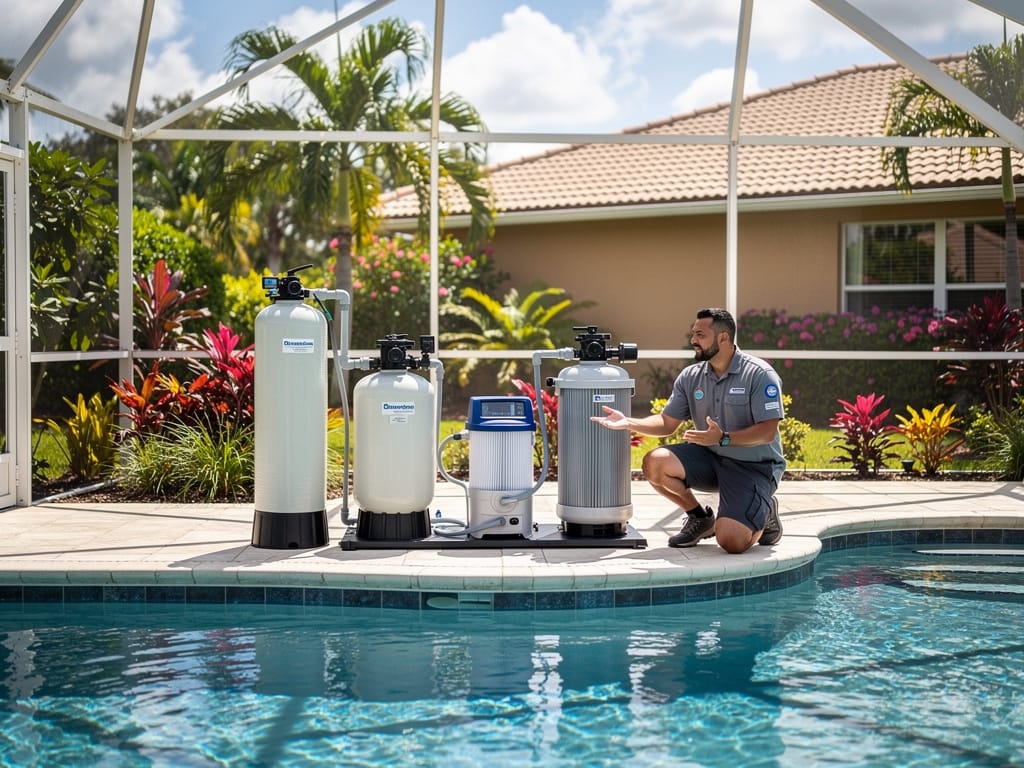
Sand filters are the most common pool filter type in Lauderdale Lakes’s older housing stock — they were the standard during the 1970s-1990s renovation cycles that replaced original equipment on the city’s 1960s-70s pools. They’re reliable, relatively maintenance-free, and long-lasting (15-20 years for the tank), but they’re also the lowest-clarity filter technology in common residential use — filtering particles down to about 20-40 microns, compared to 10-15 microns for cartridge filters and 3-5 microns for DE filters.
At Pool Service Fort Lauderdale, we service pools throughout Lauderdale Lakes and recommend filter upgrades when older sand units reach end of life. This guide covers how the three residential filter technologies compare and what upgrade path makes sense for typical Lauderdale Lakes residential pools.
Sand Filters — The Baseline
Sand filters work by passing pool water through a bed of #20 silica sand (or zeolite, glass media, or similar alternatives) that traps particles by physical interception and adsorption. When the sand bed becomes loaded with trapped particles, pressure across the filter increases and a backwash cycle is run — reversing flow to flush captured material to waste.
Advantages: Low maintenance (backwash every 1-2 weeks or when pressure rises 8-10 psi above clean baseline), no replacement media for 5-7 years, simple operation, long tank lifespan (15-20 years), low cost ($600-$1,200 installed for a residential unit).
Disadvantages: Lowest filtration clarity of the three technologies (20-40 micron cutoff). Backwashing wastes 200-400 gallons per cycle. In Lauderdale Lakes’s high-bather-load or tree-canopy pools, sand filtration may not achieve the water clarity that newer technologies provide.
When to stay with sand: Budget-constrained replacement where performance upgrade isn’t a priority, or pools where the existing plumbing is specifically configured for sand backwash connections and replumbing for another filter type isn’t feasible.
Diatomaceous Earth (DE) Filters — Finest Filtration
DE filters use grids coated with diatomaceous earth (fossilized diatom skeletons with a highly porous microstructure) to filter pool water. DE achieves filtration down to 3-5 microns — capturing particles that sand and cartridge filters pass — producing the clearest water of any residential filter technology.
Advantages: Finest water clarity achievable in residential pool filtration. Excellent performance in pools with high bather load, organic debris, or fine particulate from nearby landscaping. For Lauderdale Lakes pools near mature trees, DE’s ability to capture fine organic particles improves water clarity noticeably compared to sand.
Disadvantages: Requires periodic DE powder addition (after backwash) — a maintenance step that cartridge filters don’t require. Backwash waste includes DE powder that should not be repeatedly discharged to storm drains (Broward County environmental sensitivity). Grids require annual inspection and periodic replacement ($150-$400 for grid replacement). Installed cost: $1,200-$2,500.
When to choose DE: Pools where maximum water clarity is the priority, pools with high organic debris loads (tree canopy), or pools where the owner wants the highest-performing filter available. Also appropriate for HOA community pools where crystal clear water quality is visible to many residents.
Cartridge Filters — No Backwash, Good Clarity
Cartridge filters use pleated polyester filter elements (similar to automotive air filters) to filter pool water. Cartridges are removed and hose-cleaned (no backwash waste) every 3-6 months and replaced when they no longer recover to acceptable flow rates — typically every 2-4 years.
Advantages: No backwash (saves 200-400 gallons per backwash cycle vs. sand and DE). Filtration clarity between sand and DE (10-15 microns). No media addition required. Lower operating water waste — valuable in Lauderdale Lakes where municipal water costs accumulate in high-service-frequency pool environments. Installed cost: $700-$1,800.
Disadvantages: Cartridge elements need replacement every 2-4 years ($60-$200 per set). In pools with high debris loads (tree canopy, heavy use), cartridges may need cleaning more frequently than the standard 3-6 month interval.
When to choose cartridge: Pools where water conservation is a priority, pools in moderate debris environments, or homeowners who prefer the no-backwash maintenance simplicity. For Lauderdale Lakes’s aging pools where the owner wants a meaningful clarity upgrade over an old sand filter without the DE maintenance requirements, cartridge is the recommended middle-ground choice.
Selecting Filter Size for Lauderdale Lakes Pools
Pool filters should be sized to the pool volume and maximum flow rate of the pump — not simply to the same nominal size as the filter being replaced. With the transition to variable speed pumps (see our VSP guide), the maximum flow rate to size against is the pump’s high-speed setting rather than a constant single-speed flow rate. Over-sizing the filter (within reason) extends the cleaning interval and improves water clarity by providing more filter surface area per gallon of water passing through.
Pool Service Fort Lauderdale installs and services sand, DE, and cartridge filters for residential and commercial pools throughout Lauderdale Lakes. Call (954) 501-2754 or visit our Lauderdale Lakes pool service page. Full coverage at poolservicefortlauderdale.us.
Frequently Asked Questions
{
“@context”: “https://schema.org”,
“@type”: “FAQPage”,
“mainEntity”: [
{
“@type”: “Question”,
“name”: “What type of pool filter gives the clearest water in a Lauderdale Lakes pool?”,
“acceptedAnswer”: {
“@type”: “Answer”,
“text”: “Diatomaceous earth (DE) filters achieve the finest filtration — down to 3-5 microns — producing the clearest water of any residential filter technology. Cartridge filters are a close second (10-15 microns) with less maintenance. Sand filters provide the lowest clarity of the three (20-40 microns) but are the most common in older Lauderdale Lakes pools.”
}
},
{
“@type”: “Question”,
“name”: “When should I replace the sand in my Lauderdale Lakes pool filter?”,
“acceptedAnswer”: {
“@type”: “Answer”,
“text”: “Filter sand should be replaced every 5-7 years regardless of visible condition. Sand becomes rounded through use and loses its sharp edges that trap fine particles, reducing filtration efficiency. Many Lauderdale Lakes pools run sand well past this interval — fresh sand significantly improves water clarity and reduces backwash frequency.”
}
},
{
“@type”: “Question”,
“name”: “What is the cheapest pool filter replacement option in Lauderdale Lakes?”,
“acceptedAnswer”: {
“@type”: “Answer”,
“text”: “Replacing a like-for-like sand filter is the lowest upfront cost ($600-$1,200 installed). Cartridge filters run $700-$1,800 installed and eliminate backwash water waste. DE filters are the most expensive ($1,200-$2,500) but provide the best water clarity. For older Lauderdale Lakes pools, a cartridge or DE upgrade provides better long-term value than same-technology sand replacement.”
}
},
{
“@type”: “Question”,
“name”: “Do cartridge filters save water compared to sand filters in Lauderdale Lakes?”,
“acceptedAnswer”: {
“@type”: “Answer”,
“text”: “Yes. Sand and DE filters backwash 200-400 gallons per cycle, which is discharged to waste. Cartridge filters have no backwash — cartridges are removed and hose-cleaned, returning the wash water to the environment without wasting pool water. Over a year of normal maintenance, cartridge filters save 5,000-10,000+ gallons compared to equivalent sand filter operation.”
}
},
{
“@type”: “Question”,
“name”: “Should I upgrade my pool filter when replacing the pump in my Lauderdale Lakes home?”,
“acceptedAnswer”: {
“@type”: “Answer”,
“text”: “If the filter is within 5 years of its expected replacement (15-20 years for sand, 10-15 years for DE or cartridge), doing both at the same time saves coordination costs and allows the new pump and filter to be sized as an integrated system. If the filter has been recently replaced, it can wait for its own natural replacement cycle.”
}
}
]
}
Which filter gives clearest water? DE (3-5 microns) → cartridge (10-15 microns) → sand (20-40 microns). Most older Lauderdale Lakes pools have sand — both alternatives provide meaningful clarity upgrades.
When to replace filter sand? Every 5-7 years — sand loses its particle-trapping edges over time. Many Lauderdale Lakes pools run sand well past this interval.
Cheapest option? Same-technology sand replacement ($600-$1,200). Cartridge ($700-$1,800) and DE ($1,200-$2,500) upgrades provide better value long-term.
Do cartridge filters save water? Yes — 5,000-10,000+ gallons/year vs. sand (no backwash waste). Cartridges are hose-cleaned, not backwashed.
Upgrade filter when replacing pump? Yes, if the filter is within 5 years of needing replacement — coordinate for system optimization and coordination cost savings.