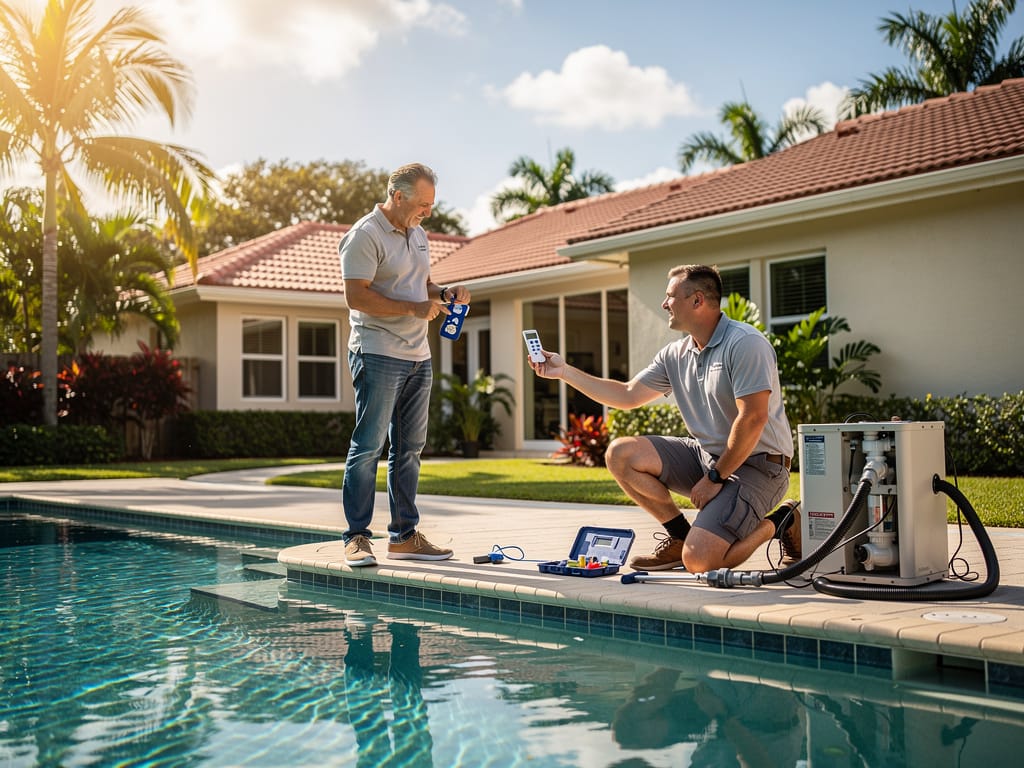
In Lauderhill’s budget-conscious residential communities, many pool owners ask a reasonable question: what can I reasonably do myself, and where do I actually need a professional? The answer is not all-or-nothing — a structured hybrid approach delivers real cost savings without the risks of full self-management.
At Pool Service Fort Lauderdale, we are honest with Lauderhill clients about what they can handle. This guide provides a clear breakdown.
What Homeowners Can Safely Do Themselves
Daily or Every-Other-Day Skimming
Removing surface debris before it sinks and decomposes is the single most impactful homeowner action between professional visits. A leaf net on a telescoping pole takes 5-10 minutes and prevents organic matter from generating chlorine demand and phosphate load. In Lauderhill’s neighborhoods with established tree canopy, daily skimming is a genuine service quality improvement over letting debris accumulate for a week.
Weekly Brushing
Brushing pool walls, steps, and floor dislodges early-stage biofilm and algae before it becomes visible. Homeowners who brush weekly between professional service visits have measurably fewer algae events. A quality pool brush and telescoping pole costs $25-$40 at any pool supply store.
Visual Equipment Checks
You don’t need a license to notice unusual pump noise, a filter pressure gauge reading higher than usual, a return jet not flowing, or a pool light out. Reporting these observations to your service technician allows small problems to be addressed before they become expensive failures.
Basic Water Testing
OTC test strips ($15-$30/season) give a directional read on pH and chlorine between professional visits — useful for catching a dangerous chlorine drop after heavy rain or bather load before the scheduled service visit. Not a replacement for the full-panel professional test, but a useful early warning tool.
What to Leave to the Professionals
Chemistry Dosing
Knowing pH is high is different from knowing how much acid to add to bring a specific volume from 7.9 to 7.4 without overshooting to 7.0. Chemistry interactions between pH, alkalinity, calcium hardness, and CYA require training or experience. Homeowners who dose their own acid routinely frequently create chemistry swings that damage surfaces and require expensive correction. Leave chemistry dosing to your technician unless you are willing to invest in a quality drop test kit and study the chemistry relationships.
Equipment Diagnosis
If the pump isn’t starting, the filter is leaking, or the automation isn’t running schedules, leave diagnosis to a licensed technician. Pool electrical carries enough voltage to injure seriously, and misdiagnosis wastes money (replacing a motor when a $15 capacitor was the actual fault). Professionals carry the diagnostic tools and component knowledge to identify root causes.
Algae Treatment
Green pool treatment requires diagnosis of algae type, chemistry conditions that allowed establishment, and a specific chemical sequence. Homeowner treatments often address visible green water without resolving the underlying chemistry condition — resulting in recurring events within weeks. Professional treatment resolves the root cause and addresses the chemistry that allowed it.
The Hybrid Model for Lauderhill Budget-Conscious Owners
Most cost-effective structure: bi-weekly professional service + homeowner daily skimming, weekly brushing, and directional strip tests between visits. This reduces professional service cost by 30-40% versus weekly service while maintaining quality — but only if the homeowner actually performs the in-between tasks. A bi-weekly contract without homeowner discipline typically produces worse outcomes than weekly professional service alone.
Pool Service Fort Lauderdale offers flexible service schedules for Lauderhill homeowners. Call (954) 501-2754 or visit our Lauderhill pool service page. Full coverage at poolservicefortlauderdale.us.
Frequently Asked Questions
{“@context”:”https://schema.org”,”@type”:”FAQPage”,”mainEntity”:[{“@type”:”Question”,”name”:”Can I maintain my Lauderhill pool completely by myself to save money?”,”acceptedAnswer”:{“@type”:”Answer”,”text”:”You can handle skimming, brushing, and basic test strip checks. But chemistry dosing, equipment diagnosis, and algae treatment require professional expertise. Fully self-managed pools in Lauderhill’s climate typically have more algae events and equipment problems than professionally-serviced pools, often costing more in remediation than the service cost savings.”}},{“@type”:”Question”,”name”:”What is the most cost-effective pool service arrangement for budget-conscious Lauderhill homeowners?”,”acceptedAnswer”:{“@type”:”Answer”,”text”:”A hybrid approach: bi-weekly professional service with homeowner skimming, brushing, and visual checks between visits. Saves 30-40% vs. weekly service. Only works if the homeowner actually performs the in-between maintenance tasks consistently.”}},{“@type”:”Question”,”name”:”What pool test kit should a Lauderhill homeowner buy?”,”acceptedAnswer”:{“@type”:”Answer”,”text”:”For directional checks: OTC test strips ($15-$30) work for quick pH and chlorine reads. For more reliable chemistry management: Taylor K-2006 drop test kit ($50-$70) is the professional-grade option homeowners can use effectively with practice.”}},{“@type”:”Question”,”name”:”Is it safe to add chlorine to my Lauderhill pool myself?”,”acceptedAnswer”:{“@type”:”Answer”,”text”:”Shock chlorination (adding liquid or granular chlorine to boost a low reading) is safe with basic precautions: gloves, add to water (not vice versa), add after sunset. Acid (pH reduction) requires more care and is best left to your technician unless you have proper training.”}},{“@type”:”Question”,”name”:”What should I do if I notice my Lauderhill pool pump is making a strange noise?”,”acceptedAnswer”:{“@type”:”Answer”,”text”:”Note the noise type (whine, grinding, screech, vibration) and when it occurs (startup only, continuous, under load). Call for an off-cycle inspection — don’t wait for the scheduled visit. A bearing whine caught early is a $100-$200 motor repair; the same motor run to failure needs full replacement at $500-$900.”}}]}
Can I maintain it myself? Skimming, brushing, strip tests — yes. Chemistry dosing, equipment diagnosis, algae treatment — leave to the professionals.
Most cost-effective arrangement? Bi-weekly professional + homeowner skimming/brushing between. Saves 30-40% — but only if homeowner tasks actually happen.
Test kit to buy? Test strips ($15-$30) for quick checks. Taylor K-2006 ($50-$70) if you want to manage chemistry yourself.
Safe to add chlorine yourself? Shock — yes with precautions. Acid — leave to your technician.
Strange pump noise? Call for off-cycle inspection. Early bearing repair: $100-$200. Full motor failure: $500-$900.