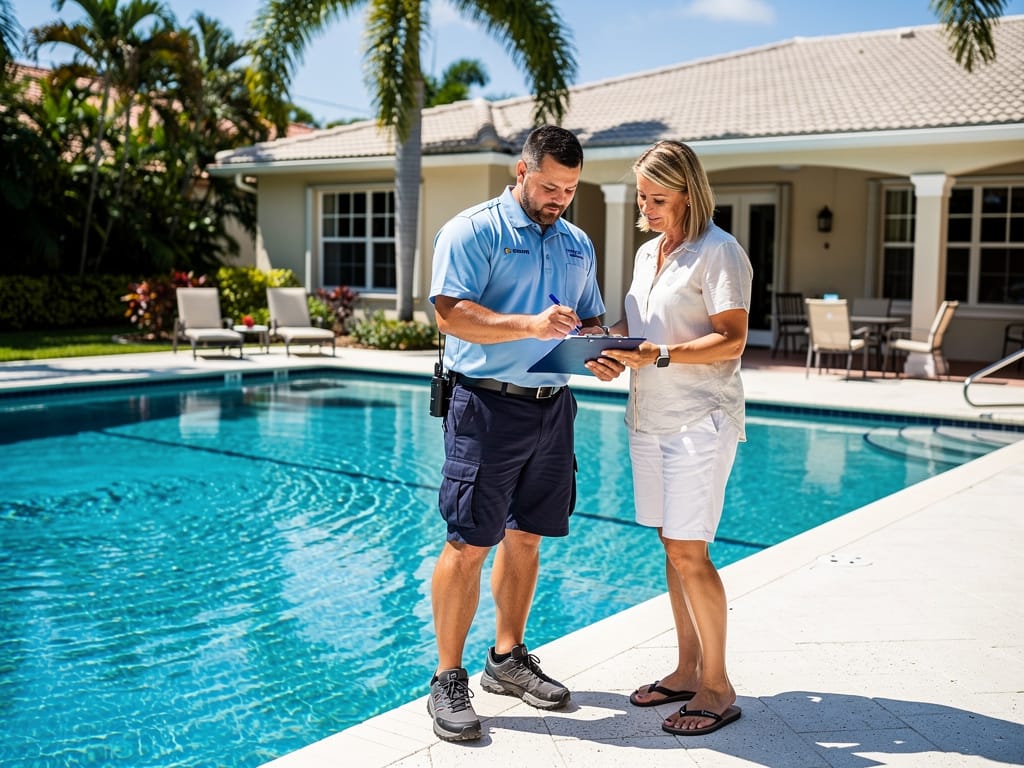
Water conservation matters in South Florida — Broward County draws its water supply from the Biscayne Aquifer, and per-capita water consumption is among the highest in the nation. For Lauderhill pool owners, evaporation and backwash waste are two controllable water costs that add up to thousands of gallons per month without active management.
At Pool Service Fort Lauderdale, we help Lauderhill homeowners understand where their pool’s water goes and where controllable losses can be reduced. This guide covers the evaporation math, water conservation strategies, and how to tell normal evaporation from a pool leak.
How Much Water Does a Lauderhill Pool Lose to Evaporation?
Evaporation from an outdoor pool depends on four factors: water temperature, air temperature, humidity, and wind speed. Lauderhill’s subtropical climate creates elevated evaporation compared to northern pools — warm water, warm air, and afternoon winds off the Atlantic all accelerate water loss.
Average evaporation rates for Lauderhill pools:
- Summer (June-September): 1/4 to 3/8 inch per day, or roughly 150-225 gallons/day for a 400 sq ft pool
- Winter (December-February): 1/8 to 1/4 inch per day, or roughly 75-150 gallons/day
- Annual total: 40,000-70,000 gallons evaporated per year for a typical Lauderhill residential pool
At Lauderhill’s typical residential water rate structure, this evaporation cost appears directly on your utility bill if your pool uses a municipal water auto-fill system. Even if you’re not tracking it as a “pool cost,” it’s there.
Evaporation vs. Leak — The Bucket Test
Auto-fill systems compensate for water loss continuously, making it difficult to tell whether your pool is losing water normally or has a structural leak. The bucket test distinguishes evaporation from structural loss:
- Fill a 5-gallon bucket with pool water and place it on the top step (in the pool, so it’s at pool water temperature)
- Mark the water level inside the bucket and the pool water level on the bucket’s exterior
- Turn off the auto-fill valve and pump for 24 hours
- After 24 hours: the bucket and pool should show similar water loss (both losing to evaporation at the same rate). If the pool water level dropped significantly more than the bucket, the difference is a structural leak
Normal differential: 0-1/8 inch. A differential of more than 1/4 inch between pool and bucket indicates a structural leak requiring investigation. See our crack repair and leak detection guide for what to do next.
Water Conservation Strategies for Lauderhill Pool Owners
Liquid Pool Cover (Evaporation Reduction Product)
Liquid solar cover products (Natural Chemistry Cover Free, Heatsavr, and similar) contain a biodegradable alcohol compound that forms a monomolecular layer on the water surface — invisible and harmless to swimmers, but reducing evaporation by 30-40% by acting as a molecular barrier. Cost: $20-$35/month for a standard residential pool. Annual savings at $0.003/gallon water cost and 40% evaporation reduction: $500-$1,500 in water. Payback: immediate. The liquid cover also slightly reduces heating costs by reducing evaporative heat loss.
Solid Pool Cover (Maximum Evaporation Reduction)
A traditional solid or mesh pool cover placed on the pool when not in use reduces evaporation by 70-95% — the most effective single water conservation measure. Cover installation cost: $400-$1,200 for a standard residential cover. In Lauderhill’s climate, a covered pool requires less makeup water, maintains chemistry better (less evaporation-driven concentration), and reduces heating costs. The tradeoff: installation and removal for each swim session, and covers require cleaning to prevent debris accumulation on the surface.
Reduce Backwash Frequency and Volume
Sand and DE filter backwashing discharges 200-400 gallons per cycle. Backwash when the filter pressure gauge reads 8-10 psi above its clean baseline — not on a fixed calendar schedule. Over-backwashing wastes water without improving filtration. Switching to a cartridge filter eliminates backwash waste entirely (cartridges are hose-cleaned, not backwashed), which at one backwash per two weeks over a year equals 5,000-10,000 gallons of avoided water waste.
Splash Reduction
Splash-out from pool use — particularly from jumping, diving, and active play by children — is a real but often overlooked water loss. A pool that loses 50-100 gallons per heavy-use session from splash replaces this from the auto-fill or hose. Windscreen fencing and thoughtful bather load management during peak splash events can meaningfully reduce this loss over a season.
Pool Service Fort Lauderdale helps Lauderhill homeowners identify water conservation opportunities and manage pool water efficiently. Call (954) 501-2754 or visit our Lauderhill pool service page. Full coverage at poolservicefortlauderdale.us.
Frequently Asked Questions
{“@context”:”https://schema.org”,”@type”:”FAQPage”,”mainEntity”:[{“@type”:”Question”,”name”:”How much water does a Lauderhill pool lose per month to evaporation?”,”acceptedAnswer”:{“@type”:”Answer”,”text”:”A typical Lauderhill residential pool (15,000-20,000 gallons, 400 sq ft surface area) loses approximately 1,000-2,500 gallons per month to evaporation, depending on season and wind conditions. Over a full year this totals 40,000-70,000 gallons — all of which shows up on your utility bill if an auto-fill system is connected to municipal water.”}},{“@type”:”Question”,”name”:”How do I tell if my Lauderhill pool is evaporating normally or has a leak?”,”acceptedAnswer”:{“@type”:”Answer”,”text”:”Use the bucket test: place a bucket of pool water on the top step, mark water levels inside and outside the bucket, turn off auto-fill and pump for 24 hours, compare. Both bucket and pool should lose similar amounts (both evaporating). If the pool lost significantly more than the bucket, a structural leak is present and professional leak detection is recommended.”}},{“@type”:”Question”,”name”:”What is the most effective way to reduce pool evaporation in Lauderhill?”,”acceptedAnswer”:{“@type”:”Answer”,”text”:”A solid or mesh pool cover reduces evaporation by 70-95% when the pool is not in use — the most effective single measure. Liquid solar cover products reduce evaporation by 30-40% without the cover installation and removal step. Cost: $20-$35/month for liquid cover products.”}},{“@type”:”Question”,”name”:”Does a pool cover save money on chemicals as well as water in Lauderhill?”,”acceptedAnswer”:{“@type”:”Answer”,”text”:”Yes. Evaporation concentrates dissolved minerals in the remaining water — raising calcium hardness and TDS over time — requiring partial drain-and-refill to dilute. Reducing evaporation slows this concentration effect, reducing the frequency of dilution refills and the chemical cost of rebalancing after refill. A covered pool also requires less chlorine because UV exposure (a major chlorine depletion source) is reduced when the cover is on.”}},{“@type”:”Question”,”name”:”Does backwashing a Lauderhill pool waste a lot of water?”,”acceptedAnswer”:{“@type”:”Answer”,”text”:”Each backwash cycle discharges 200-400 gallons. At one backwash per two weeks, this totals 5,000-10,000 gallons per year. Backwash when needed (8-10 psi above clean baseline) rather than on a fixed schedule. Cartridge filters eliminate backwash waste entirely — cartridges are hose-cleaned, not backwashed.”}}]}
Monthly evaporation loss? 1,000-2,500 gallons/month (150-225 gallons/day in summer). 40,000-70,000 gallons/year total — all appearing on your utility bill.
Evaporation or leak? Bucket test: both pool and bucket should lose similar amounts. More pool loss than bucket = structural leak.
Best evaporation reduction? Solid pool cover (70-95% reduction). Liquid solar cover products (30-40% reduction, no installation/removal step, $20-$35/month).
Does cover save on chemicals too? Yes — slows mineral concentration and reduces UV-driven chlorine depletion when cover is on.
Does backwash waste a lot of water? 200-400 gallons per cycle. 5,000-10,000 gallons/year. Backwash when needed — not on a fixed schedule. Cartridge filters eliminate backwash waste entirely.