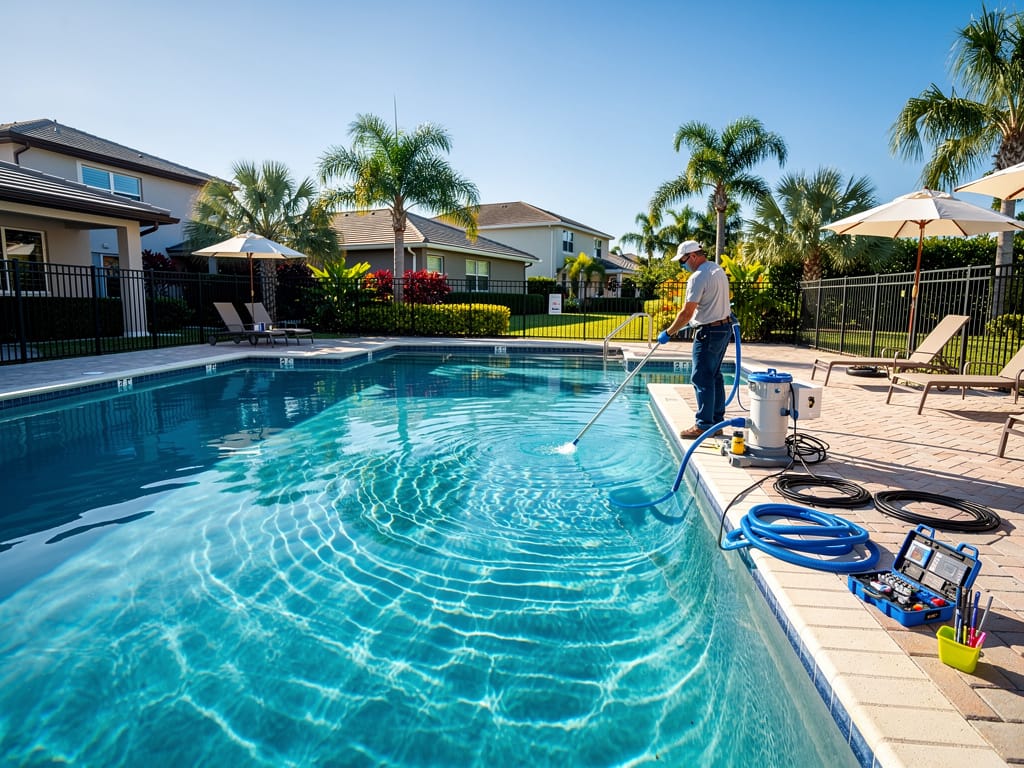
Margate’s established communities — including Oriole Gardens, Wynmoor (Coconut Creek-adjacent), and other 1970s-80s-era HOA subdivisions — have governing documents that regulate many aspects of private property appearance and maintenance, including backyard pools. For private pool owners in these communities, understanding the HOA layer on top of state and county code is essential to avoid fines and forced compliance.
At Pool Service Fort Lauderdale, we work with Margate homeowners in HOA communities who need their pools maintained to community standards. This guide covers the common HOA requirements affecting private pools in Margate.
Florida State Code Baseline — The Floor, Not the Ceiling
Florida Building Code Section 454 and Broward County Ordinance establish the minimum requirements for residential pool barriers:
- Pool barrier required: All residential pools must be surrounded by a barrier (fence, wall, or enclosure) at least 4 feet high with a self-closing, self-latching gate that opens outward and has its latch above 54 inches from the ground.
- Screen enclosure alternative: A screen enclosure meeting code specifications can serve as the pool barrier.
- Alarms: Door alarms for any home doors that provide direct access to the pool area are required as a barrier supplement in some configurations.
These are state minimums. Margate HOAs frequently add to these requirements.
Common HOA Pool Requirements in Margate Communities
While specific rules vary by community, the most frequently encountered HOA pool requirements in Margate’s established subdivisions include:
- Screen enclosure requirement: Many Margate HOAs require a screened enclosure (not just a fence) for any private pool. This goes beyond state code, which allows fence-only barriers. Homeowners who added a pool without a screen enclosure may be required to add one under HOA enforcement.
- Fence material and appearance: HOAs frequently specify acceptable fence materials (aluminum, vinyl — not chain link visible from any common area), maximum fence height on certain lot lines, and color requirements. Galvanized chain-link is almost universally prohibited in Margate’s established HOA communities.
- ARC approval for additions: Adding a pool, expanding an existing pool, adding a pool cage, adding an outdoor kitchen near the pool, or changing pool equipment visible from shared areas typically requires ARC (Architectural Review Committee) approval before starting. The ARC has defined timelines for approval and homeowners risk fines if they proceed without approval.
- Pool equipment visual screening: HOA rules may require that pool pump, filter, and heater equipment be screened from view from streets or common areas. A lattice screen or planted hedge buffer may be required if the equipment pad is visible.
- Chemical maintenance documentation: Some Margate HOAs reserve the right to require homeowners to produce evidence of professional pool service (service logs, water test records) in response to a neighbor complaint about a neglected or green pool.
When HOA Rules and State Code Conflict
In general, HOA rules can be stricter than state code but cannot require something that violates state law. A Margate HOA cannot, for example, require a pool fence height below the state minimum 4 feet. But an HOA can require a 6-foot fence where state code requires only 4 feet. The HOA’s stricter standard governs for homeowners in that community.
HOA Violation Response
If a Margate HOA homeowner receives a violation notice related to their pool:
- Review the specific rule cited in the violation notice against the actual HOA governing documents (CC&Rs, Rules and Regulations)
- Confirm the violation is accurate — HOA boards make citation errors
- Respond within the stated deadline — typically 10-30 days
- Request a hearing if you dispute the violation or need an extension — Florida law (FS 720) gives homeowners the right to a hearing before fines are imposed
- Comply as required or negotiate a compliance timeline — HOA fines in Florida can accumulate and become liens
Pool Service Fort Lauderdale provides Margate HOA homeowners with professional service records and water chemistry documentation that satisfies most community maintenance requirements. Call (954) 501-2754 or visit our Margate pool service page. Full coverage at poolservicefortlauderdale.us.
Frequently Asked Questions
{“@context”:”https://schema.org”,”@type”:”FAQPage”,”mainEntity”:[{“@type”:”Question”,”name”:”Do I need HOA approval to add a pool in my Margate HOA community?”,”acceptedAnswer”:{“@type”:”Answer”,”text”:”Almost certainly yes. Adding a pool to a property in a Margate HOA community almost universally requires Architectural Review Committee (ARC) approval before construction begins. Proceeding without ARC approval can result in mandatory removal, fines, and litigation costs. Submit an ARC application with plans and proposed equipment before contracting with a pool builder.”}},{“@type”:”Question”,”name”:”My Margate HOA says I need a screen enclosure — is that legally required?”,”acceptedAnswer”:{“@type”:”Answer”,”text”:”Florida state code allows a fence barrier as an alternative to a screen enclosure. However, your HOA’s CC&Rs can require a screen enclosure as an additional community standard beyond state minimums. If your HOA’s governing documents specify a screen enclosure requirement, you are bound by that rule as a condition of HOA membership — even if state code doesn’t independently require it.”}},{“@type”:”Question”,”name”:”Can my Margate HOA fine me for not maintaining my pool chemistry?”,”acceptedAnswer”:{“@type”:”Answer”,”text”:”Yes, if your HOA documents include pool maintenance standards. Most HOA communities can cite homeowners for visible pool neglect (green or cloudy water, visible debris, strong chemical odor) as a property maintenance violation. Some HOAs can request water chemistry records. HOA fines in Florida can accumulate daily and become property liens.”}},{“@type”:”Question”,”name”:”Can I use chain-link fencing around my pool in a Margate HOA community?”,”acceptedAnswer”:{“@type”:”Answer”,”text”:”Likely not. Most Margate HOA communities prohibit chain-link fencing that is visible from streets or common areas. HOA governing documents typically specify acceptable fence materials — usually aluminum or vinyl. Check your specific CC&Rs for the exact fence specification. Galvanized chain-link that is visible from any shared space is the most commonly prohibited fence type in Margate’s established HOA communities.”}},{“@type”:”Question”,”name”:”What rights do I have if my Margate HOA issues a pool violation notice?”,”acceptedAnswer”:{“@type”:”Answer”,”text”:”Florida Statute 720 gives HOA homeowners the right to a hearing before fines are imposed. You can dispute the violation by requesting a hearing within the notice deadline, review the actual governing document provision cited, and negotiate a compliance timeline with the board. HOA boards do make citation errors — always verify the specific rule cited against the actual documents before complying.”}}]}
Need HOA approval to add a pool? Almost certainly yes — ARC approval is required before construction in virtually all Margate HOA communities.
HOA requiring a screen enclosure — is that legal? Yes — HOAs can require stricter standards than state code. If your CC&Rs require it, you’re bound by it.
Can HOA fine you for pool chemistry? Yes — neglected or visibly green pools are a common HOA violation. Fines accumulate daily and become property liens.
Chain-link fencing allowed? Rarely. Most Margate HOAs require aluminum or vinyl fencing. Check your CC&Rs for the exact specification.
Rights against a violation notice? Florida FS 720 gives you the right to a hearing before fines are imposed. Always verify the rule cited against the actual governing documents.