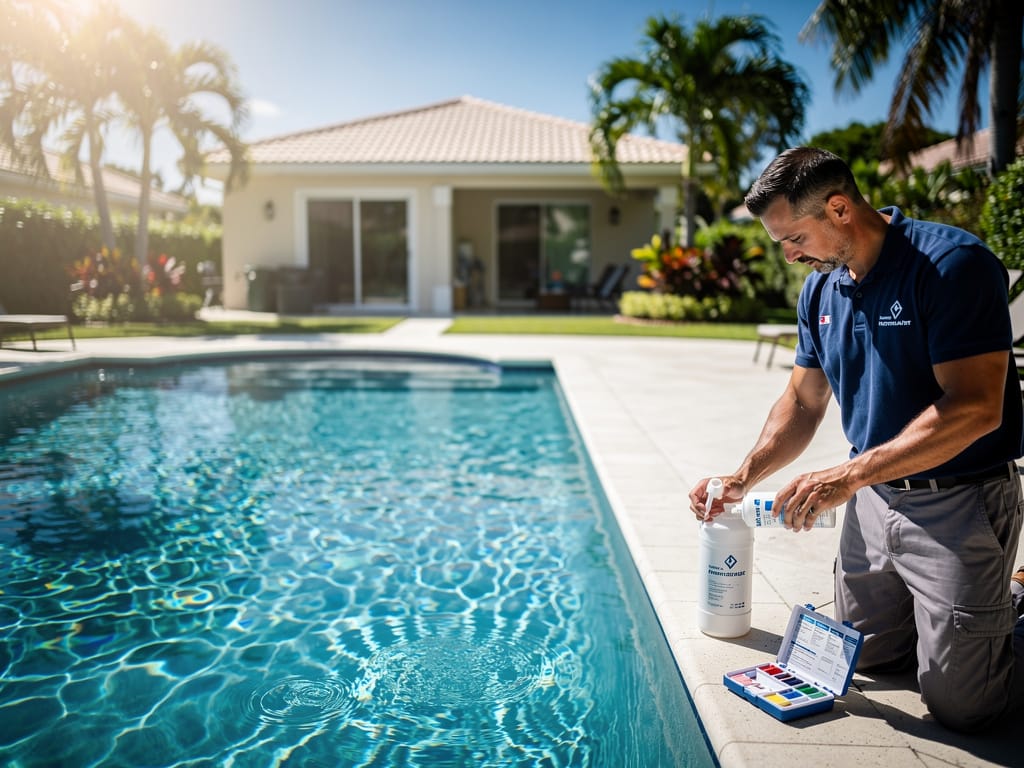
Tamarac’s residential neighborhoods were planted in the 1970s and the landscape has had five decades to mature. The ficus hedges that provide privacy along property lines, the live oak canopy in older sections, and the tropical plants that characterize South Florida landscaping all produce organic matter that finds its way into pool water — via wind, rain splash, and direct overhang.
At Pool Service Fort Lauderdale, we manage pools throughout Tamarac’s established neighborhoods and see the phosphate-algae connection regularly. This guide explains what’s happening chemically and what to do about it.
How Phosphate Gets Into Tamarac Pools
Phosphate enters pool water through multiple pathways in a mature-landscape environment:
- Direct leaf and plant debris: Leaves and plant matter that fall into or blow into the pool begin decomposing immediately. As organic matter breaks down, it releases inorganic phosphate into the water. This process continues as long as any decomposing material remains in the pool.
- Rain splash from surrounding soil: Rainwater that splashes from landscape beds adjacent to the pool carries dissolved phosphate from decomposing organic material in the soil into the pool water. This is a significant pathway in Tamarac during summer rainy season.
- Fertilizer runoff: Lawn and landscape fertilizers contain phosphate. Fertilizer applied to grass or landscape beds near the pool can enter via rain runoff and irrigation overspray. Tamarac homeowners who fertilize their own yards should use low-phosphate or phosphate-free formulations near the pool.
- Fill water: Broward County municipal water contains trace phosphate (typically 50-150 ppb). Auto-fill systems that continuously add fill water gradually add phosphate along with the makeup water. This is a slow accumulation but contributes to baseline levels.
Why Phosphate Causes Algae Even With Adequate Chlorine
Chlorine kills algae cells when it contacts them — but it’s a reactive sanitizer, not a preventive one. Algae requires nutrients to grow, and phosphate is the primary growth-limiting nutrient for pool algae. When phosphate is below 200-300 ppb, algae has difficulty establishing and maintaining a bloom. When phosphate exceeds 500 ppb, algae can grow faster than chlorine can kill it — leading to blooms even in pools with 2-3 ppm free chlorine.
This is why Tamarac pools can appear green even when the homeowner is certain they added chlorine recently. High phosphate removes the chemical barrier that prevents algae from establishing. Addressing the phosphate is the solution; adding more chlorine alone is not.
Testing for Phosphate in Tamarac Pools
Standard pool test strips (3-way or 5-way) do not test for phosphate. Phosphate testing requires:
- Bring a water sample to a pool store with a phosphate test (takes 5-10 minutes; most stores do this free)
- Service providers with proper test kits can test phosphate at the pool visit
- Digital phosphate test kits are available for home use ($40-$80)
For Tamarac pools with significant landscape exposure, test phosphate at least monthly during rainy season and every 6-8 weeks year-round. Results above 500 ppb warrant treatment; results above 1,000 ppb warrant immediate treatment before the next service visit.
Phosphate Removal Treatment — How It Works
Lanthanum-based phosphate removal products (Natural Chemistry PHOSfree, Orenda PR-10,000, BioGuard Optimizer Plus, and similar) bind dissolved phosphate and cause it to precipitate as an insoluble compound that the filter captures. Application steps:
- Pour the measured dose directly into the skimmer with the pump running
- Run the pump continuously for 24 hours
- Backwash or clean the filter after 24 hours to remove precipitated phosphate — critical step, or the bound phosphate re-dissolves back into the water
- Retest phosphate 48 hours after treatment to confirm reduction to target range (below 200 ppb)
For high phosphate levels (1,000+ ppb), a second treatment cycle may be needed. One treatment cycle handles approximately 500 ppb reduction in a standard 15,000-gallon Tamarac residential pool.
Pool Service Fort Lauderdale includes phosphate testing and treatment as part of service for Tamarac pools with landscape exposure. Call (954) 501-2754 or visit our Tamarac pool service page. Full coverage at poolservicefortlauderdale.us.
Frequently Asked Questions
{“@context”:”https://schema.org”,”@type”:”FAQPage”,”mainEntity”:[{“@type”:”Question”,”name”:”Why does my Tamarac pool keep turning green even when I add chlorine?”,”acceptedAnswer”:{“@type”:”Answer”,”text”:”High phosphate is the most likely cause. When phosphate exceeds 500 ppb, algae grows faster than chlorine can kill it — leading to green water even with seemingly adequate chlorine. Test your pool’s phosphate level (standard test strips don’t test phosphate — bring a water sample to a pool store or have your service provider test it). If phosphate is elevated, a lanthanum-based phosphate removal treatment addresses the root cause, not just the symptom.”}},{“@type”:”Question”,”name”:”How do I reduce phosphate levels in my Tamarac pool?”,”acceptedAnswer”:{“@type”:”Answer”,”text”:”Apply a lanthanum-based phosphate remover (Natural Chemistry PHOSfree, Orenda PR-10,000, or similar) according to product dosing instructions, run the pump 24 hours continuously, then clean or backwash the filter — the filter captures the bound phosphate and must be cleaned or the phosphate re-dissolves. Retest 48 hours after treatment. For phosphate above 1,000 ppb, a second treatment cycle may be needed.”}},{“@type”:”Question”,”name”:”How often should I test phosphate in my Tamarac pool?”,”acceptedAnswer”:{“@type”:”Answer”,”text”:”Monthly during rainy season (June-October) for Tamarac pools with significant landscape exposure (ficus hedges, oak trees, planting beds near the pool). Every 6-8 weeks year-round as a baseline. Test immediately if algae starts appearing despite adequate chlorine — this symptom pattern strongly suggests elevated phosphate.”}},{“@type”:”Question”,”name”:”Does the type of plants near my Tamarac pool affect phosphate levels?”,”acceptedAnswer”:{“@type”:”Answer”,”text”:”Yes. High-debris plants — ficus, live oak, Brazilian pepper, gumbo limbo, palms with frequent frond drop — produce more organic matter that releases phosphate as it decomposes. Dense hedges adjacent to the pool also shelter the pool surface from wind, which slows debris removal by the skimmer and allows more decomposition in the pool. Phosphate problems are typically more severe for Tamarac pools surrounded by mature high-debris landscaping.”}},{“@type”:”Question”,”name”:”Will phosphate removal products hurt my Tamarac pool equipment or chemistry?”,”acceptedAnswer”:{“@type”:”Answer”,”text”:”No, when used as directed. Lanthanum-based phosphate removers don’t affect chlorine, pH, alkalinity, calcium hardness, or CYA. The only downstream effect is on the filter — the precipitated phosphate loads the filter and requires a clean or backwash within 24-48 hours of treatment. Skipping the post-treatment filter clean allows the bound phosphate to re-dissolve, largely negating the treatment.”}}]}
Why does Tamarac pool keep turning green with chlorine added? High phosphate — algae outgrows chlorine’s kill rate above 500 ppb. Test phosphate (strips don’t test it), then treat with lanthanum-based phosphate remover.
How to remove phosphate? Lanthanum product in skimmer, 24-hour pump run, then filter clean/backwash. Retest 48 hours later. Second treatment if above 1,000 ppb initial.
How often to test? Monthly during rainy season, every 6-8 weeks year-round for landscape-exposed Tamarac pools.
Do nearby plants matter? Yes — ficus, oak, palm frond drop all increase phosphate loading. Dense hedges that shelter the pool allow more decomposition in the water.
Will treatment hurt equipment? No — no effect on chlorine/pH/alkalinity/CYA. Only effect is loading the filter, which requires cleaning within 24-48 hours post-treatment.