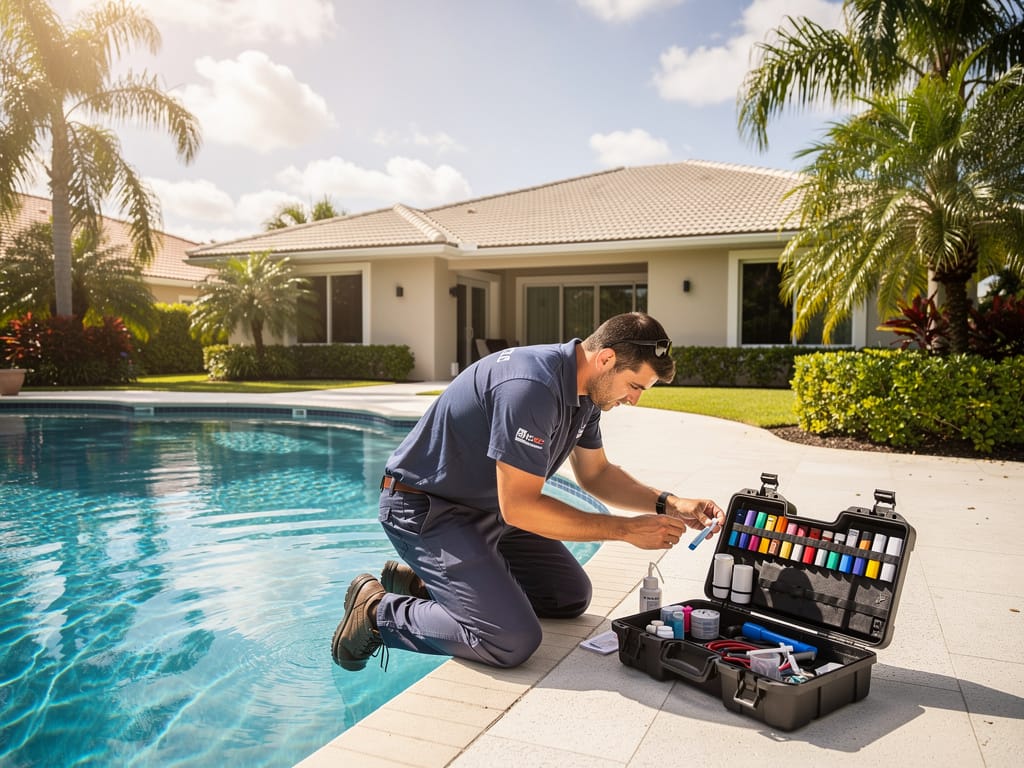
Calcium scale is one of the most consistent long-term maintenance challenges for Tamarac pool owners. Broward County’s water — like most South Florida municipal water — comes from the Biscayne Aquifer with naturally elevated calcium content. Every gallon of makeup water added to a Tamarac pool introduces calcium. Every gallon that evaporates leaves that calcium behind. Over years of evaporation and makeup cycles, calcium concentration increases steadily — and when calcium saturation exceeds what the water chemistry can hold in solution, scale precipitates on every surface it touches.
At Pool Service Fort Lauderdale, we monitor calcium hardness as part of regular service for Tamarac pools and manage scale proactively. This guide explains why scale forms and what to do at each stage.
The Langelier Saturation Index — How Scale Tendency Is Calculated
Pool professionals use the Langelier Saturation Index (LSI) to quantify a pool water’s tendency to either scale or corrode. The LSI incorporates pH, calcium hardness, alkalinity, TDS, and water temperature. A positive LSI means the water is scale-prone (will deposit calcium carbonate). A negative LSI means the water is corrosive (will dissolve calcium carbonate from surfaces, etching plaster and corroding metal).
For Tamarac pools with high-calcium fill water, maintaining a slightly negative to neutral LSI (−0.3 to +0.3) prevents active scaling while avoiding corrosive conditions. This is achieved primarily through pH management (keep pH at 7.4-7.6) and periodic partial drain-and-refill when calcium hardness gets too high.
Monitoring Calcium Hardness in Tamarac Pools
Test calcium hardness monthly as part of routine water chemistry monitoring. Target range: 200-400 ppm for plaster pools, 175-225 ppm for vinyl or fiberglass. When calcium hardness approaches 500 ppm:
- Scale inhibitor (sequestrant) application becomes more important — keep calcium in solution
- Plan a partial drain and dilution: drain 20-25% of pool water and refill with fresh tap water (which at 200-300 ppm calcium is still lower than a pool that has concentrated to 500+ ppm through evaporation)
When calcium hardness exceeds 600 ppm, scale formation is aggressive regardless of pH management. Partial drain and dilution is the only effective remedy at this stage — scale inhibitors can slow deposition but cannot prevent it when calcium is this far above target.
Scale Inhibitor (Sequestrant) Treatment
Sequestrant products (Natural Chemistry Scale Free, Orenda SC-1000, Jack’s Magic Stuff, and similar) contain polyacrylate or phosphonate compounds that bind dissolved calcium and hold it in solution rather than allowing it to precipitate on surfaces. Monthly sequestrant treatment for Tamarac pools with fill water at 200-300 ppm calcium:
- Cost: $10-$25/month for a standard 15,000-gallon pool
- Application: pour into skimmer with pump running, circulate 2+ hours
- Effect: keeps calcium in solution, reduces scale buildup rate on tile and surfaces
Sequestrant is a management tool, not a cure. It reduces scale formation rate but doesn’t eliminate it when calcium hardness is significantly elevated. Use it in combination with pH management and periodic dilution.
Removing Existing Scale in Tamarac Pools
Scale that has already formed requires physical or chemical removal:
- Waterline tile scale: Pumice stone rubbing with water for light scale (homeowner-accessible). Professional tile cleaning with calcium-specific acid cleaner for heavier scale deposits. Cost: $150-$400 for professional tile cleaning on a standard Tamarac pool.
- Plaster surface scale: Mild scale may respond to a brief controlled acid treatment. Heavy scale requires professional acid washing (drain, acid application, scrub, rinse) at $400-$800.
- Heater heat exchanger scale: Internal scale buildup is the most common cause of reduced heater efficiency in Tamarac pools. Professional heater descaling with citric acid solution: $200-$400. Heaters that have been allowed to scale heavily over years may require heat exchanger replacement rather than descaling.
Pool Service Fort Lauderdale includes calcium hardness monitoring and scale inhibitor application in regular service for Tamarac pools. Call (954) 501-2754 or visit our Tamarac pool service page. Full coverage at poolservicefortlauderdale.us.
Frequently Asked Questions
{“@context”:”https://schema.org”,”@type”:”FAQPage”,”mainEntity”:[{“@type”:”Question”,”name”:”Why does my Tamarac pool get white scale deposits on the tile and surfaces?”,”acceptedAnswer”:{“@type”:”Answer”,”text”:”Broward County fill water has naturally high calcium (200-300 ppm). As pool water evaporates, the calcium stays behind and concentrates. When calcium hardness exceeds about 400-500 ppm or when pH rises above 7.6, calcium carbonate precipitates as white scale on surfaces, tile, and equipment internals. Monthly sequestrant treatment and maintaining pH at 7.4-7.6 are the primary prevention strategies.”}},{“@type”:”Question”,”name”:”How do I remove calcium scale from my Tamarac pool tile?”,”acceptedAnswer”:{“@type”:”Answer”,”text”:”Light scale: pumice stone rubbing with water — homeowner accessible, takes time and elbow grease. Moderate scale: professional tile cleaning with calcium-specific acid cleaner, $150-$400 for a standard Tamarac pool. Heavy scale: same professional method but may require multiple treatments. Never use household acid cleaners (muriatic acid from hardware stores diluted for tile) without understanding pool chemistry implications — improper application can damage grout and affect pool chemistry.”}},{“@type”:”Question”,”name”:”How often should I test calcium hardness in my Tamarac pool?”,”acceptedAnswer”:{“@type”:”Answer”,”text”:”Monthly minimum. Calcium hardness changes slowly but accumulates steadily from Broward County’s hard fill water. Testing monthly catches the trend before calcium reaches problem levels (above 400-500 ppm). If your auto-fill runs frequently (high evaporation from heavy use or hot weather), calcium accumulates faster and warrants more frequent monitoring.”}},{“@type”:”Question”,”name”:”What is a scale inhibitor and does it work for Tamarac pools?”,”acceptedAnswer”:{“@type”:”Answer”,”text”:”Scale inhibitor (sequestrant) products contain compounds that bind dissolved calcium and hold it in solution rather than allowing it to deposit on surfaces. Monthly application ($10-$25/month) significantly reduces scale deposition rate in Tamarac pools with hard fill water. It reduces scale formation but doesn’t eliminate it when calcium hardness is very high — combine with pH management and periodic partial drain-and-dilution for best results.”}},{“@type”:”Question”,”name”:”When should I drain and dilute my Tamarac pool to reduce calcium hardness?”,”acceptedAnswer”:{“@type”:”Answer”,”text”:”When calcium hardness exceeds 500 ppm, plan a partial drain (20-25% of pool volume) and refill with fresh tap water. Fresh Broward County tap water at 200-300 ppm calcium is still diluting relative to a pool concentrated to 500+ ppm. Full drain-and-refill is rarely needed — partial dilutions repeated over time keep calcium in range. In Tamarac, this is typically needed once every 2-4 years depending on evaporation rate and fill water frequency.”}}]}
Why does Tamarac pool get white scale? Broward County fill water is high-calcium (200-300 ppm). Evaporation concentrates it until calcium carbonate precipitates as white scale at high pH or very high calcium levels.
How to remove tile scale? Light: pumice stone. Moderate/heavy: professional tile cleaning with calcium acid cleaner, $150-$400.
How often to test calcium hardness? Monthly minimum. Accumulates steadily from hard fill water — catch it before it reaches problem levels (above 400-500 ppm).
Does scale inhibitor work? Yes — reduces deposition rate significantly at $10-$25/month. Combine with pH management and periodic partial dilution. Not a standalone solution above 600 ppm calcium.
When to drain and dilute? When calcium hardness exceeds 500 ppm — partial drain (20-25% of volume) and refill dilutes. Typically needed every 2-4 years in Tamarac.