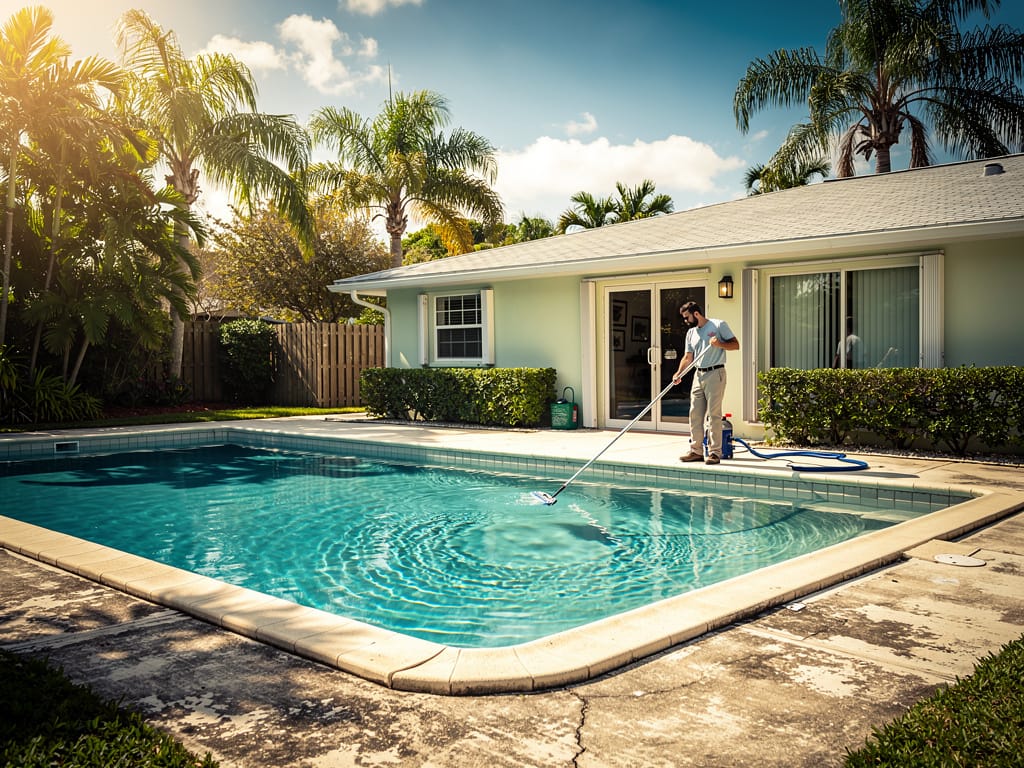
Tamarac’s 50-year-old pools have had five decades for staining to develop from multiple sources. The plumbing that carries fill water, the heating system, the surrounding trees, and the pool chemistry management over decades all contribute to the stain history. Understanding what type of stain is present determines which treatment will actually work.
At Pool Service Fort Lauderdale, we diagnose and treat pool staining throughout Tamarac and have extensive experience with the specific staining patterns common in the area’s older pool stock. This guide covers identification and treatment for each stain type.
Stain Type 1: Iron Staining
Appearance: Rust-brown, orange-brown, or reddish discoloration on pool floors, walls, and steps. Often more concentrated near return jets (where fresh fill water enters) or in low-flow areas of the pool floor. In Tamarac wells (if any) or municipal supply lines with aging iron content, staining appears as generalized brownish cast to pool surfaces that worsens over time without treatment.
Identification test: Place a vitamin C tablet (ascorbic acid) directly on the stain and hold it there for 30 seconds. If the stain lightens noticeably, it’s a metal stain (typically iron or copper). If it doesn’t respond, it’s likely organic (tannin or algae).
Treatment:
- Light iron staining: Ascorbic acid (vitamin C) treatment — pour 1 lb of ascorbic acid powder into the pool while the pump is running. Circulate for 24 hours. Iron stains should lighten or disappear. Then apply a sequestrant (Jack’s Magic Blue Stuff, Orenda SC-1000) to prevent re-deposition.
- Heavy iron staining: Professional acid treatment or EDTA-based chelating treatment may be required. Consult a pool professional for severe iron staining rather than attempting multiple rounds of DIY ascorbic acid, which can drive down pH significantly with large doses.
Prevention: Monthly sequestrant (metal chelator) treatment keeps dissolved iron in solution and prevents deposition on surfaces. If your fill water source is high in iron, filter the fill water with an inline iron filter on the fill line.
Stain Type 2: Copper Staining
Appearance: Blue-green, teal, or turquoise staining on pool surfaces, particularly steps and shallow end walls. Sometimes a green tinge to the water itself. In Tamarac’s older pools, copper staining often traces to: corrosion of older copper heat exchanger components in gas heaters or older heat pumps (non-titanium exchangers), use of copper-based algaecide products (CuLator, copper-silver ionizers), or acidic pool water (low pH) that dissolves copper fittings and pipes.
Identification test: Vitamin C tablet test (same as iron) — copper staining responds to ascorbic acid and lightens quickly. Copper staining is often more blue-green in color vs. the orange-brown of iron staining.
Treatment:
- Ascorbic acid treatment (same as iron) to remove existing staining
- Sequestrant application after ascorbic acid treatment to keep dissolved copper in solution and prevent re-deposition
- Identify and address the copper source: if a non-titanium heat exchanger is the source, upgrade to a titanium-cell unit that doesn’t corrode in pool water; if copper algaecide products are being used, discontinue them; if pH has been chronically low (allowing copper corrosion), stabilize chemistry
Stain Type 3: Tannin Staining (Organic)
Appearance: Brownish-yellow or tea-colored water tint, or brownish staining on surfaces — typically in areas where leaves or plant matter settled for extended periods. Unlike metal staining, tannin staining often affects the water color (making the water look brown or amber) as well as surfaces. Common in Tamarac pools under ficus hedges and oak trees.
Identification test: Vitamin C tablet test will NOT affect tannin staining. If the stain doesn’t lighten with vitamin C, it’s organic. Confirm by shocking the pool — heavy chlorine shocking (superchlorination to 10 ppm) fades tannin staining in many cases.
Treatment:
- Superchlorinate to 10 ppm free chlorine and run the pump continuously for 24-48 hours — oxidizes many organic tannin compounds
- Pool enzyme treatment (Natural Chemistry Pool Perfect, Orenda CV-600) — enzymes break down tannin and organic compounds that chlorine alone can’t fully oxidize
- Clarifier to coagulate tannin particles for filter capture
- For persistent surface staining: professional tannin stain treatment with oxalic acid compounds
Pool Service Fort Lauderdale diagnoses and treats pool staining throughout Tamarac. Call (954) 501-2754 or visit our Tamarac pool service page. Full coverage at poolservicefortlauderdale.us.
Frequently Asked Questions
{“@context”:”https://schema.org”,”@type”:”FAQPage”,”mainEntity”:[{“@type”:”Question”,”name”:”How do I tell if my Tamarac pool stain is from iron, copper, or organic matter?”,”acceptedAnswer”:{“@type”:”Answer”,”text”:”Apply a vitamin C tablet (ascorbic acid) directly to the stain for 30 seconds. If the stain lightens, it’s a metal stain (iron or copper). Iron staining is typically rust-brown/orange; copper staining is typically blue-green/teal. If the stain doesn’t respond to vitamin C, it’s likely organic (tannin from tree debris). Tannin staining often tints the water brownish-yellow as well as staining surfaces.”}},{“@type”:”Question”,”name”:”How do I treat iron staining in my Tamarac pool?”,”acceptedAnswer”:{“@type”:”Answer”,”text”:”Add 1 lb of ascorbic acid powder to the pool with the pump running and circulate for 24 hours. Iron stains should lighten significantly. After treatment, apply a sequestrant (metal chelator) to prevent re-deposition of dissolved iron. For heavy iron staining or recurrent staining despite sequestrant use, add an inline iron filter on the fill water line to prevent continuous new iron introduction with makeup water.”}},{“@type”:”Question”,”name”:”My Tamarac pool has blue-green staining on the steps — what causes this?”,”acceptedAnswer”:{“@type”:”Answer”,”text”:”Blue-green or teal staining is typically copper. Common sources in Tamarac’s older pools: corrosion of non-titanium heat exchanger components in heaters or old heat pumps, copper-based algaecide products (copper-silver ionizers, CuLator), or chronically low pH that dissolves copper fittings and plumbing. Treat with ascorbic acid plus sequestrant, then identify and address the copper source to prevent recurrence.”}},{“@type”:”Question”,”name”:”Can I use bleach or chlorine to remove stains in my Tamarac pool?”,”acceptedAnswer”:{“@type”:”Answer”,”text”:”Chlorine shock helps with tannin (organic) staining — superchlorinating to 10 ppm free chlorine oxidizes organic tannin compounds and can fade brown water tint and surface staining. However, adding chlorine to iron or copper staining makes it worse — chlorine oxidizes dissolved metals and causes them to precipitate more aggressively. Always identify the stain type before treating.”}},{“@type”:”Question”,”name”:”How can I prevent future staining in my Tamarac pool?”,”acceptedAnswer”:{“@type”:”Answer”,”text”:”Monthly sequestrant application keeps metals (iron, copper) in solution and prevents deposition. Monthly enzyme treatment reduces organic tannin load from tree debris. Maintaining pH at 7.4-7.6 prevents corrosive conditions that accelerate copper dissolution from fittings. Removing leaf debris promptly before it decomposes on pool surfaces prevents tannin surface contact staining. Upgrade to a titanium heat exchanger if copper corrosion from a heater is confirmed as a stain source.”}}]}
How to identify stain type? Vitamin C tablet test: lightens in 30 seconds = metal stain (iron = orange-brown, copper = blue-green). No response = organic/tannin. Tannin often colors the water brownish-yellow too.
Iron stain treatment? 1 lb ascorbic acid in pool, 24-hour circulation, then sequestrant to prevent re-deposition. Inline fill water filter if iron keeps recurring.
Blue-green staining on steps? Copper — from non-titanium heat exchanger corrosion, copper algaecide use, or low-pH corrosion of copper plumbing. Ascorbic acid + sequestrant, then find and fix the source.
Will chlorine/bleach remove stains? Yes for tannin/organic — shock to 10 ppm. Makes metal stains (iron/copper) worse — oxidizes dissolved metals and worsens deposition. Always identify first.
Prevention? Monthly sequestrant for metals, monthly enzyme for organics, pH at 7.4-7.6, prompt leaf removal, titanium heat exchanger if copper corrosion is confirmed.