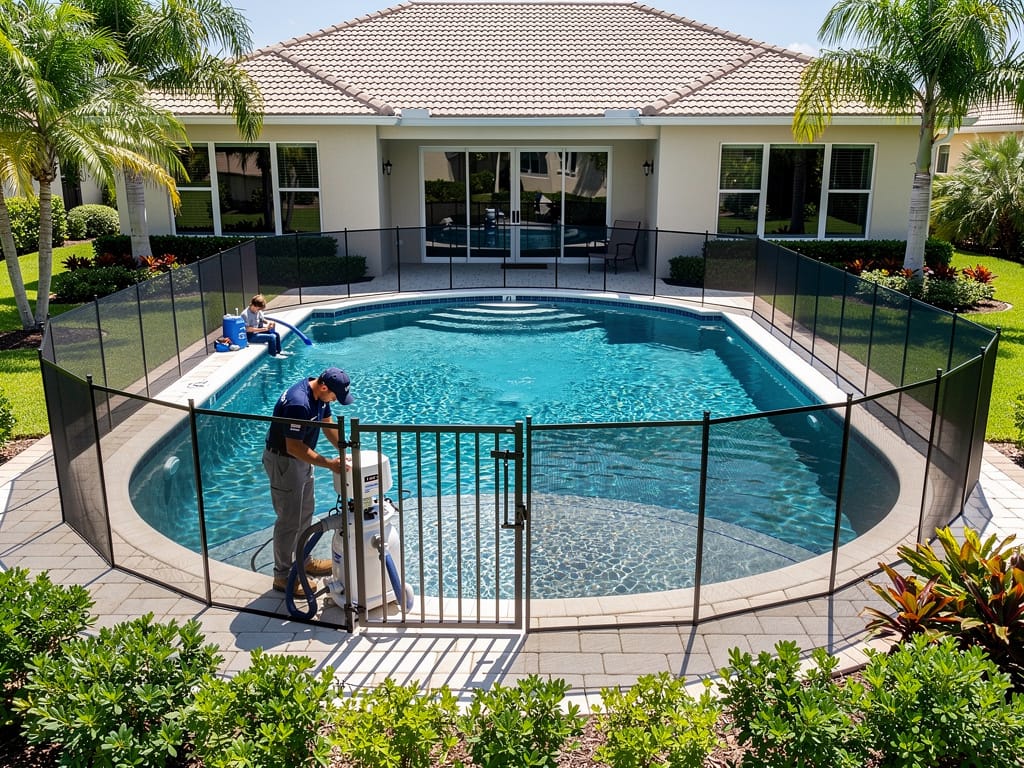
Coconut Creek’s younger family demographic — professionals with young children in the city’s well-regarded school zones — creates a specific and serious pool safety responsibility. A backyard pool is one of the greatest joys of South Florida family life and one of the most serious hazards for young children. The families who navigate this combination most successfully are the ones who build multiple safety layers into their pool setup rather than relying on any single protective measure.
At Pool Service Fort Lauderdale, we serve Coconut Creek families and consider it part of our responsibility to raise pool safety practices as part of every new service relationship. This guide covers the five-layer framework that pool safety experts recommend for households with children under 5.
Why a Single Safety Layer Isn’t Enough
The pool fence gets most of the attention in discussions of child pool safety — and it is the most important single layer. But every safety mechanism has failure modes:
- Pool fence gates are left open by adults or defeated by older children who haven’t been taught to keep them closed
- Pool alarms can be turned off or disabled when entertaining, left in maintenance mode
- Door alarms with chime-only function can be ignored by adults distracted in a house full of guests
- Swimming lessons reduce but don’t eliminate drowning risk — even competent young swimmers can become fatigued, panic, or have a health event in the water
- Supervision lapses — the majority of child drownings occur with a parent nearby, typically during a momentary distraction
Each layer compensates for the failure modes of the others. A child who defeats the pool fence may trigger the water entry alarm; a gate that was left open is caught by a door alarm when the child accesses the pool from the house. The layers work together.
Layer 1: Four-Sided Pool Fence
Florida law requires a pool barrier for all residential pools. The Florida Building Code and Broward County require:
- Minimum 4-foot barrier height
- Self-closing gate that opens outward from the pool
- Self-latching mechanism located above 54 inches from finished grade (out of a small child’s reach)
- No horizontal rails that could serve as foot holds for climbing
- Maximum gap spacing that prevents a 4-inch sphere from passing through
The critical distinction: a four-sided fence that completely isolates the pool from the house is more protective than a three-sided fence that uses the house wall as one barrier. A three-sided fence requires the door from the house to the pool area to function as part of the barrier — meaning any door left unlocked or unalarmed creates a direct access path. Four-sided fencing with the gate as the only pool access point is the safer configuration.
Pool fence installation in Coconut Creek: $2,000-$5,000 for aluminum or mesh four-sided fencing around a standard residential pool.
Layer 2: Pool Alarm
Pool alarms detect when a child (or anyone) enters the water. Types:
- Subsurface disturbance alarms (Poolguard PGRM-2, Safety Turtle Immersion Alarm): Detect the wave disturbance created by a body entering the water. Mounted at the pool wall; sounds a loud alarm inside the home and at the pool. Must be deactivated during pool use and reactivated afterward — the most common failure mode is not reactivating after swimming.
- Wearable wrist alarms (Safety Turtle, SwimAlert): Wristband worn by the child that triggers an alarm if the wristband is submerged. Alarm sounds at a parent-carried base unit. Advantage: alarms even if the child enters a neighbor’s pool, a pond, or any water source while wearing the band. Must be worn consistently.
Layer 3: Door Alarm on All Home-to-Pool Access Doors
Every door in the home that provides access to the pool area should have an audible alarm that sounds when the door is opened. Standard door/window alarm sensors (available at hardware stores for $10-$20 each) mounted on the door frame provide this function. For Coconut Creek homes where children might silently exit through a sliding glass door to the lanai, alarms on all potential access doors are essential. Set alarms to chime immediately on door opening — a delayed alarm gives a young child time to reach the pool before the sound alerts an adult.
Layer 4: Swimming Lessons
The American Academy of Pediatrics now recommends swimming lessons for most children as young as 12-18 months (previously the recommendation was age 4). Survival swim lessons — focused on floating and self-rescue rather than stroke technique — reduce drowning risk in young children who enter the water unexpectedly. The Broward County area has multiple infant and toddler swimming instruction programs. This layer reduces risk for the accidental water entry scenarios that the other layers are designed to prevent but may not completely stop.
Layer 5: Active Adult Supervision
Even with all four physical layers in place, active supervision is essential. The designated water watcher concept: one adult, phone put away, whose only responsibility is watching the children in and around the water. Rotating the water watcher role explicitly — “You’re the water watcher for the next 30 minutes” — prevents the assumption that someone else is watching. Most child drownings occur when multiple adults are present and each assumes another is supervising.
Pool Service Fort Lauderdale serves Coconut Creek families who want their pool to be an enjoyment, not a hazard. Call (954) 501-2754 or visit our Coconut Creek pool service page. Full coverage at poolservicefortlauderdale.us.
Frequently Asked Questions
{“@context”:”https://schema.org”,”@type”:”FAQPage”,”mainEntity”:[{“@type”:”Question”,”name”:”What pool safety measures are required by Florida law for Coconut Creek homeowners?”,”acceptedAnswer”:{“@type”:”Answer”,”text”:”Florida law (Florida Building Code Section 454) requires a pool barrier at least 4 feet high with a self-closing gate that opens outward and a self-latching mechanism above 54 inches from grade. As an alternative to a fence, a screen enclosure meeting code specifications can serve as the barrier. Some barrier configurations also require door alarms on home doors providing pool access. Broward County enforces these requirements through building permits and inspections.”}},{“@type”:”Question”,”name”:”Is a pool fence required if I have a screen enclosure in Coconut Creek?”,”acceptedAnswer”:{“@type”:”Answer”,”text”:”A screen enclosure that meets Florida Building Code specifications (appropriate height, self-closing screened door with self-latching mechanism) can serve as the pool barrier in place of a separate fence. However, a screen enclosure used as the barrier must have all panels intact and all doors properly self-closing and self-latching. A torn screen panel or propped-open screened door compromises the barrier function — these must be repaired promptly.”}},{“@type”:”Question”,”name”:”At what age should Coconut Creek children start swimming lessons?”,”acceptedAnswer”:{“@type”:”Answer”,”text”:”The American Academy of Pediatrics recommends swimming lessons for most children starting at 12-18 months. Survival swim (ISR – Infant Swimming Resource) programs starting as early as 6 months focus on self-rescue skills (floating face-up) rather than stroke technique. For families with backyard pools in Coconut Creek, early survival swim instruction significantly reduces drowning risk in the accident scenarios that physical barriers may not completely prevent.”}},{“@type”:”Question”,”name”:”What is a water watcher and how does it work?”,”acceptedAnswer”:{“@type”:”Answer”,”text”:”A water watcher is a designated adult whose only responsibility during pool time is watching the children in and near the water — no phone, no conversation, undivided attention on the pool. The role is rotated explicitly among adults: ‘You’re the water watcher for the next 30 minutes.’ This prevents the dangerous assumption that ‘someone else is watching’ when multiple adults are present — a factor in the majority of child drowning incidents that occur with adults present nearby.”}},{“@type”:”Question”,”name”:”How much does a pool safety fence cost in Coconut Creek?”,”acceptedAnswer”:{“@type”:”Answer”,”text”:”Four-sided aluminum or removable mesh pool fence installation in Coconut Creek: $2,000-$5,000 depending on the perimeter length and fence type. Removable mesh fencing (designed to be taken down when not needed and reinstalled quickly) is popular among Coconut Creek families who want safety protection during young-child years with the option to remove it later. Permanent aluminum fencing is the more typical choice for long-term installation.”}}]}
Florida law requirements? 4-foot barrier, self-closing outward-swinging gate, self-latching above 54 inches. Screen enclosure can substitute if fully intact with compliant self-latching screened doors.
Screen enclosure instead of fence? Yes — if code-compliant. Any torn screen panel or propped door compromises the barrier. Must stay fully intact.
When to start swimming lessons? AAP recommends 12-18 months. Survival swim programs start as early as 6 months. Early self-rescue skills are the target, not stroke technique.
What is a water watcher? Designated adult, phone away, watching only. Rotate explicitly every 30 minutes. Prevents the “someone else is watching” assumption that underlies most drownings with adults present.
Fence cost in Coconut Creek? $2,000-$5,000 for four-sided aluminum or removable mesh. Removable mesh popular for young-child years with option to remove later.