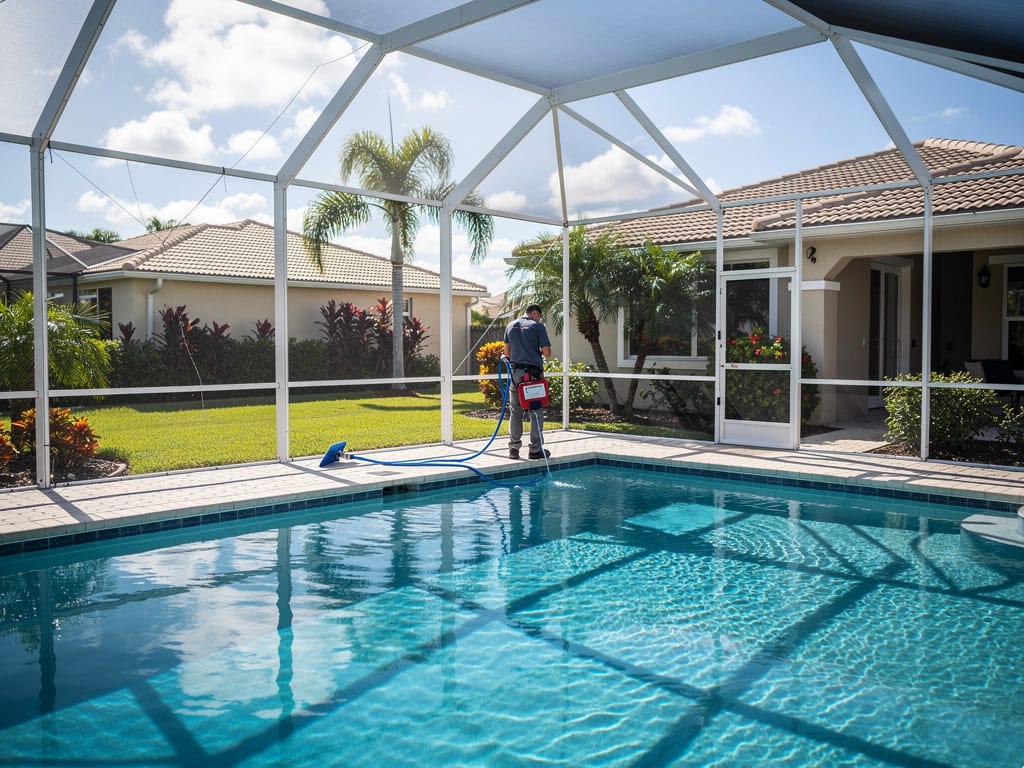
Cooper City’s standard for home maintenance runs high — the community’s aesthetic is a point of pride that HOA standards reinforce in Rock Creek, Embassy Lakes, and surrounding neighborhoods. Screen enclosures are nearly universal in Cooper City’s residential pool inventory, both for pool enjoyment and as required HOA compliance elements. What many homeowners miss is that the enclosure’s condition directly affects pool chemistry and maintenance cost.
At Pool Service Fort Lauderdale, we see the relationship between enclosure condition and pool chemistry regularly in Cooper City. This guide explains the connection and what proper enclosure maintenance looks like.
How a Screen Enclosure Affects Pool Water Chemistry
UV Reduction and Chlorine Stability
Direct overhead sunlight degrades free chlorine in pool water through photolysis — UV breaks the chemical bond in hypochlorous acid, releasing chlorine as gas. In direct South Florida sunlight, an unstabilized pool (low cyanuric acid) loses 90% of its free chlorine within 2 hours. A fiberglass or aluminum screen enclosure reduces incoming UV intensity by 40-70% depending on screen density, meaningfully extending chlorine stability. A Cooper City pool under a full-coverage screen enclosure needs less chlorine per week than a comparable open-air pool because less chlorine is destroyed by UV during the day.
Organic Debris and Chlorine Demand
Leaves, pollen, seed pods, bird droppings, and organic particulates landing in pool water consume free chlorine through oxidation. A screen enclosure blocks the majority of this organic input from surrounding Cooper City landscaping. A torn screen panel or open frame section that allows significant debris entry increases the pool’s organic chlorine demand — more chlorine is consumed by debris oxidation, leaving less available for sanitization.
Evaporation and Splash-Out
A screen enclosure reduces wind exposure at pool surface, slowing evaporation. An unenclosed Cooper City pool can lose 1.5-2 inches of water per week to evaporation during summer — the water itself leaves but its dissolved chemicals (calcium, cyanuric acid, alkalinity minerals) remain and concentrate. Slower evaporation under a screen enclosure means fewer chemistry concentration effects requiring dilution correction.
Screen Enclosure Maintenance Issues That Affect Pool Chemistry
Torn Panels
A torn screen panel eliminates that section’s UV reduction, debris filtration, and wind resistance. A single 12-inch tear in an overhead panel creates a direct debris and UV exposure zone in the pool. Torn screen repair: $50-$150 per panel for screen re-stretching, or $200-$500 for panel replacement depending on panel size and access difficulty.
Screen Algae Accumulation
Green or black algae growing on the exterior of screen panels is extremely common in Cooper City’s humid climate. During rain events, algae-covered panels shed contaminated water containing algae cells and their byproducts into the pool water below. This is a direct algae seeding event — and a source of recurring algae problems that homeowners may not connect to the enclosure. Pressure washing screen panels annually (or when visible algae accumulation develops) eliminates this contamination pathway.
Aluminum Frame Oxidation
Oxidizing aluminum frame surface residue (the white chalky deposit on older aluminum screen frame) also washes into pool water during rain events. While not as directly problematic as algae, aluminum oxide residue contributes to water cloudiness and can affect pH. Annual frame cleaning with an appropriate aluminum cleaner maintains the frame and reduces this input.
Enclosure Inspection Points for Cooper City Homeowners
- Walk the perimeter and inspect all screen panels for tears, holes, and loose screen edges — quarterly
- Inspect overhead panels for sagging (water pooling weight) after heavy rain events
- Check door self-closing and self-latching function monthly (safety requirement and HOA compliance)
- Inspect frame joints for corrosion, separation, or loose screws — annually
- Schedule pressure wash cleaning when visible green or black algae appears on screen surfaces — don’t wait for the annual schedule if algae is visible
Pool Service Fort Lauderdale serves Cooper City families with full pool and enclosure-adjacent service coordination. Call (954) 501-2754 or visit our Cooper City pool service page. Full coverage at poolservicefortlauderdale.us.
Frequently Asked Questions
{“@context”:”https://schema.org”,”@type”:”FAQPage”,”mainEntity”:[{“@type”:”Question”,”name”:”How does a torn screen panel affect my Cooper City pool chemistry?”,”acceptedAnswer”:{“@type”:”Answer”,”text”:”A torn screen panel eliminates UV reduction in that zone, allowing direct sunlight to destroy chlorine faster in the area below the tear. It also allows direct debris input (leaves, pollen, organic material) from surrounding landscaping, increasing the pool’s organic chlorine demand. Even a single 12-inch tear in an overhead panel creates a measurable difference in chlorine consumption in a Cooper City pool. Screen panel repair ($50-$150 per panel) is a worthwhile chemistry-management investment, not just an aesthetic one.”}},{“@type”:”Question”,”name”:”Can algae growing on my screen enclosure contaminate my Cooper City pool water?”,”acceptedAnswer”:{“@type”:”Answer”,”text”:”Yes. Algae on screen panel surfaces washes off during rain events, introducing algae cells and biofilm residue directly into the pool water below. This is a direct algae seeding pathway that can cause recurring algae problems in Cooper City pools even when chemistry appears well-managed. Pressure washing screen panels when algae is visible (typically once or twice a year in Cooper City’s climate) eliminates this contamination pathway.”}},{“@type”:”Question”,”name”:”How much does screen enclosure maintenance cost for a Cooper City pool?”,”acceptedAnswer”:{“@type”:”Answer”,”text”:”Ongoing maintenance costs: torn screen panel repair $50-$150 per panel; full panel replacement $200-$500 depending on size; annual pressure wash cleaning $150-$300; door hardware replacement (hinges, latches) $50-$150 per door. A well-maintained Cooper City screen enclosure with prompt repair of torn panels and annual cleaning should cost $200-$600/year to maintain in good condition.”}},{“@type”:”Question”,”name”:”Does a screen enclosure reduce how much chlorine I need in my Cooper City pool?”,”acceptedAnswer”:{“@type”:”Answer”,”text”:”Yes. A properly functioning screen enclosure reduces UV intensity on pool water by 40-70% compared to an open-air pool, directly extending chlorine life. It also blocks most organic debris input from landscaping, reducing the oxidation demand on chlorine. Cooper City pools under full-coverage screen enclosures consistently require less chlorine per week than equivalent open-air pools in comparable South Florida climates.”}},{“@type”:”Question”,”name”:”How often should I have my Cooper City pool screen enclosure pressure washed?”,”acceptedAnswer”:{“@type”:”Answer”,”text”:”Annually is the baseline recommendation for Cooper City’s humid climate where algae growth on screen surfaces is common. If visible green or black algae appears on screen panels before the annual schedule, wash sooner — algae on screens washes into pool water during rain and seeds recurring pool algae problems. Cooper City’s rainy season (June-September) accelerates screen algae growth; a pre-rainy-season wash in May and a post-season inspection in October is a practical schedule.”}}]}
How does a torn panel affect pool chemistry? Eliminates UV reduction in that zone (more chlorine destroyed by sunlight) and allows direct debris entry (higher organic chlorine demand). Repair ($50-$150/panel) is a chemistry-management investment.
Can screen algae contaminate pool water? Yes — algae washes off during rain events, seeding pool algae problems. Pressure wash panels when algae is visible, at minimum annually.
Screen enclosure maintenance cost? $200-$600/year for a well-maintained enclosure: panel repairs $50-$500/panel, annual pressure wash $150-$300, door hardware $50-$150.
Does a screen enclosure reduce chlorine need? Yes — 40-70% UV reduction extends chlorine life. Less debris input reduces organic oxidation demand. Consistently lower weekly chlorine consumption than open-air equivalent pools.
How often to pressure wash the enclosure? Annually minimum. Wash immediately if visible algae appears — don’t wait for the schedule. May and October are practical timing in Cooper City.