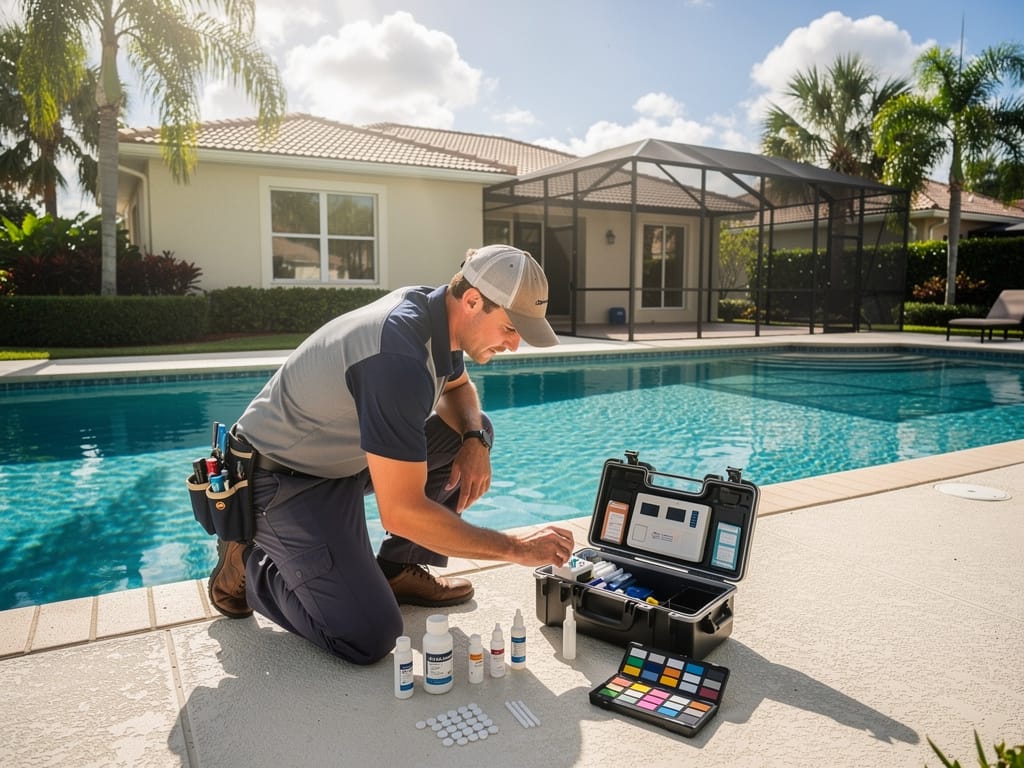
Cooper City’s high-quality residential homes — particularly in Rock Creek and Embassy Lakes — typically feature quality pool surface finishes (pebble tec, quartz, exposed aggregate) that represent significant investments. The calcium hardness chemistry that Cooper City homeowners often underestimate is one of the primary mechanisms through which pool surfaces age prematurely — either through scale deposition from high calcium or surface etching from calcium-deficient water.
At Pool Service Fort Lauderdale, we test calcium hardness as part of our standard service chemistry panel for Cooper City pools and manage it proactively to protect pool surfaces. This guide covers what calcium hardness does and what managing it looks like over a pool’s life.
The Langelier Saturation Index — Why Calcium Hardness Isn’t Just One Number
Calcium hardness doesn’t operate in isolation — it interacts with pH, total alkalinity, water temperature, and total dissolved solids (TDS) to determine whether pool water is “scaling” (deposits calcium) or “aggressive” (dissolves calcium). The Langelier Saturation Index (LSI) combines all these parameters into a single number:
- LSI above +0.3: Water is supersaturated — calcium carbonate precipitates out as scale. White deposits form on surfaces, fittings, and filter media. Heat amplifies this: a pool heater creates localized hotspots that trigger accelerated scale deposition on the heat exchanger.
- LSI below -0.3: Water is undersaturated — aggressively dissolves calcium from pool surfaces. Plaster and pebble finishes develop pitting and surface roughness. Very aggressive water (LSI below -0.5) can visibly etch surfaces within weeks.
- LSI between -0.3 and +0.3: Balanced — minimal scale or etching. This is the target range.
Practically: a Cooper City pool with calcium hardness at 350 ppm, pH at 7.6, and total alkalinity at 120 ppm will have a different LSI than the same calcium hardness at pH 8.0 and alkalinity at 160 ppm. This is why managing calcium hardness requires monitoring it in context with other parameters rather than treating it in isolation.
How Calcium Accumulates in Cooper City Pools
Cooper City pool water loses calcium-free water to evaporation and splash-out — the remaining water retains the calcium. Over 12-24 months of South Florida evaporation rates (1.5-2 inches/week in summer), calcium concentration can rise by 100-200 ppm from baseline fill water. Without periodic partial drains or dilution, calcium slowly concentrates above scale-forming levels.
Signs of high calcium accumulation in a Cooper City pool:
- White crusty deposits at the waterline (calcium carbonate ring)
- White scale on return fittings, light housings, and ladder rails
- Cloudy water that doesn’t clear with normal filtration (calcium carbonate particles in suspension)
- Rough-textured pool surfaces that feel sharper than they did when new
- Increased filter pressure (calcium scale in filter media)
Managing Calcium Hardness in Cooper City Pools
To raise calcium hardness (below 200 ppm): Add calcium chloride (pool-grade) incrementally. Do not add more than 10 lbs per 10,000 gallons at one time — calcium chloride raises water temperature as it dissolves and should be pre-dissolved in a bucket of water before adding. Add with pump running for distribution.
To lower calcium hardness (above 450 ppm): The only effective method is water dilution — partial drain and refill with lower-calcium water. There is no practical chemical that removes calcium from pool water. For a Cooper City pool at 600 ppm calcium: draining 30-40% of pool volume and refilling with municipal fill water (150-200 ppm) brings calcium back into range. This is why preventing calcium accumulation through regular monitoring is far preferable to correcting it after the fact.
Pool Service Fort Lauderdale tests calcium hardness at every service visit for Cooper City pools and manages it proactively to protect pool surfaces. Call (954) 501-2754 or visit our Cooper City pool service page. Full coverage at poolservicefortlauderdale.us.
Frequently Asked Questions
{“@context”:”https://schema.org”,”@type”:”FAQPage”,”mainEntity”:[{“@type”:”Question”,”name”:”What is the ideal calcium hardness for a Cooper City pool?”,”acceptedAnswer”:{“@type”:”Answer”,”text”:”The ideal calcium hardness range for a plaster, pebble, or quartz-surface pool in Cooper City is 200-400 ppm. Vinyl liner pools can tolerate a slightly lower range (175-225 ppm). Below 150 ppm, pool water becomes aggressive and begins dissolving calcium from plaster surfaces — causing pitting and surface erosion. Above 450 ppm, calcium carbonate begins depositing as scale on surfaces, fittings, and equipment.”}},{“@type”:”Question”,”name”:”Why does calcium buildup keep appearing at my Cooper City pool waterline?”,”acceptedAnswer”:{“@type”:”Answer”,”text”:”Calcium carbonate scale at the waterline forms when pool water calcium concentration is above scale-forming levels at that pH and alkalinity, and when heat-driven evaporation concentrates calcium at the waterline surface. It’s particularly pronounced in Cooper City’s warm climate where evaporation rates are high. Weekly brushing of the waterline tile reduces scale accumulation, but the root cause is elevated calcium hardness or pH that must be addressed through chemistry management, not just surface cleaning.”}},{“@type”:”Question”,”name”:”How often should calcium hardness be tested in a Cooper City pool?”,”acceptedAnswer”:{“@type”:”Answer”,”text”:”Monthly minimum. Calcium hardness changes slowly compared to chlorine or pH, but accumulates over time without periodic testing. A professional pool service provider testing calcium monthly can identify upward trends and recommend dilution before calcium reaches scale-forming levels. Annual testing is insufficient for Cooper City’s evaporation rates — calcium can rise 50-100 ppm in a single South Florida summer.”}},{“@type”:”Question”,”name”:”Can I lower calcium hardness in my Cooper City pool without a partial drain?”,”acceptedAnswer”:{“@type”:”Answer”,”text”:”There is no practical pool chemical that removes dissolved calcium from pool water. Partial drain and refill with lower-calcium water (South Florida municipal supply is typically 150-200 ppm) is the only effective method for lowering calcium hardness above 450 ppm. Some markets offer reverse osmosis pool treatment trucks that filter pool water in-place without draining — this service may be available in the Cooper City area for pools where draining and refilling is impractical.”}},{“@type”:”Question”,”name”:”Does high calcium hardness damage pool equipment in Cooper City?”,”acceptedAnswer”:{“@type”:”Answer”,”text”:”Yes. Scale-forming water deposits calcium carbonate on heat exchanger surfaces inside pool heaters, reducing heating efficiency and eventually causing equipment failure. Salt chlorine generator cells are particularly vulnerable — scale deposits on the electrolytic plates reduce chlorine production and shorten cell life. Regular cell cleaning (quarterly) is essential for Cooper City salt water pools, and reducing calcium to target range eliminates accelerated cell scaling.”}}]}
Ideal calcium hardness for Cooper City pool? 200-400 ppm for plaster/pebble/quartz surfaces. Below 150 ppm: aggressive water etches surfaces. Above 450 ppm: calcium scale deposits on surfaces and equipment.
Why does calcium build up at the waterline? High calcium concentration + heat-driven evaporation concentrates calcium at the waterline surface. Root cause is elevated calcium hardness or pH — surface cleaning treats the symptom, chemistry management treats the cause.
How often to test calcium hardness? Monthly minimum. Calcium accumulates slowly but rises significantly over one South Florida summer without monitoring. Annual testing is insufficient.
How to lower calcium hardness? Partial drain and refill only — no chemical removes dissolved calcium. RO pool treatment trucks may offer in-place filtration as an alternative to draining.
Does high calcium damage equipment? Yes — scale deposits on heat exchangers (reduces efficiency) and salt cell plates (reduces chlorine output, shortens cell life). Quarterly cell cleaning and in-range calcium are both essential for salt pool equipment longevity.