Cooper City’s landscaped neighborhoods — the manicured lawns and plantings that define Rock Creek and Embassy Lakes aesthetics — are one of the primary sources of pool phosphate. Fertilizer applied to the lawn adjacent to the pool, rain washing landscape runoff toward the pool area, and leaf decomposition from Cooper City’s mature tree canopy all introduce phosphate into pool water. For families who have dealt with recurring green algae that “keeps coming back” despite adequate chlorine and pH, phosphate accumulation is almost always the root cause.
At Pool Service Fort Lauderdale, we test phosphate at every service visit for Cooper City pools with algae history and include phosphate removal in ongoing service protocols for high-phosphate environments. This guide explains the phosphate-algae connection and the management approach.
Why High Phosphate Enables Algae to Beat Chlorine
Free chlorine kills algae through oxidation — it attacks algae cell walls and disrupts cellular function. At normal chlorine levels (1-3 ppm), this sanitization process keeps algae at non-visible concentrations. But algae growth rate is limited by available nutrients — primarily phosphorus (phosphate). When phosphate concentration is high, algae reproduces faster and maintains higher population density. At sufficient phosphate levels, the algae reproduction rate can exceed chlorine’s kill rate, and visible algae blooms develop even with “adequate” chlorine.
This is why treating a high-phosphate Cooper City pool with shock and algaecide resolves visible algae temporarily but doesn’t prevent recurrence — the algae bloom is cleared, but the phosphate that enabled it remains. Within weeks, the algae returns because the nutritional environment that supported the bloom hasn’t changed.
Cooper City-Specific Phosphate Sources
Lawn fertilizer runoff: The primary phosphate source for most Cooper City pools. Fertilizer applied to the lawn adjacent to the pool is carried by rain and irrigation runoff toward the pool area, with some entering the water directly and more washing in through pool deck drain gaps and landscape borders. The Broward County rainy season (June-September) drives fertilizer runoff events that can spike pool phosphate levels significantly after heavy rain.
Leaf decomposition: Leaves that enter the pool and are not removed promptly begin decomposing. Phosphate is released from decomposing organic material — the longer leaves sit in the pool water, the more phosphate they contribute. Prompt removal of leaves (daily in fall’s high-debris period) is phosphate management as much as cleanliness management.
Swimmer contamination: Sweat, body oils, and some personal care products contribute small amounts of phosphate per swimmer. In Cooper City pools with heavy family use, this accumulates as a baseline phosphate source.
Fill water: South Florida municipal fill water contains measurable phosphate — typically 100-300 ppb. Large volume additions (refilling after a partial drain) introduce significant phosphate load from the fill water alone.
Some pool chemicals: Certain phosphate-based pool chemicals (some stain preventers, certain clarifiers) add phosphate directly to pool water. Check product chemistry on any additive that doesn’t clearly state “phosphate-free.”
Testing and Managing Phosphate in Cooper City Pools
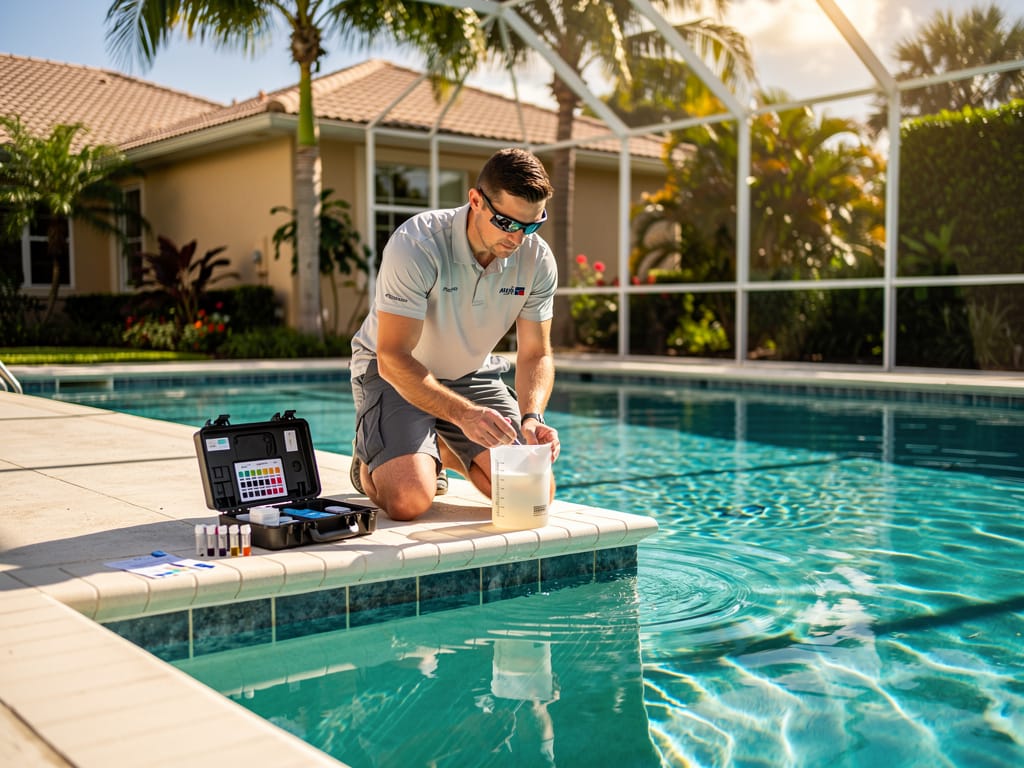
Phosphate test frequency: Monthly minimum; after significant rain events; after adding large fill water volumes.
Target level: Below 200 ppb. Above 500 ppb: algae growth is facilitated even with adequate chlorine. Above 1,000 ppb: aggressive phosphate removal is needed.
Phosphate removal products: Lanthanum-based removers (PHOSfree, Natural Chemistry PhosFree, Orenda PR-10000) bind dissolved orthophosphate and create a filterable precipitate. Apply per label dosage, run pump for 24-48 hours, backwash or clean filter (the filter captures the precipitate). For Cooper City pools with levels above 1,000 ppb, multiple treatment cycles may be needed to bring phosphate to target level.
Phosphate prevention practices for Cooper City:
- Use phosphate-free fertilizers on lawn areas adjacent to the pool
- Remove leaves and organic debris promptly — don’t allow decomposition in pool water
- Include phosphate testing in the monthly service chemistry panel
- Pre-treat fill water additions with phosphate remover when adding more than 500 gallons
Pool Service Fort Lauderdale tests and manages phosphate as part of comprehensive service for Cooper City pools with algae history. Call (954) 501-2754 or visit our Cooper City pool service page. Full coverage at poolservicefortlauderdale.us.
Frequently Asked Questions
{“@context”:”https://schema.org”,”@type”:”FAQPage”,”mainEntity”:[{“@type”:”Question”,”name”:”Why does algae keep coming back in my Cooper City pool even though my chlorine is at the right level?”,”acceptedAnswer”:{“@type”:”Answer”,”text”:”Recurring algae with adequate chlorine is almost always a phosphate problem. High phosphate (above 500 ppb) provides sufficient algae nutrition for algae to reproduce faster than chlorine can kill it. Shock and algaecide treatment clears the visible bloom but doesn’t remove the phosphate — so algae returns. The solution is phosphate testing and removal with a lanthanum-based phosphate remover (PHOSfree, Natural Chemistry PhosFree), combined with preventing the phosphate sources (lawn fertilizer runoff, leaf decomposition) from continuously reloading the pool.”}},{“@type”:”Question”,”name”:”What is the ideal phosphate level for a Cooper City pool?”,”acceptedAnswer”:{“@type”:”Answer”,”text”:”Target phosphate below 200 ppb. Above 500 ppb, algae growth is facilitated even with adequate chlorine. Above 1,000 ppb, aggressive phosphate removal is needed and algae problems are likely to be frequent or persistent. Many professional pool service providers in Cooper City now include phosphate testing monthly as a standard panel item, not just chlorine, pH, and alkalinity.”}},{“@type”:”Question”,”name”:”Where does phosphate come from in a Cooper City pool?”,”acceptedAnswer”:{“@type”:”Answer”,”text”:”Primary sources for Cooper City pools: lawn fertilizer runoff from adjacent landscaping (the largest contributor, amplified during the rainy season); leaf and organic matter decomposition in pool water; swimmer body contamination (sweat, oils); South Florida municipal fill water (100-300 ppb); and some pool chemical additives (stain preventers, certain clarifiers). Using phosphate-free fertilizers near the pool, removing leaves promptly, and testing phosphate monthly are the primary prevention strategies.”}},{“@type”:”Question”,”name”:”How do phosphate removers work in Cooper City pools?”,”acceptedAnswer”:{“@type”:”Answer”,”text”:”Lanthanum-based phosphate removers (PHOSfree, Natural Chemistry PhosFree, Orenda PR-10000) bind dissolved orthophosphate ions in pool water, creating a cloudy lanthanum phosphate precipitate. Running the pump for 24-48 hours after treatment allows the precipitate to be filtered out. Backwash or clean the filter after treatment — the phosphate is now captured in the filter media. For Cooper City pools with levels above 1,000 ppb, multiple treatment cycles spaced a few days apart may be needed.”}},{“@type”:”Question”,”name”:”Does pool phosphate affect water clarity in my Cooper City pool?”,”acceptedAnswer”:{“@type”:”Answer”,”text”:”Not directly — phosphate itself is colorless and doesn’t cloud pool water. But the algae that phosphate enables does affect clarity dramatically, from slight haze (early bloom) to opaque green (advanced bloom). The sequence is: phosphate accumulates → algae bloom develops → water clarity declines. The phosphate itself is invisible until the algae it feeds becomes visible. This is why monthly phosphate testing catches the problem before it manifests as visible algae.”}}]}
Why does algae keep coming back? High phosphate (above 500 ppb) fuels algae nutrition beyond what chlorine can overcome. Shock clears the bloom but leaves the phosphate — algae returns. Test and remove phosphate with lanthanum-based remover; address the sources (fertilizer runoff, leaf decomposition).
Target phosphate level? Below 200 ppb. Above 500 ppb: algae facilitated even with adequate chlorine. Above 1,000 ppb: aggressive removal needed.
Where does phosphate come from in Cooper City? Lawn fertilizer runoff (primary), leaf decomposition, swimmer contamination, municipal fill water, and some pool chemical additives.
How do phosphate removers work? Lanthanum binds dissolved phosphate into a filterable precipitate. Run pump 24-48 hours, then backwash filter. Multiple treatments may be needed for levels above 1,000 ppb.
Does phosphate affect water clarity? Not directly — phosphate is colorless. But the algae it enables makes water hazy to opaque green. Monthly testing catches it before the algae bloom is visible.