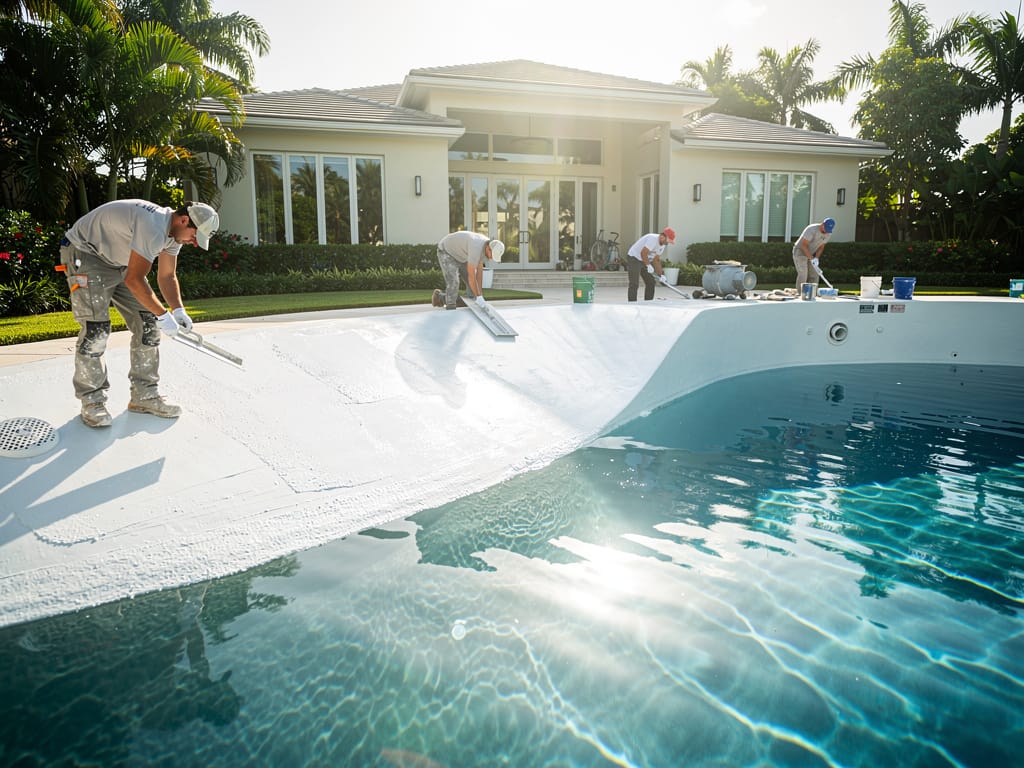
Parkland’s luxury estate pools represent some of the finest residential pool construction in South Florida. The surface finish is often the single highest-cost component in a custom pool build — glass bead aggregate and custom mosaic tile installations on larger estate pools can reach $40,000-$80,000. These surfaces are designed to last 10-20 years with proper care. The chemistry and maintenance practices during those years determine whether the finish reaches its design life or deteriorates prematurely.
At Pool Service Fort Lauderdale, we prioritize surface finish preservation in our chemistry management program for Parkland estate pools. This guide covers the specific chemistry requirements for premium surfaces and what maintenance practices make the difference between a pool that looks magnificent at 15 years vs one that requires resurfacing at 8.
Glass Bead Aggregate Finishes
Glass bead finishes (Pebble Tec Del Sol, SGM Jewels Bead, Diamond Brite glass bead) embed crushed or rounded glass particles in a white marble dust matrix. The brilliance and depth of color come from the glass particles refracting and reflecting light — a visual effect unique to glass bead aggregate. This finish’s appearance depends on the glass particles remaining clean, uncoated, and undamaged.
Scale on glass bead finishes: Calcium carbonate scale deposits preferentially on glass surfaces — the electrostatic affinity between calcium ions and glass is higher than with natural stone aggregate. Scale coats the glass particles, progressively dulling the reflective brilliance that makes the finish valuable. Early-stage scale accumulation looks like a subtle haze; advanced scale makes the pool surface appear gray and matte regardless of how clear the water is. Acid washing removes scale but is itself mildly aggressive — a Parkland estate glass bead pool that requires acid washing every 2-3 years due to persistent scale is being slowly damaged by the remedy. Prevention through LSI management is the correct approach.
Chemistry targets for glass bead finishes:
- pH: 7.4-7.6 (tighter than the 7.2-7.8 acceptable range — glass surfaces are more pH-sensitive than plaster)
- Calcium hardness: 200-300 ppm (mid-range; keep away from both the 150 ppm aggressive floor and the 400 ppm scale ceiling)
- Total alkalinity: 80-100 ppm (lower than standard pool recommendation — higher alkalinity in glass bead pools can buffer pH at a level that promotes scale)
- CYA: 40-70 ppm (stabilized chlorine)
- LSI: -0.1 to +0.2 (slightly on the protective side, never above +0.3)
Custom Mosaic Tile — Glass and Natural Stone
Custom mosaic tile on Parkland estate pools — pool floor patterns, wall murals, waterline tile borders, and step edges — uses glass tile, natural stone tile (travertine, marble, mother-of-pearl), or ceramic tile with specialty glazes. Each material responds differently to pool chemistry:
- Glass mosaic tile: Highly scale-prone (same glass-surface calcium affinity as glass bead aggregate). Scale in tile grout lines is particularly problematic — grout is more porous than tile faces and accumulates scale faster. Weekly waterline tile cleaning with a non-abrasive pool tile cleaner prevents grout scale before it requires acid treatment.
- Natural stone tile (travertine, marble): Acid-sensitive — the calcium carbonate in natural stone tile is dissolved by acidic conditions (low pH or aggressive acid washing). Natural stone tile waterline areas require particularly careful pH management (never below 7.2) and should not be cleaned with acid-based tile cleaners. Use only pH-neutral or alkaline stone cleaners on travertine and marble surfaces.
- Mother-of-pearl and shell tile: Extremely delicate — the aragonite (calcium carbonate) structure is vulnerable to both acid and high-chlorine bleaching. Requires professional cleaning only; homeowner chemical application is not recommended.
Professional Surface Inspection Schedule
For Parkland estate pool finishes, Pool Service Fort Lauderdale recommends:
- Monthly: Visual inspection of all tile surfaces for early-stage scale, staining, or grout deterioration; document and address early
- Quarterly: Full surface assessment including LSI calculation, calcium trend analysis, and recommendation for any treatment intervention before scale or etching advances
- Annually: Professional tile cleaning (non-acid waterline cleaning), equipment inspection, and 5-year surface condition assessment to project resurfacing timeline
Pool Service Fort Lauderdale maintains premium surface finishes for Parkland estate pools. Call (954) 501-2754 or visit our Parkland pool service page. Full coverage at poolservicefortlauderdale.us.
Frequently Asked Questions
{“@context”:”https://schema.org”,”@type”:”FAQPage”,”mainEntity”:[{“@type”:”Question”,”name”:”What chemistry parameters matter most for preserving a glass bead pool finish in Parkland?”,”acceptedAnswer”:{“@type”:”Answer”,”text”:”pH (maintain 7.4-7.6, tighter than standard plaster pools), calcium hardness (200-300 ppm, avoiding both the aggressive floor below 200 ppm and the scale ceiling above 350 ppm), total alkalinity (80-100 ppm for glass bead — lower than standard recommendation), and Langelier Saturation Index (LSI -0.1 to +0.2). Glass surfaces have higher calcium affinity than natural aggregate — scale deposits faster on glass bead finishes and must be prevented through consistent LSI management rather than periodic acid washing.”}},{“@type”:”Question”,”name”:”How long should a premium pool finish last on a Parkland estate pool?”,”acceptedAnswer”:{“@type”:”Answer”,”text”:”Quality glass bead aggregate and pebble tec premium finishes are designed to last 15-20 years with proper chemistry management and maintenance. Poorly managed chemistry — persistent scaling or aggressive water conditions — can reduce this to 8-12 years, requiring resurfacing on a much earlier timeline. The chemistry management investment over the finish’s lifetime is a small fraction of the resurfacing cost it prevents.”}},{“@type”:”Question”,”name”:”Can I use acid washing to remove scale from my Parkland pool’s glass tile?”,”acceptedAnswer”:{“@type”:”Answer”,”text”:”Mild acid washing can remove calcium scale from glass tile surfaces, but it’s a last resort, not a maintenance routine. Each acid treatment mildly etches tile surfaces and grout; repeated acid washing progressively damages grout integrity and the tile face coating. Prevention through LSI management and weekly tile cleaning with a non-abrasive pool tile cleaner is the correct approach. Natural stone tile (travertine, marble) should never be cleaned with acid-based cleaners — use pH-neutral or alkaline stone cleaners only.”}},{“@type”:”Question”,”name”:”Why does my Parkland pool’s tile grout look discolored or crusty?”,”acceptedAnswer”:{“@type”:”Answer”,”text”:”Grout discoloration and crusting has two likely causes: (1) calcium carbonate scale — white or gray deposits, particularly at the waterline where evaporation concentrates calcium; requires scale removal and calcium hardness reduction; (2) algae or biofilm in grout — green, black, or brown discoloration from biological growth in porous grout; requires chemical treatment and brushing. Most waterline tile issues in Parkland pools are scale-related, driven by elevated calcium or pH. Weekly waterline tile cleaning prevents minor accumulation from becoming a removal project.”}},{“@type”:”Question”,”name”:”How do I protect mother-of-pearl tile in my Parkland pool?”,”acceptedAnswer”:{“@type”:”Answer”,”text”:”Mother-of-pearl tile requires professional cleaning only — never homeowner chemical application. Maintain pH consistently at 7.4-7.6 (never below 7.2, as aragonite shell material dissolves in acidic conditions). Maintain free chlorine at 1-2 ppm (not above 3 ppm — high chlorine bleaches the iridescent layer). Avoid shock dosing the pool when mother-of-pearl tile is present without dilution precautions. Quarterly professional inspection of all mother-of-pearl surfaces documents condition and catches deterioration before it advances.”}}]}
Most important chemistry for glass bead finish? pH 7.4-7.6 (tighter range than plaster), calcium 200-300 ppm, alkalinity 80-100 ppm (lower than standard), LSI -0.1 to +0.2. Glass surfaces accumulate scale faster — prevention through LSI management is the correct approach, not periodic acid washing.
How long should a premium finish last? 15-20 years with proper chemistry management. Poor chemistry reduces this to 8-12 years, requiring costly earlier resurfacing.
Can acid washing remove scale from glass tile? Yes, but it’s a last resort — each treatment mildly damages grout integrity. Prevention is correct approach. Never use acid-based cleaners on natural stone tile (travertine, marble) — use pH-neutral or alkaline stone cleaners only.
What causes grout discoloration or crusting? Scale (white/gray, calcium-driven) or algae/biofilm (green/black/brown). Most waterline tile issues in Parkland pools are scale-related. Weekly waterline cleaning prevents minor buildup from becoming a removal project.
How to protect mother-of-pearl tile? Professional cleaning only — never homeowner chemical application. pH 7.4-7.6 strict, never below 7.2. Free chlorine 1-2 ppm max. No shock dosing without dilution precautions near mother-of-pearl surfaces.