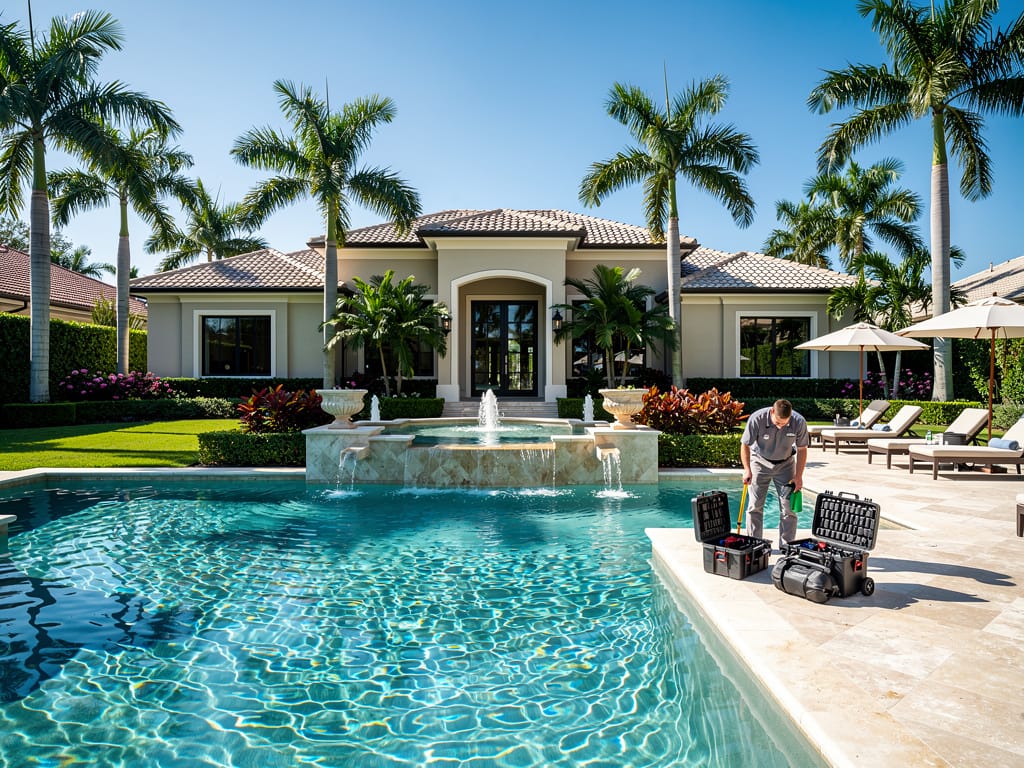
Parkland’s luxury estate properties feature some of South Florida’s largest and most impressive residential pools — pools designed and built for enjoyment. In January through April, these pools are pristine: clear, comfortable, and perfect for swimming. In July and August, the same pool can be 93°F — uncomfortable for sustained swimming, particularly for the active families who drive Parkland’s estate market. A pool that’s too warm to comfortably swim in during peak summer months is underperforming its potential, and for Parkland homeowners who expect their outdoor amenities to function at the highest level year-round, a pool chiller is the premium solution.
At Pool Service Fort Lauderdale, we install and service pool chiller systems for Parkland estate properties. This guide covers how pool chillers work, what sizing looks like for large estate pools, and what the operating economics are.
How Pool Chillers Work
A pool chiller operates on the same refrigeration cycle as an air conditioning system or a heat pump — it just runs in the cooling direction rather than the heating direction. A refrigerant circuit extracts heat from pool water passing through a heat exchanger, then rejects that heat to the outdoor air through a condenser coil and fan. The result: pool water exits the chiller 2-4°F cooler than it entered; over many hours of continuous operation, this cooling effect accumulates to achieve the target temperature reduction.
The key distinction from a heat pump: most heat pumps can be switched between heating and cooling modes, but they achieve this by reversing the refrigerant flow direction and the COP (Coefficient of Performance) in cooling mode is lower than in heating mode — a heat pump that heats at COP 5.0 typically cools at COP 2.5-3.5. Dedicated pool chillers are optimized for cooling and operate more efficiently in the cooling direction than a reversible heat pump.
Heat Load Calculation for Parkland Estate Pools
Sizing a pool chiller for a Parkland estate pool requires calculating the heat load — how much thermal energy the pool absorbs per day from sun exposure, air temperature, and any equipment heat contributions (heat pump waste heat if it remains connected, equipment pad proximity). Key variables:
- Pool surface area: The primary solar heat collection surface. A 1,500 sq ft pool surface (approximately 40×37 ft, within Parkland estate scale) can absorb 300,000-450,000 BTU of solar heat per day in peak summer with full sun exposure — a massive heat input that requires a substantial cooling capacity to offset.
- Screen enclosure or shade structure: A pool under full screen enclosure absorbs 40-70% less direct solar radiation than an open-air pool. If the Parkland estate pool is fully enclosed, the chiller capacity requirement is significantly reduced.
- Nighttime cooling opportunity: South Florida summer nights rarely drop below 78-80°F, which limits the natural overnight cooling that would reduce the chiller’s daily workload. Unlike northern climates where nighttime cooling offsets some daytime heat gain, Parkland pools gain and retain heat around the clock in summer.
Pool Chiller Sizing for Parkland Estate Pools
Residential pool chiller capacities in BTU/hr of cooling:
- 1-1.5 ton (12,000-18,000 BTU/hr): Suitable for smaller pools under 15,000 gallons with screen enclosure
- 2-3 ton (24,000-36,000 BTU/hr): Appropriate for 15,000-25,000 gallon estate pools with screen enclosure; insufficient for open-air pools of this size
- 4-5 ton (48,000-60,000 BTU/hr): Required for 20,000-35,000 gallon open-air pools or larger enclosed pools. This is commercial chiller territory — most residential pool chiller manufacturers stop at 3 ton; beyond this requires commercial chiller equipment or multiple residential units
For Parkland estate pools in the 30,000-50,000 gallon range with significant sun exposure, custom chiller engineering may be required — a two-unit parallel installation or a commercial refrigeration contractor assessment.
Operating Costs and Economics
A 2.5-ton pool chiller at an EER (Energy Efficiency Ratio) of 10 consumes approximately 3,000 watts of electricity. Running 8-12 hours per day during South Florida summer: 24-36 kWh/day × $0.13/kWh = $3.12-$4.68/day, or $95-$140/month per peak summer month. For a larger 4-5 ton commercial-class chiller: $180-$400/month during the cooling season (typically June-September, 4 months). Annual cooling cost for a large Parkland estate pool: $720-$1,600.
Pool Service Fort Lauderdale installs and services pool chiller systems for Parkland estate properties. Call (954) 501-2754 or visit our Parkland pool service page. Full coverage at poolservicefortlauderdale.us.
Frequently Asked Questions
{“@context”:”https://schema.org”,”@type”:”FAQPage”,”mainEntity”:[{“@type”:”Question”,”name”:”How hot does a Parkland estate pool get in summer without a chiller?”,”acceptedAnswer”:{“@type”:”Answer”,”text”:”An unshaded Parkland estate pool in peak summer (July-August) typically reaches 88-95°F without cooling intervention. Pools under full screen enclosure run 5-8°F cooler than open-air pools due to reduced direct solar radiation. Most swimmers find pool water above 86-88°F uncomfortable for sustained swimming — the pool feels like a warm bath rather than a refreshing amenity. A pool chiller targeting 78-82°F delivers comfortable swimming conditions throughout South Florida’s 4-month peak summer period.”}},{“@type”:”Question”,”name”:”How much does a pool chiller cost for a Parkland luxury pool?”,”acceptedAnswer”:{“@type”:”Answer”,”text”:”Residential pool chiller equipment: $3,000-$7,000 for 1.5-3 ton units suitable for enclosed estate pools up to 25,000 gallons. Commercial-class chiller equipment for larger open-air Parkland estate pools (4-5 ton): $8,000-$18,000. Installation (electrical, plumbing integration, controls): $1,500-$4,000. Total installed cost for a typical Parkland estate pool chiller: $5,000-$22,000 depending on pool size, sun exposure, and target temperature reduction.”}},{“@type”:”Question”,”name”:”Can a heat pump cool a Parkland pool instead of a dedicated chiller?”,”acceptedAnswer”:{“@type”:”Answer”,”text”:”Some reversible heat pumps (Aquacal SuperQuiet, Hayward HeatPro with cooling mode) can operate in cooling mode for pool chilling. However, COP in cooling mode (2.5-3.5) is lower than in heating mode (5.0-6.0), making heat pump cooling less efficient than a dedicated chiller. Additionally, heat pumps optimized for heating may not have adequate cooling capacity for large Parkland estate pools. A dedicated chiller is the more efficient and reliable choice for consistent summer cooling of large estate pools.”}},{“@type”:”Question”,”name”:”How long does it take a pool chiller to cool a large Parkland estate pool?”,”acceptedAnswer”:{“@type”:”Answer”,”text”:”A properly sized chiller for a 20,000-gallon pool running continuously can reduce water temperature by 8-12°F over 24-48 hours from initial startup. Ongoing maintenance cooling (keeping the pool at target temperature once cooled) requires 6-10 hours of daily chiller operation to offset South Florida summer heat gain. The first cool-down from 92°F to 80°F takes 2-3 days; maintaining 80°F throughout the summer requires daily chiller operation during the peak season.”}},{“@type”:”Question”,”name”:”Does cooling a pool affect water chemistry in Parkland?”,”acceptedAnswer”:{“@type”:”Answer”,”text”:”Cooler water actually improves chlorine stability — chlorine breaks down more slowly in cooler water, reducing chemical consumption. pH drift is also slower in cooler water. Cooling a Parkland estate pool from 92°F to 80°F reduces chlorine consumption and pH fluctuation, potentially reducing weekly chemical costs by 15-25%. The primary chemistry consideration specific to cooling: ensure the pool heater and chiller control systems don’t compete — the chiller should have priority in summer months to prevent the heater from counteracting cooling.”}}]}
How hot does a Parkland pool get without a chiller? 88-95°F in peak summer — uncomfortable for sustained swimming. Screen enclosure reduces peak temperature 5-8°F vs open-air. Chiller targeting 78-82°F restores comfortable swimming conditions through the 4-month peak summer period.
Cost of a pool chiller for a Parkland estate pool? Residential 1.5-3 ton units: $3,000-$7,000 equipment; $5,000-$11,000 installed. Commercial 4-5 ton for large open-air pools: $8,000-$18,000 equipment; up to $22,000 installed total.
Can a heat pump cool instead of a dedicated chiller? Some reversible heat pumps have cooling mode, but COP in cooling is lower and capacity may be insufficient for large estate pools. Dedicated chillers are more efficient and reliable for consistent summer cooling.
How long to cool a large estate pool? 2-3 days to achieve target temperature from 92°F to 80°F initial cool-down. 6-10 hours daily to maintain target temperature against summer heat gain thereafter.
Does cooling affect chemistry? Positively — cooler water slows chlorine degradation and pH drift. Can reduce weekly chemical costs 15-25%. Ensure heater and chiller controls don’t compete — chiller should have priority in summer months.