Sunrise’s geography — a planned suburban city built on the drained Everglades fringe — includes an extensive network of canals, drainage basins, and retention areas that provide the water management infrastructure for both drainage and irrigation. This waterway system, while essential to the city’s function, creates an enriched phosphate environment that directly affects residential pool chemistry for properties near these water features.
At Pool Service Fort Lauderdale, we service pools throughout Sunrise and regularly see the elevated phosphate pattern in pools adjacent to canals and retention areas. This guide explains the connection and what proactive management looks like.
The Phosphate-Algae Connection in Sunrise
Phosphate is to algae what fertilizer is to lawn grass — an essential nutrient that enables and accelerates growth. In a pool with adequate chlorine and phosphate below 200 ppb, algae cannot sustain visible colony growth because chlorine kills algae faster than it can reproduce. At phosphate levels above 500 ppb, the nutritional supply is sufficient to support algae reproduction rates that outpace normal chlorine sanitization — visible green blooms develop even in pools with technically adequate chlorine levels.
The canal proximity effect in Sunrise works through several mechanisms:
- Airborne particulates: Canal water surfaces produce aerosol droplets containing dissolved phosphate and algae cells that drift into adjacent pools in wind. Sunrise pools downwind of canals receive a continuous small-volume inoculation of canal phosphate and biological material.
- Irrigation overspray: Many Sunrise homeowners use canal water or shared well irrigation that draws from the same phosphate-enriched groundwater influenced by nearby waterways. Irrigation overspray onto pool deck surfaces and into the pool directly delivers phosphate from the groundwater source.
- Rain runoff routing: Heavy rain events route surface runoff across landscaped areas toward the pool deck and into the pool. This runoff picks up phosphate from fertilized lawn areas and soil adjacent to the pool — and in Sunrise’s flat terrain, runoff from a large area may route toward a single pool.
Signs of Phosphate-Driven Algae Problems in a Sunrise Pool
- Recurring green algae that clears with shock treatment but returns within 2-4 weeks
- Algae appearing on pool walls and floor despite adequate tested chlorine (1-3 ppm free chlorine)
- Water taking on a slight green tint within a few days of the weekly service visit despite the technician adding chlorine
- Increased chlorine demand — needing significantly more chlorine than similar-size pools in non-canal locations
These patterns suggest phosphate is enabling algae growth faster than the chlorine program can control. The solution is not more chlorine — it is phosphate removal combined with an ongoing phosphate management protocol.
The Phosphate Management Protocol for Canal-Adjacent Sunrise Pools
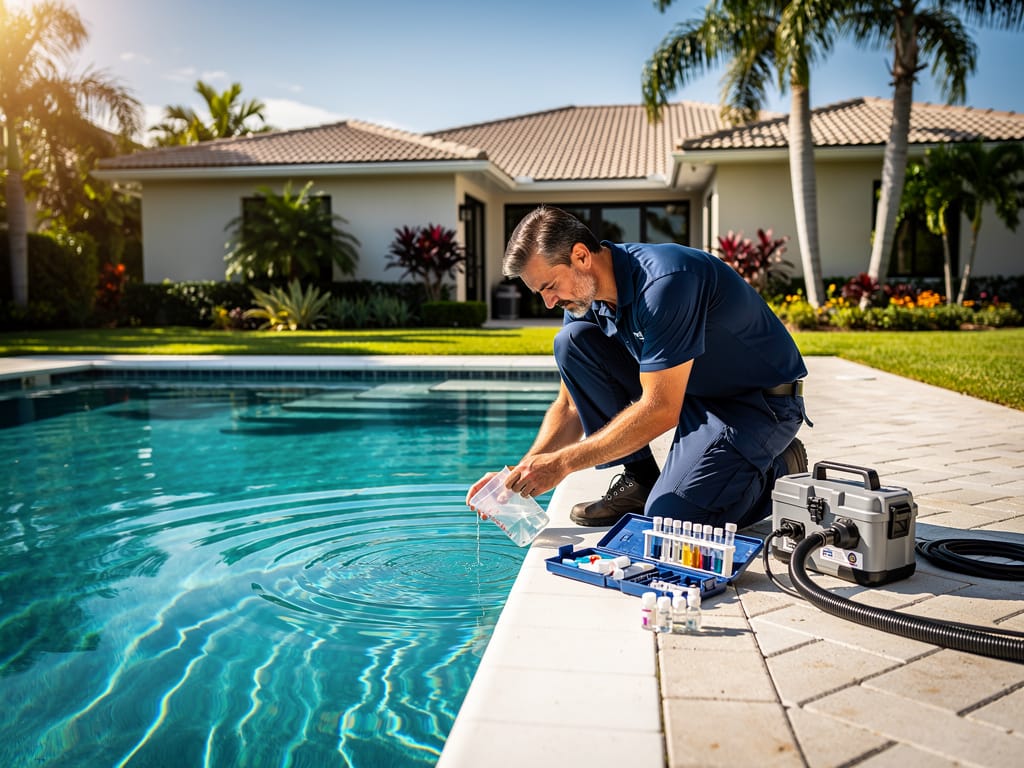
Step 1 — Baseline phosphate test: Test current phosphate level (ppb). If above 500 ppb, proceed immediately to Step 2. If 200-500 ppb, begin monthly monitoring and low-level prevention. If below 200 ppb, continue monthly monitoring.
Step 2 — Phosphate removal treatment: Apply a lanthanum-based phosphate remover (PHOSfree, Natural Chemistry PhosFree, Orenda PR-10000) at the appropriate dose for the tested phosphate level. Run the pump for 24-48 hours. Backwash or clean the filter to remove the precipitated phosphate captured in filter media. For Sunrise pools with phosphate above 1,000 ppb, multiple sequential treatments may be needed.
Step 3 — Prevention protocol: Monthly phosphate testing as a standard chemistry panel item. Lanthanum-based preventive dose monthly (a maintenance dose, not full treatment dose) to keep phosphate from re-accumulating. Phosphate-free fertilizers on lawn areas adjacent to the pool — eliminating the most controllable phosphate input pathway.
Pool Service Fort Lauderdale includes phosphate testing and management in its regular service program for Sunrise pools near canals and waterways. Call (954) 501-2754 or visit our Sunrise pool service page. Full coverage at poolservicefortlauderdale.us.
Frequently Asked Questions
{“@context”:”https://schema.org”,”@type”:”FAQPage”,”mainEntity”:[{“@type”:”Question”,”name”:”Why does my Sunrise pool near the canal keep getting algae even though my chlorine is fine?”,”acceptedAnswer”:{“@type”:”Answer”,”text”:”Recurring algae with adequate chlorine is a phosphate problem. Canal-adjacent pools in Sunrise receive elevated phosphate loading from airborne canal particulates, irrigation water from phosphate-enriched groundwater, and rain runoff from fertilized landscaping. At phosphate levels above 500 ppb, algae can sustain growth even in the presence of 1-3 ppm free chlorine. Test phosphate levels and treat with a lanthanum-based phosphate remover — addressing the root cause rather than increasing chlorine.”}},{“@type”:”Question”,”name”:”How often should phosphate be tested in a Sunrise pool near a canal?”,”acceptedAnswer”:{“@type”:”Answer”,”text”:”Monthly minimum for canal-adjacent or waterway-adjacent pools in Sunrise. These pools receive continuous low-level phosphate input from multiple environmental pathways and can accumulate above 500 ppb faster than pools in non-canal locations. Monthly testing catches the trend before it reaches algae-enabling levels. After a phosphate removal treatment, test again 2 weeks later to confirm the level stayed down and the filter captured the phosphate precipitate effectively.”}},{“@type”:”Question”,”name”:”Can I prevent phosphate from entering my Sunrise pool near the canal?”,”acceptedAnswer”:{“@type”:”Answer”,”text”:”Partially. You can eliminate the most controllable input pathway: use phosphate-free fertilizers on lawn and landscape areas adjacent to the pool, eliminating the most significant controllable phosphate source. You cannot fully prevent airborne canal particulates or groundwater-influenced irrigation water phosphate. The realistic management goal is reduction combined with a monthly phosphate removal maintenance dose to keep levels below the algae-enabling threshold.”}},{“@type”:”Question”,”name”:”What phosphate level is too high for a Sunrise pool?”,”acceptedAnswer”:{“@type”:”Answer”,”text”:”Above 500 ppb, algae growth is facilitated even with adequate chlorine. Above 1,000 ppb, aggressive removal is needed and recurring algae is virtually guaranteed. The target is below 200 ppb — achievable with a lanthanum-based removal treatment and a monthly maintenance prevention protocol. Most pool supply stores offer basic phosphate test strips; a professional liquid reagent test provides more accurate readings for managing near the 200-500 ppb transition zone.”}},{“@type”:”Question”,”name”:”Does pool phosphate affect water clarity in Sunrise?”,”acceptedAnswer”:{“@type”:”Answer”,”text”:”Phosphate itself is colorless and transparent. The algae that high phosphate enables does affect clarity dramatically — from slight green haze (early bloom) to opaque green water (advanced bloom). By the time water clarity is affected, phosphate-driven algae growth is already well established. Monthly phosphate testing catches the problem before it manifests as visible algae or clarity loss — this is why proactive phosphate management is more effective and less expensive than reactive shock-and-algaecide treatment.”}}]}
Why does my canal-adjacent Sunrise pool keep getting algae despite adequate chlorine? Phosphate problem. Canal-adjacent pools receive elevated phosphate from airborne particulates, phosphate-enriched irrigation water, and rain runoff from fertilized landscaping. Above 500 ppb phosphate, algae outpaces normal chlorine control. Test and treat with lanthanum-based remover — don’t just add more chlorine.
How often to test phosphate near a canal? Monthly minimum — these pools accumulate phosphate faster than non-canal locations. Monthly testing catches the trend before it hits the 500 ppb algae-enabling threshold.
Can I prevent phosphate from entering the pool? Partially. Use phosphate-free fertilizers near the pool to eliminate the most controllable input. Airborne canal particulates and groundwater influences can’t be fully prevented — monthly maintenance prevention doses keep levels manageable.
What phosphate level is too high? Above 500 ppb: algae enabled. Above 1,000 ppb: aggressive removal needed, recurring algae virtually guaranteed. Target: below 200 ppb with monthly maintenance protocol.
Does phosphate affect water clarity? Phosphate itself is invisible — but the algae it enables ranges from slight green haze to opaque green water. Monthly testing catches the problem before clarity is affected — proactive management is far cheaper than reactive shock-and-algaecide cycles.