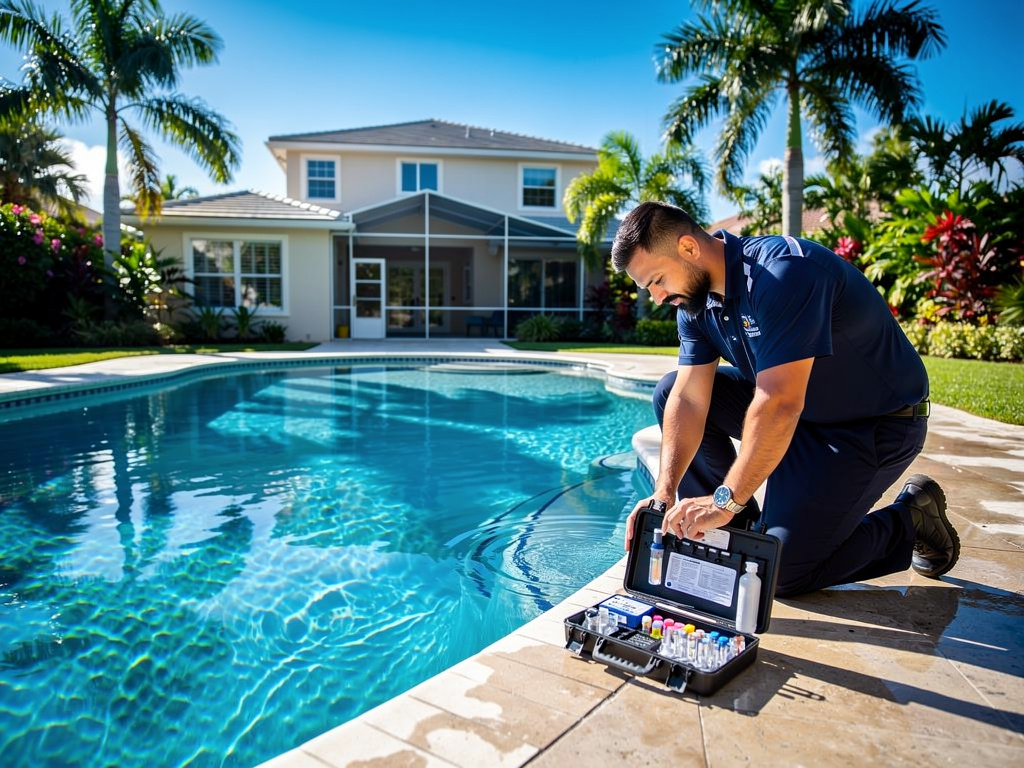
Boca Raton’s luxury pool market features surfaces that represent substantial investments: glass bead aggregate finishes at $12,000-$18,000, custom mosaic tile work at $20,000-$50,000, polished natural stone coping and decking at $25,000-$80,000, and infinity edge structures with premium interior finishes at the highest level. These surfaces were chosen for their visual impact and the premium character they add to the property. Their longevity depends heavily on the precision of the water chemistry that surrounds them every day.
At Pool Service Fort Lauderdale, we manage pool chemistry for Boca Raton luxury properties and understand the surface-specific chemistry requirements that premium finishes demand. This guide covers what precision chemistry management looks like and why it matters for the most valuable pool surfaces in the market.
The Langelier Saturation Index (LSI): The Core Chemistry Framework
The LSI is the industry-standard tool for assessing whether pool water will scale (deposit calcium carbonate on surfaces, equipment, and pipes) or etch (dissolve calcium carbonate from plaster and cementitious surfaces). LSI is calculated from pH, calcium hardness, total alkalinity, temperature, and TDS:
- LSI positive (above 0): Water is over-saturated — tends to deposit calcium scale on surfaces. Scale deposits on glass bead surfaces mask the glass reflective quality; scale on tile grout lines causes discoloration and grout damage.
- LSI negative (below -0.3): Water is under-saturated — tends to dissolve calcium from cementitious surfaces (plaster, grout, coping mortar joints). Etching from aggressive water is the primary surface damage mechanism for Boca Raton’s premium cementitious finishes.
- LSI target range: -0.3 to +0.3 — balanced water that neither scales nor etches under normal conditions.
For premium Boca Raton pool surfaces, the target LSI range is tighter: -0.1 to +0.2. The narrower tolerance accounts for the higher sensitivity of premium materials to both etching and scaling compared to standard plaster.
Glass Bead Aggregate Chemistry Requirements
Glass bead pool surfaces (Beadcrete, SGM Glass, and custom glass bead aggregate formulations) use glass microspheres embedded in white cement matrix. The glass beads themselves are chemically inert — they don’t react with pool chemistry. The white cement matrix between the beads is sensitive to LSI management in the same way as standard plaster, but with a key distinction: because the glass beads create a smooth, reflective surface that catches light, etching of the cement matrix is highly visible against the glass bead background. A pH that drifts to 7.1 for 2-3 weeks produces etching that is visible as dull, matte areas among the reflective glass — visible imperfection in a surface chosen specifically for its visual brilliance.
Glass bead chemistry targets: pH 7.4-7.6 (narrower than standard plaster’s 7.2-7.8 range); calcium hardness 300-400 ppm (tighter than standard); total alkalinity 80-100 ppm.
Mosaic and Decorative Tile Chemistry Requirements
Custom mosaic tile pools in Boca Raton feature glass tile, ceramic tile, natural stone tile, and specialty materials including copper-backed glass and metallic glass. Chemistry considerations:
- Tile grout: Unsanded grout used in waterline tile and decorative mosaics is sensitive to both aggressive water (etching) and scaling water (scale deposits discolor grout and create calcium-stained grout lines). Monthly inspection of waterline tile grout condition is appropriate for Boca Raton luxury tile pools.
- Copper-backed and metallic glass tile: Some specialty glass tile products have metallic or copper backing that can be affected by improper chemical applications — particularly high-concentration chlorine directly applied to the tile surface. Granular chlorine shock should never be broadcast across pools with these tile types; liquid chlorine application away from tile surfaces is required.
- Natural stone tile: Limestone, travertine, and marble tile are particularly sensitive to acidic water (pH below 7.2) — these calcium carbonate stones etch in the same acidic water that etches plaster, but often faster because natural stone has less uniform density than manufactured plaster.
What Precision Chemistry Management Looks Like in Practice
For Boca Raton luxury pool surfaces, precision chemistry management means:
- 7-parameter testing on every service visit (not 2-3 parameter)
- LSI calculation on each test result to confirm balanced water before and after chemical additions
- pH maintained at 7.4-7.6, adjusted at every service visit rather than when it “looks off”
- Calcium hardness tested monthly and maintained in the appropriate range for the surface type
- Chemical additions applied in ways that don’t contact specialty tile surfaces directly
- Seasonal adjustments for temperature effects on LSI (warmer water shifts LSI positive; chemistry must be adjusted accordingly)
Pool Service Fort Lauderdale provides precision chemistry management for Boca Raton’s premium pool surfaces. Call (954) 501-2754 or visit our Boca Raton pool service page. Full coverage at poolservicefortlauderdale.us.
Frequently Asked Questions
{“@context”:”https://schema.org”,”@type”:”FAQPage”,”mainEntity”:[{“@type”:”Question”,”name”:”Why does my Boca Raton glass bead pool surface look dull in some areas?”,”acceptedAnswer”:{“@type”:”Answer”,”text”:”Localized dull areas in a glass bead pool surface typically indicate etching — the white cement matrix between the glass beads has been dissolved by aggressive (low LSI) water, reducing the reflective quality that makes glass bead surfaces visually distinctive. Etching in glass bead surfaces is more visible than in standard plaster because the matte cement texture contrasts with the surrounding reflective glass. Prevention requires maintaining pH at 7.4-7.6 and calcium hardness at 300-400 ppm to keep LSI in the -0.1 to +0.2 range. Etched glass bead surfaces cannot be polished — re-application of glass bead material to the affected area is the corrective option.”}},{“@type”:”Question”,”name”:”What is LSI and why does it matter for Boca Raton luxury pool surfaces?”,”acceptedAnswer”:{“@type”:”Answer”,”text”:”LSI (Langelier Saturation Index) quantifies whether pool water will scale or etch surfaces. LSI above 0: water deposits calcium scale. LSI below -0.3: water dissolves calcium from surfaces (etching). For standard plaster, the target is -0.3 to +0.5. For Boca Raton’s premium surfaces (glass bead, mosaic tile, natural stone), the target is tighter: -0.1 to +0.2. Maintaining this tighter target requires testing calcium hardness, total alkalinity, pH, and temperature on every visit and calculating the current LSI — not estimating chemistry balance from chlorine and pH alone.”}},{“@type”:”Question”,”name”:”Can I use granular chlorine shock in my Boca Raton pool with mosaic tile?”,”acceptedAnswer”:{“@type”:”Answer”,”text”:”Use with caution near tile surfaces. Granular calcium hypochlorite shock creates a high-concentration pocket of chlorine and temporarily elevated pH where it contacts the pool surface. For pools with decorative mosaic tile — particularly copper-backed or metallic glass tile — granular shock should be pre-dissolved in a bucket of water before adding to the pool, and should not be broadcast directly over tile surfaces. Liquid chlorine (sodium hypochlorite) applied away from tile surfaces is the safest shocking method for Boca Raton pools with premium tile work.”}},{“@type”:”Question”,”name”:”How often should the water chemistry be tested in a Boca Raton luxury pool?”,”acceptedAnswer”:{“@type”:”Answer”,”text”:”Weekly minimum for all 7 parameters (free chlorine, pH, total alkalinity, calcium hardness, CYA, phosphate, TDS/salt). For pools with premium glass bead or mosaic tile surfaces, calcium hardness should be tested at every weekly visit rather than monthly — calcium drift that goes undetected for 3-4 weeks can shift LSI outside the safe range and begin etching before it’s corrected. Automated ORP/pH monitoring between service visits provides additional protection for Boca Raton pools where the surface investment justifies continuous chemistry oversight.”}},{“@type”:”Question”,”name”:”How long does a premium glass bead pool surface last in Boca Raton with proper chemistry?”,”acceptedAnswer”:{“@type”:”Answer”,”text”:”A glass bead aggregate pool surface maintained within precise chemistry parameters (pH 7.4-7.6, calcium hardness 300-400 ppm, LSI -0.1 to +0.2) typically lasts 15-20 years in South Florida. The same surface maintained with imprecise chemistry — pH allowed to drift below 7.2 periodically, calcium hardness allowed to fall below 200 ppm — may develop visible etching within 5-8 years. The difference in surface life between precise and imprecise chemistry management for a $15,000 glass bead surface represents $1,000-$2,000 per year in implied surface life value.”}}]}
Why does my glass bead surface look dull in some areas? Etching — the cement matrix between the glass beads has been dissolved by aggressive (low LSI) water. More visible than plaster etching because matte cement contrasts with reflective glass. Prevention: pH 7.4-7.6, calcium 300-400 ppm, LSI -0.1 to +0.2. Correction requires re-application of glass bead material to affected area.
What is LSI and why does it matter for luxury surfaces? LSI quantifies scale vs etch tendency. Standard plaster target: -0.3 to +0.5. Premium Boca Raton surfaces (glass bead, mosaic, natural stone): tighter at -0.1 to +0.2. Requires testing calcium hardness, alkalinity, pH, and temperature on every visit — not estimating from chlorine and pH alone.
Can I use granular chlorine shock near mosaic tile? Use with caution. Granular cal-hypo creates high-concentration pocket where it contacts the surface. Pre-dissolve in a bucket first; don’t broadcast over tile surfaces. Liquid chlorine applied away from tile surfaces is the safest option for pools with premium metallic or copper-backed glass tile.
How often to test chemistry in a luxury Boca Raton pool? Weekly all 7 parameters. Calcium hardness every weekly visit (not monthly) — drift over 3-4 weeks can shift LSI outside safe range and begin etching before next correction. Automated ORP/pH monitoring between visits provides additional protection.
How long does a glass bead surface last with proper chemistry? 15-20 years with precise chemistry (pH 7.4-7.6, calcium 300-400 ppm). The same surface with imprecise chemistry may develop visible etching in 5-8 years — implying $1,000-$2,000/year in surface life value difference between precise and imprecise management.