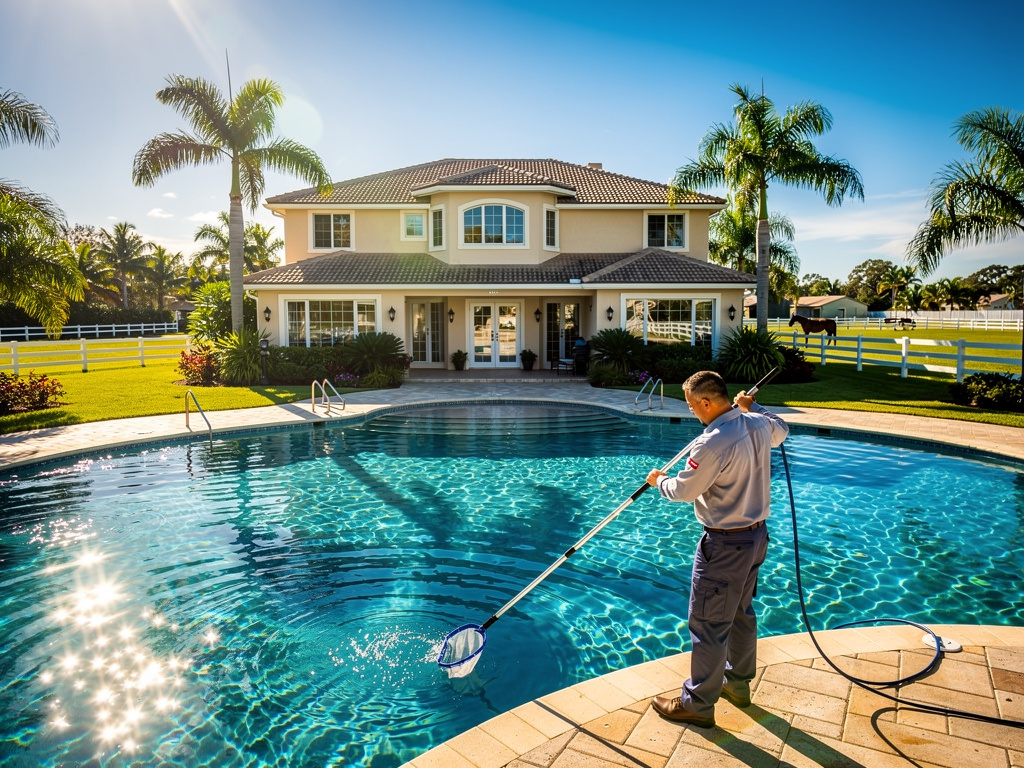
Davie’s rural lots offer what most Broward homeowners can’t get: genuine open space. But a pool in the center of a cleared lot, horse pasture, or open ranch property — no house shadow in the afternoon, no overhanging trees, no screen enclosure — is operating in conditions that drive maximum UV chlorine degradation and maximum solar heating simultaneously. Understanding how this differs from a shaded suburban pool environment helps Davie rural lot owners calibrate the right service protocol and chemical program.
At Pool Service Fort Lauderdale, we manage pools in Davie’s full-sun rural environments and configure chemical programs appropriately for the sun load these pools experience. This guide covers what the open-sky environment does to pool chemistry and how to manage it.
UV and Chlorine: The Critical Relationship in Full-Sun Davie Pools
Chlorine — in its free available form — is degraded by UV radiation. In an unstabilized pool (no cyanuric acid), UV light at South Florida’s June UV index of 11-12 can destroy 75-90% of the pool’s free chlorine in a single sunny day. This is why outdoor pool service in South Florida cannot mirror indoor pool maintenance — the UV environment is categorically different.
CYA (cyanuric acid, also called pool stabilizer or conditioner) buffers free chlorine against UV degradation by forming a loose molecular bond that slows the UV reaction. At CYA 40-50 ppm, chlorine lasts approximately 8-10 times longer in direct sun than in an unstabilized pool. This is why almost all South Florida outdoor pools use some form of stabilizer — without it, maintaining effective chlorine in a full-sun Davie rural pool would require multiple daily additions.
CYA target for full-sun Davie pools: 40-60 ppm. Below 40 ppm: UV degradation is unacceptably high for an unshaded pool. Above 80 ppm: CYA begins to interfere with chlorine effectiveness (the same molecular bond that slows UV degradation also reduces chlorine’s oxidizing power — at excessive CYA, effective sanitization requires higher free chlorine levels). Managing CYA in the 40-60 ppm range is the optimum for Davie’s full-sun pools.
Solar Heating — Managing Summer Water Temperatures in Unshaded Pools
A Davie rural lot pool in full summer sun absorbs solar energy from the pool surface continuously throughout the day. An unshaded 20,000 gallon pool can absorb 300,000-400,000 BTU of solar heat on a peak August day — enough to raise water temperature by 5-8°F from the morning low to the afternoon high. Sustained exposure through summer produces water temperatures of 88-95°F by August in unshaded Davie rural pools.
Consequences of high water temperature:
- Accelerated chlorine degradation: Warmer water increases chemical reaction rates — chlorine depletes faster in 90°F water than 80°F water
- Maximum algae growth rate: Algae growth rates peak in the 85-95°F range — full-sun Davie pools in August are in the optimal temperature range for algae bloom
- Reduced bather comfort: Pool water at 90-95°F is not comfortable for sustained swimming — the pool feels like bath water rather than a refreshing experience
Options for temperature management in full-sun Davie rural pools: pool aerators for modest cooling (3-5°F reduction overnight); a reversible heat pump with cooling mode for 8-12°F temperature reduction; or a dedicated pool chiller for consistent target temperature in peak summer. Pool covers (solar blankets) at night can reduce solar heat gain by covering the surface during low-sun hours, but they’re counterproductive during the day — a solar cover left on during full sun actually increases heat accumulation.
Evaporation and Mineral Concentration
Full-sun pools in Davie’s dry season (November-April) experience higher evaporation rates than shaded pools — unshaded water surface area in direct sunlight evaporates significantly faster than shaded pool water. Higher evaporation means more frequent top-off, and each top-off adds minerals (calcium, TDS, and any trace elements in the fill water) without diluting the minerals already in the pool. Davie full-sun rural pool owners should: track calcium hardness monthly; plan for partial drain to dilute mineral concentration when calcium approaches 400 ppm; and if topping off with well water, be particularly attentive to iron and calcium accumulation from the top-off source.
Pool Service Fort Lauderdale provides full-sun-calibrated service for Davie’s rural lot pools. Call (954) 501-2754 or visit our Davie pool service page. Full coverage at poolservicefortlauderdale.us.
Frequently Asked Questions
{“@context”:”https://schema.org”,”@type”:”FAQPage”,”mainEntity”:[{“@type”:”Question”,”name”:”Why does my Davie open-lot pool lose chlorine so fast?”,”acceptedAnswer”:{“@type”:”Answer”,”text”:”Full sun exposure in South Florida’s summer UV environment degrades free chlorine at the maximum rate. An unstabilized pool (CYA below 30 ppm) can lose 75-90% of its chlorine in a single sunny day. Ensure CYA is maintained at 40-60 ppm — at this stabilizer level, chlorine lasts 8-10 times longer in direct sun. If CYA is adequate (tested, not estimated), rapid chlorine loss indicates high organic load or high bather load creating elevated chlorine demand beyond UV degradation.”}},{“@type”:”Question”,”name”:”What is CYA and how much should my full-sun Davie pool have?”,”acceptedAnswer”:{“@type”:”Answer”,”text”:”CYA (cyanuric acid, pool stabilizer) buffers free chlorine against UV degradation by forming a molecular bond that slows the UV reaction. Target for an unshaded Davie rural lot pool: 40-60 ppm. Below 40 ppm: UV degradation is too high for full-sun South Florida conditions. Above 80 ppm: CYA begins to reduce chlorine effectiveness (requiring higher free chlorine targets to maintain sanitization). Most trichlor tablets add CYA with each dose; dichlor granules also contain CYA. Liquid chlorine and calcium hypochlorite shock contain no CYA — pools using only these products need separate CYA addition.”}},{“@type”:”Question”,”name”:”How hot does a full-sun Davie rural pool get in summer?”,”acceptedAnswer”:{“@type”:”Answer”,”text”:”88-95°F in peak August for an unshaded pool on a cleared Davie rural lot. The pool absorbs 300,000-400,000 BTU of solar energy on a peak summer day, producing 5-8°F temperature rise from morning low to afternoon high. Sustained exposure through the summer season produces the maximum range. Compared to the same pool under partial tree canopy or inside a screen enclosure, which runs 5-10°F cooler due to reduced direct solar radiation.”}},{“@type”:”Question”,”name”:”Does a solar cover heat or cool a full-sun Davie pool?”,”acceptedAnswer”:{“@type”:”Answer”,”text”:”Solar covers (blue bubble blankets) HEAT pool water — they trap solar radiation and prevent evaporative cooling. Using a solar cover during the day on a full-sun Davie pool in summer will increase water temperature, not reduce it. Solar covers are appropriate for: covering an unheated pool overnight in winter to retain heat, and for minimizing evaporation. For summer, remove the solar cover during the day. If summer pool cooling is the goal, run a pool aerator overnight, use a reversible heat pump in cooling mode, or install a dedicated pool chiller.”}},{“@type”:”Question”,”name”:”How does full sun affect pool chemistry testing accuracy in Davie?”,”acceptedAnswer”:{“@type”:”Answer”,”text”:”Test results can vary depending on when in the day the sample is taken. Morning readings (before the day’s UV degradation has occurred) show higher chlorine than afternoon readings. For consistent service-to-service comparison, test samples should be taken at the same time of day — most service providers test at the beginning of the visit, before adding any chemicals. On full-sun Davie rural pools, testing in the afternoon after significant UV exposure may show chlorine below 1 ppm even in a pool that had 3 ppm at the previous morning service visit — this is normal UV degradation, not a service failure.”}}]}
Why does my open-lot Davie pool lose chlorine so fast? Full sun in South Florida’s summer UV environment (index 11-12) degrades free chlorine rapidly. Unstabilized pool: 75-90% chlorine loss per sunny day. Maintain CYA at 40-60 ppm — at this level chlorine lasts 8-10× longer in direct sun. If CYA is adequate, rapid loss = high organic or bather load.
What is CYA and how much for a full-sun Davie pool? Cyanuric acid — UV stabilizer that buffers free chlorine against UV degradation. Target: 40-60 ppm unshaded. Below 40 ppm: UV degradation too high. Above 80 ppm: reduces chlorine effectiveness. Trichlor tablets add CYA with each dose; liquid chlorine/cal-hypo contain none — pools using only these need separate CYA addition.
How hot does a full-sun Davie rural pool get in summer? 88-95°F peak August. 300,000-400,000 BTU solar input per peak summer day = 5-8°F daily temperature rise. Shaded or enclosed pool runs 5-10°F cooler. Options to manage: aerators (3-5°F reduction), reversible heat pump cooling mode (8-12°F), dedicated pool chiller (consistent target temperature).
Does a solar cover heat or cool a full-sun Davie pool? Heats it — traps solar radiation, prevents evaporative cooling. Never use a solar cover during the day on a summer Davie pool trying to stay cool. Appropriate only for overnight heat retention in winter or to minimize evaporation in shoulder seasons.
How does full sun affect test timing accuracy? Morning readings show higher chlorine than afternoon readings after UV degradation. Take test samples at a consistent time of day for comparable service-to-service results. Afternoon chlorine below 1 ppm on a full-sun pool after a week of sun is normal UV degradation, not a service failure — calibrate expectations accordingly.