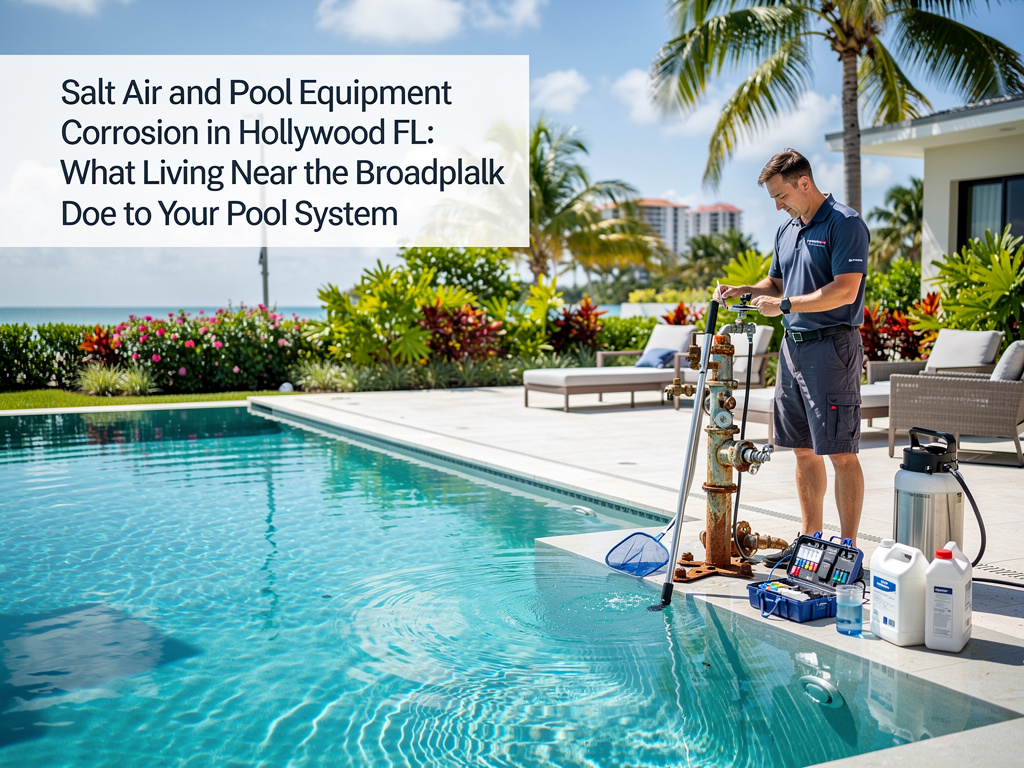
Hollywood Is a Beach Town — and Your Pool Equipment Pays the Price
Hollywood, Florida sits less than two miles from the Atlantic Ocean at its widest inland point, and properties in the eastern half of the city — everything near the Broadwalk, Hollywood Beach, and the A1A corridor — are well within the range where salt-laden ocean air actively degrades metal and electrical components. This isn’t a hypothetical risk. Pool service technicians working in beach-adjacent Hollywood neighborhoods routinely see equipment that fails years ahead of schedule compared to identical units installed in inland communities like Davie or Margate.
Salt air corrosion works through a process called electrochemical oxidation. Microscopic salt particles suspended in coastal air land on metal surfaces, absorb atmospheric moisture, and create a conductive electrolyte solution that accelerates the normal rusting and oxidation process. The closer your equipment pad is to the ocean, the more concentrated this particle load and the faster the damage accumulates. On the Hollywood Broadwalk itself, salt deposition rates can be twenty to thirty times higher than readings taken five miles inland. For pool equipment padded in an eastern Hollywood backyard, that translates to dramatically shortened service life unless you’re taking active steps to counteract it.
Which Pool Components Are Most Vulnerable to Salt Air
Not all pool equipment corrodes at the same rate. Understanding which components are highest-risk helps you prioritize inspections and replacements before a single failed part cascades into a larger system problem.
Pool pump motors are typically the first to show damage. The motor housing is usually cast aluminum or coated steel, and both corrode in salt air. More critically, the internal windings and capacitors are electrical components housed inside a shell with ventilation openings — and salt particles enter those openings with every cycle of the motor cooling down and drawing in air. Once salt deposits bridge electrical contacts inside the motor, you’ll see intermittent start failures before the motor dies completely. In high-salinity zones of Hollywood, motor lifespan can drop from the standard 8–12 years to 4–6 years without protective measures.
Gas heaters and heat pumps are particularly vulnerable because they combine metal heat exchangers, combustion chambers (gas), and refrigerant coils (heat pump) with external electrical controls — all of which corrode at different rates. Heat pump coils are designed to be exposed to outside air, but they need to be rinsed with fresh water periodically to remove salt accumulation. Gas heater copper or cupro-nickel heat exchangers can pit and develop pinholes faster in coastal air, and the result is a leak into the combustion chamber that ruins the heater entirely.
Electrical panels and subpanels near pool equipment pads in Hollywood’s coastal neighborhoods should be checked annually for terminal corrosion, corroded breaker contacts, and degraded wiring insulation. Salt air causes breaker contacts to oxidize in ways that can result in nuisance trips or, worse, high-resistance connections that generate heat. The pool bonding wire and its connection points at the equipment pad are also frequently corroded in coastal installations.
Chrome and stainless fittings, including return jet fittings, ladder anchors, and handrail sockets, are visible corrosion indicators. Even 304 stainless — the most common grade used in pool construction — is susceptible to pitting corrosion in chloride-rich environments. 316 marine-grade stainless is significantly more resistant and worth specifying when replacing fittings in high-salinity Hollywood locations.
Monthly Protection Habits That Extend Equipment Life
The most effective defense against salt air corrosion is simple and costs almost nothing: a monthly fresh-water rinse of all exposed equipment. Use a garden hose to thoroughly rinse the pump housing, filter tank, heater exterior, and any visible electrical conduit runs. This dilutes and removes accumulated salt deposits before they have time to cause sustained electrochemical damage. In the eastern Hollywood neighborhoods closest to the beach, doing this twice per month is worthwhile.
Apply dielectric grease to all electrical connections at the equipment pad when you have them serviced. Dielectric grease is silicone-based and non-conductive — it doesn’t improve electrical contact but it seals the connection against moisture and salt ingress. Any licensed electrician or pool tech can apply it during a service visit, and it dramatically slows terminal corrosion at junction boxes, time clock contacts, and the connections at your pool controller.
Heater covers are worth installing if you’re running a gas heater or heat pump in a high-salt environment. These are breathable weatherproof enclosures that reduce direct salt air exposure to the exterior cabinet without trapping moisture. Combination covers that also provide UV protection are available and are a reasonable investment for any heater within a half-mile of the Hollywood shoreline.
Consider applying a corrosion-inhibiting spray (available at marine supply stores as “corrosion inhibitor” or “contact cleaner with lubricant”) to the exterior of motor housings and the inside of electrical panel doors annually. These products leave a thin protective film that displaces moisture and slows oxidation on the metal surfaces.
Is a Saltwater System Actually Better Near the Beach?
Many Hollywood homeowners near the Broadwalk assume that because salt air is already an issue, switching to a saltwater pool system (salt chlorine generator) will make the corrosion problem worse. The reality is counterintuitive: salt chlorine generators are often a better choice in coastal environments than traditional tablet-and-granule chlorine systems, for a specific reason.
Traditional erosion-type chlorine feeders — the plastic cylinders through which pool water flows over trichlor tablets — introduce highly concentrated trichloroisocyanuric acid into the water in that zone. At high concentrations, trichlorosanuric acid is highly corrosive to metal components it contacts. The equipment immediately downstream of a tablet feeder (the heater, the check valve, the returns) sees localized chemical attack from the concentrated acid. Salt chlorine generators, by contrast, produce chlorine gradually and uniformly throughout the water column, at much lower localized concentrations.
The salt itself — maintained at 2,700–3,400 ppm in a properly operated saltwater pool — is well below the threshold where it causes additional corrosion risk to your pool shell, plaster, or equipment beyond what coastal salt air already creates. The cell itself is titanium-based, designed specifically for salt exposure, and typically lasts 5–7 years with proper care.
When to Call a Professional for Salt Corrosion Assessment
If your Hollywood pool equipment is more than five years old and hasn’t been assessed for coastal corrosion, schedule an inspection before a failure occurs. A professional assessment should cover: motor housing condition, heater heat exchanger integrity (either visual inspection or a pressure test), bonding continuity at the equipment pad, and the condition of all exposed electrical terminals. Early-stage corrosion can often be treated and slowed; advanced corrosion usually means replacement is more economical than repair.
Signs you need assessment now include: the pump making grinding or intermittent starting noises, visible rust streaks on or around equipment, heater error codes that weren’t previously appearing, GFCI trips that weren’t happening before, or any visible pitting or white chalky deposits on metal surfaces that don’t wipe away with the monthly rinse.
For professional pool equipment inspection and corrosion protection service in Hollywood and the surrounding Broadwalk area, contact Pool Service Fort Lauderdale at (954) 501-2754. We serve all of Hollywood, including Hollywood Beach, Hollywood Hills, and the Dania Beach border neighborhoods. Visit our Hollywood pool service page or our homepage to schedule service. 9900 W Sample Rd, Coral Springs, FL 33065.
{“@context”:”https://schema.org”,”@type”:”FAQPage”,”mainEntity”:[{“@type”:”Question”,”name”:”How far from the beach does salt air affect pool equipment in Hollywood FL?”,”acceptedAnswer”:{“@type”:”Answer”,”text”:”Salt air corrosion is significant within 1–2 miles of the ocean. Properties within half a mile of the Hollywood Broadwalk or beach face the highest risk. Equipment closest to the water — within a few hundred yards — can see corrosion rates twenty to thirty times higher than inland communities.”}},{“@type”:”Question”,”name”:”Which pool components corrode fastest in salt air?”,”acceptedAnswer”:{“@type”:”Answer”,”text”:”Pool pump motors, gas heaters and heat pumps, electrical panels, bonding wire connections, and chrome or stainless steel fittings are most vulnerable. The motor is typically the first component to fail prematurely in coastal Hollywood environments.”}},{“@type”:”Question”,”name”:”Does a saltwater pool system make salt air corrosion worse?”,”acceptedAnswer”:{“@type”:”Answer”,”text”:”No — saltwater systems at 2,700–3,400 ppm are far below ocean salinity (35,000 ppm) and don’t meaningfully add to the ambient salt air load. They are often a better choice near the beach than trichlor tablet systems, which introduce highly concentrated acid at the equipment feeder.”}},{“@type”:”Question”,”name”:”How do I protect my pool heater from salt air in Hollywood FL?”,”acceptedAnswer”:{“@type”:”Answer”,”text”:”Rinse the heater exterior monthly with fresh water, use a breathable weatherproof heater cover, have the heat exchanger inspected annually, and specify marine-grade titanium heat exchangers if replacing the unit. Keeping the heater covered when unused extends cabinet life significantly.”}},{“@type”:”Question”,”name”:”What is the first sign of salt air corrosion on pool equipment?”,”acceptedAnswer”:{“@type”:”Answer”,”text”:”White powdery deposits on metal surfaces that don’t wash away easily, rust streaks below fittings or motor housings, intermittent motor starting failures, and pitting on stainless or chrome fittings are early indicators of salt corrosion damage.”}}]}