Miramar’s New Development Boom and the New Pool Problem
Miramar is one of the fastest-growing cities in Broward County, and the wave of new residential construction across communities like Silver Lakes, Riviera Isles, Sunset Lakes, and the newer western Miramar subdivisions has delivered thousands of brand-new pools to homeowners who are often first-time pool owners. A new pool is not simply a finished pool — it’s a pool surface in the process of chemically curing, and the first 30 days of water chemistry management determine whether that surface develops correctly or begins accumulating problems that compound over years.
The consequence of getting new pool startup wrong is not immediately obvious. A pool that was improperly started may look fine at 30 days and even at 90 days. The problems — calcium nodule formation, surface pitting, early delamination, persistent staining — typically manifest at 12 to 36 months, exactly when the builder’s warranty period is expiring or has just expired. Understanding what the startup period requires and executing it correctly is the most important pool chemistry investment a Miramar new-construction homeowner will ever make.
What Plaster Is and Why It Needs 28 Days
New pool plaster is a mixture of white Portland cement, marble dust (calcium carbonate aggregate), and water, applied as a 3/8- to 1/2-inch coating over the gunite or concrete shell. When the plaster is first filled, it is still chemically active — the cement is completing its hydration reaction, releasing calcium and hydroxide ions into the water. This is why fresh plaster looks milky when the pool is first filled: the surface is literally dissolving a thin layer of calcium into the fill water as the hydration reaction completes.
During this 28-day cure window, the plaster surface is more vulnerable than at any subsequent point in its life. Calcium deposits can form on the surface if pH and calcium saturation are not managed carefully. Acid — even the organic acids from pool chemicals — can etch the soft, not-yet-hardened surface in ways that create a permanently rough texture. Metals in the fill water (iron, copper) can stain the light-colored new plaster surface in ways that are impossible to remove without aggressive acid washing that further damages the surface.
Fill Water: Start Right Before You Add Anything
The first step in a Miramar new pool startup is to test the fill water before adding any chemicals. Miramar’s municipal water — sourced from the Biscayne Aquifer via Broward County treatment — typically has calcium hardness in the 200–350 ppm range and total alkalinity in the 80–120 ppm range. These levels are workable starting points, but they should be confirmed, not assumed.
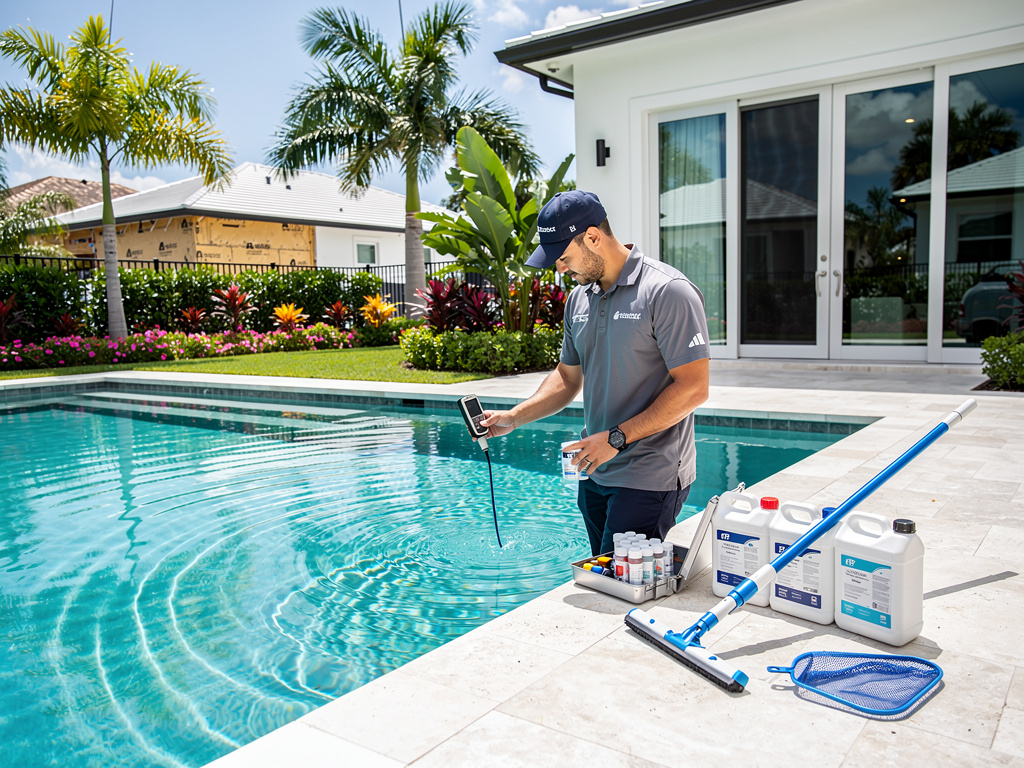
Fill the pool completely before testing. Once the pool is full, collect a water sample from elbow depth at the center of the deep end (not from the hose or the surface, which may not be representative) and test: pH, total alkalinity, calcium hardness, and metals (iron and copper). If metals are detected above 0.2 ppm, add a sequestrant immediately, before any chlorine is introduced. Chlorine oxidizes dissolved iron and copper, causing them to precipitate out of solution as visible stains on the new white plaster surface. A sequestrant keeps the metals in dissolved form until the water chemistry stabilizes.
The Startup Chemistry Sequence
The correct startup chemistry sequence for a new Miramar pool has a specific order that matters:
Step 1 — Total alkalinity: Correct alkalinity first (target 80–120 ppm). Alkalinity acts as a pH buffer, and without it in range, pH will swing unpredictably in response to any subsequent additions. Use sodium bicarbonate to raise; muriatic acid to lower.
Step 2 — pH: With alkalinity in range, adjust pH to 7.4–7.6. On a new plaster pool, staying at the low end of this range (7.4–7.5) reduces calcium carbonate precipitation on the new surface. Use muriatic acid to lower; sodium carbonate (soda ash) to raise. Do not add pH adjusters in large doses — divide large corrections into two additions 4 hours apart to avoid overshooting.
Step 3 — Calcium hardness: Target 200–300 ppm. New Miramar plaster is releasing calcium during the cure period, so the starting calcium hardness may rise 50–100 ppm on its own over the first two weeks without any additions. If fill water is already at 200+ ppm, monitor rather than adding calcium chloride immediately. If below 150 ppm, a modest addition is appropriate.
Step 4 — Chlorine: Only after pH and alkalinity are in range, add chlorine. Use liquid sodium hypochlorite (liquid pool chlorine) — not trichlor tablets, not dichlor, not cal-hypo during the first 30 days. Trichlor tablets add CYA (cyanuric acid) with every dose; you want zero CYA for the first 30 days so that chlorine performs at maximum efficiency during the cure period. Cal-hypo adds calcium; during the cure period when plaster is already releasing calcium, additional calcium can accelerate scaling.
The Daily Brushing Requirement
New plaster requires daily brushing for the first 28 days. This is not optional. Brushing serves two functions: it physically disrupts calcium carbonate deposits as they begin to form on the surface (before they harden into permanent nodules), and it circulates the pool water near the surface to prevent concentration gradients of calcium and hydroxide from the curing plaster.
Use a nylon-bristle brush, not a stainless-steel brush. Steel bristles scratch new plaster during the cure period when it’s still relatively soft. A long-handled nylon brush covering the entire surface — walls, floor, steps, corners — once per day for 28 days is the single most important physical maintenance action for a new Miramar pool. It takes 20–30 minutes. Skipping it during the first month is a common reason plaster surfaces develop textured calcium deposits that are visible from above as white blotching at 6–12 months.
What to Avoid in the First 30 Days
Several common pool maintenance practices that are fine for established pools are harmful during the plaster cure period. Algaecide containing metal-based compounds (copper algaecides) should not be used on new plaster — copper can stain a new white surface. Trichlor tablets should be avoided as described above. Shock with calcium hypochlorite should also be avoided during the cure period; if shock is needed, use liquid sodium hypochlorite or potassium monopersulfate (non-chlorine shock). Automatic robotic cleaners should stay out of the pool for at least 30 days; the rubber tracks can leave marks on the uncured surface.
Additionally, the pool should not be drained or significantly lowered during the cure period. Partial or full exposure of the curing plaster to air — and the thermal cycling that comes with it — can cause surface checking and hairline cracking in the partially cured plaster. If rain dilution or fill water addition drives the pool over capacity during the cure period, allow natural evaporation to reduce the level rather than opening the waste valve.
When Is the Pool “Broken In”?
After 28–30 days of correct startup management, the plaster cure is substantially complete. You can now add CYA (if your pool is outdoor and uses chlorine) to 30–50 ppm, transition to your normal maintenance chemical program, introduce an automatic cleaner, and consider adding a saltwater generator if that was part of your long-term plan. At this point, a full chemistry panel — pH, alkalinity, calcium hardness, cyanuric acid, metals, TDS — gives you a baseline against which to track your new pool’s chemistry going forward. Save this baseline reading; it’s the cleanest reference point you’ll ever have for how your pool water behaves before years of chemical additions, evaporation concentration, and bather load have modified it.
Pool Service Fort Lauderdale handles new construction pool startups throughout Miramar’s new developments, including Silver Lakes, Riviera Isles, and Sunset Lakes. Call (954) 501-2754, visit our Miramar pool service page, or see our full website. 9900 W Sample Rd, Coral Springs, FL 33065.
{“@context”:”https://schema.org”,”@type”:”FAQPage”,”mainEntity”:[{“@type”:”Question”,”name”:”How long does new pool plaster take to cure in Miramar FL?”,”acceptedAnswer”:{“@type”:”Answer”,”text”:”New plaster requires approximately 28 days to complete its initial cure. During this period, daily brushing, conservative chemistry management, and avoidance of stabilized chlorine products are essential to prevent calcium nodules, etching, and surface staining that can permanently damage the finish.”}},{“@type”:”Question”,”name”:”Can I use chlorine tablets on a brand-new Miramar pool?”,”acceptedAnswer”:{“@type”:”Answer”,”text”:”No. Trichlor tablets contain cyanuric acid (CYA) which accumulates in the water. During the first 30 days of a new pool’s life, zero CYA is preferred so chlorine operates at maximum effectiveness. Use liquid sodium hypochlorite (liquid pool chlorine) exclusively for the first 30 days.”}},{“@type”:”Question”,”name”:”Why does new pool water look milky after filling?”,”acceptedAnswer”:{“@type”:”Answer”,”text”:”Fresh plaster releases calcium and hydroxide ions into the water as the Portland cement completes its hydration reaction. This creates a temporary milky appearance that typically clears within 24–48 hours as the pool circulates and the surface’s initial curing reaction slows. It’s normal and expected.”}},{“@type”:”Question”,”name”:”How often should I brush a new pool in Miramar FL?”,”acceptedAnswer”:{“@type”:”Answer”,”text”:”Daily for 28 days, using a nylon-bristle brush (not stainless steel). Daily brushing disrupts early-forming calcium carbonate deposits before they harden into permanent nodules and circulates water near the surface to prevent concentration gradients.”}},{“@type”:”Question”,”name”:”When can I add a robotic cleaner to a new Miramar pool?”,”acceptedAnswer”:{“@type”:”Answer”,”text”:”Wait at least 30 days after initial plaster application. Before 30 days, the rubber tracks of automatic cleaners can leave marks or discoloration on the still-curing plaster surface. After 30 days and completion of the startup protocol, robotic cleaners can be introduced normally.”}]}}