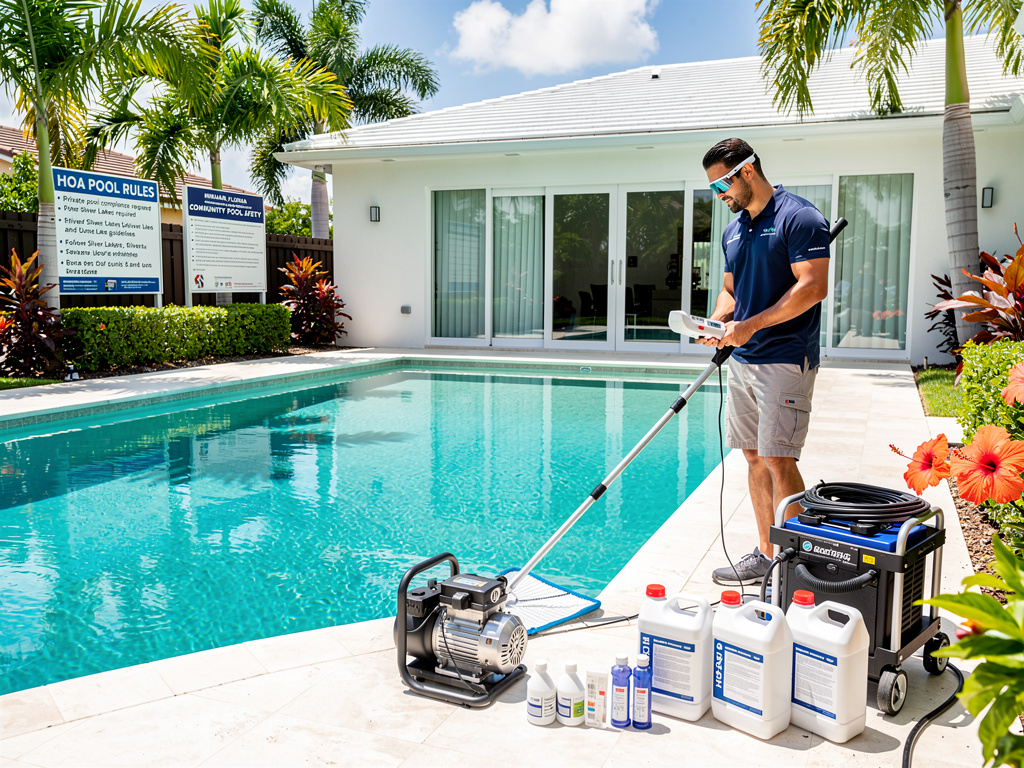
Miramar’s HOA Landscape and Pool Governance
Miramar has one of the highest concentrations of HOA-governed communities in Broward County — a natural consequence of being a planned-growth city where most residential development occurred after the 1980s, when HOA governance had become a standard feature of Florida residential subdivision development. Communities like Silver Lakes, Riviera Isles, Sunset Lakes, and the numerous other planned developments that make up the majority of Miramar’s residential fabric each have their own governing documents — CC&Rs, declaration of restrictions, and community rules — that govern what residents can and cannot do with their properties, including what they can do with or to their pools.
The intersection of HOA governance and pool ownership in Miramar creates a regulatory environment that many homeowners find more complex than expected. Florida law sets the floor — minimum safety requirements, setback standards, and permit requirements. But HOAs routinely set the ceiling much higher, imposing specific requirements for fence materials, pool equipment visibility, pool surface color choices, landscaping around the pool, and more. Understanding both layers of regulation before making any changes to your pool — and understanding how to navigate the HOA approval process — prevents the costly conflicts that arise when homeowners install first and ask permission later.
What Miramar HOAs Typically Regulate About Pools
Pool addition approval: In virtually every Miramar HOA community, adding a pool to a lot that doesn’t currently have one requires Architectural Review Committee (ARC) approval before any excavation or permitting occurs. The ARC submission typically requires: a site plan showing pool location relative to property lines and structures; a design plan showing pool dimensions, depth, and features; a specification of coping, deck, and finish materials; and an equipment plan showing where the pump, filter, and heater will be located relative to property boundaries. Some HOAs require that equipment be screened from neighboring lots and streets by landscaping or a fence panel.
Fence and barrier aesthetics: Florida law requires a 48-inch barrier but doesn’t specify the material. Miramar HOAs, however, frequently do. Chain-link fencing — functional and Florida-code-compliant — is often prohibited in the pool area by HOA rules in favor of aluminum panel fencing, black wrought-iron-style aluminum, or vinyl privacy panels. The approved fence materials list should be confirmed before purchasing any safety barrier components, since non-approved materials may need to be removed at the homeowner’s expense after an HOA inspection.
Equipment screening and noise: Many Miramar HOAs require that pool equipment be placed on the side or rear of the home where it is not visible from the street, or that it be screened by a fence or planting. Equipment noise — specifically, older single-speed pumps running at high RPM — has been a source of neighbor complaints in some Miramar communities. Variable-speed pumps running at lower speeds are significantly quieter and are increasingly specified by both Florida energy code and HOA noise management considerations.
Pool water appearance: Some Miramar HOA communities include provisions in their rules that green or visibly neglected pool water constitutes a nuisance or violation. An HOA that can see a neighbor’s green pool from a common area or shared property line may issue a violation notice requiring correction within a specified period. This is the HOA counterpart to Miramar’s municipal nuisance and code enforcement ordinances — both may apply simultaneously in some cases.
The ARC Approval Process: What to Expect
The ARC approval process timeline varies significantly between Miramar’s different HOA communities. Some ARCs meet monthly and review submissions at each meeting; others review on a rolling basis within 30 days of submission. A few of Miramar’s larger communities (Silver Lakes is one) have more structured processes with pre-submission meetings or designated HOA contact points for pool projects. Research your specific community’s process before scheduling a pool contractor, since contractor deposits are typically non-refundable if an ARC denial requires a design revision that delays the project.
When submitting to the ARC, more documentation is always better than less. A professional pool designer’s rendering (even a basic one) rather than a hand-drawn sketch improves approval rates. Material samples or manufacturer specifications for coping, deck finish, and fence materials demonstrate that the homeowner has researched compliant options rather than leaving the ARC to guess. A landscaping plan showing screening of equipment from adjacent properties addresses the most common ARC concern about pool additions in Miramar’s denser neighborhoods.
After approval, any changes to the approved design — a different coping material, a relocated equipment pad, a modified fence alignment — typically require a change notification or amended approval from the ARC. Document changes in writing, not just verbally with the contractor. The approved plan is the reference document if a compliance dispute arises later.
HOA Pool Rules vs Florida Law: Who Wins?
When an HOA rule conflicts with Florida law, Florida law generally prevails — but this is rarely the relevant conflict in Miramar. HOA rules typically don’t conflict with Florida law because they add requirements on top of state minimums rather than contradicting them. The rare conflict arises when an HOA rule is so restrictive that it makes complying with Florida’s safety barrier requirements technically difficult (for example, an HOA rule requiring a fence material that is not available in a VGB-compliant drain-cover-height format). In those cases, consulting with a Florida HOA attorney is appropriate before proceeding.
More commonly, Miramar homeowners discover that their HOA has requirements they didn’t know about because they didn’t read the governing documents before purchasing. Florida law requires disclosure of HOA documents before purchase, but understanding them is the buyer’s responsibility. Before starting any pool project in a Miramar HOA community, request the current CC&Rs, declaration, and community rules specifically referencing pools, landscaping, and exterior improvements — then read them carefully or have your attorney review the relevant sections.
Maintenance Standards and HOA Compliance
Beyond construction, some Miramar HOAs have ongoing maintenance standards that affect pool owners. Green, abandoned, or visibly algae-ridden pools trigger complaints and often HOA violation notices. Some communities also address pool areas in their property maintenance requirements — overgrown landscaping around a pool, deteriorated pool deck concrete, faded or peeling pool fencing may all constitute HOA violations separate from any code enforcement action by the city of Miramar itself.
Regular professional pool service prevents the water quality issues that lead to HOA complaints. A pool that is serviced weekly maintains the appearance standards that keep it from becoming a neighbor dispute. The relatively high HOA density in Miramar means that pool maintenance failures are more likely to be noticed and reported than in non-HOA neighborhoods — which is one practical reason why professional service rates are higher in HOA-dense communities like Miramar’s lakefront developments.
Pool Service Fort Lauderdale provides weekly maintenance service throughout Miramar FL including Silver Lakes, Riviera Isles, and Sunset Lakes HOA communities. Call (954) 501-2754, visit our Miramar pool service page, or see our full website. 9900 W Sample Rd, Coral Springs, FL 33065.
{“@context”:”https://schema.org”,”@type”:”FAQPage”,”mainEntity”:[{“@type”:”Question”,”name”:”Do I need HOA approval to add a pool in Miramar FL’s Silver Lakes or Riviera Isles?”,”acceptedAnswer”:{“@type”:”Answer”,”text”:”Yes. Virtually all of Miramar’s HOA communities require Architectural Review Committee (ARC) approval before any pool addition. Submitting a site plan, design drawings, and material specifications before excavation or permitting is required. ARC approval should be obtained in writing before signing any contractor agreement.”}},{“@type”:”Question”,”name”:”What fence materials are allowed for pool barriers in Miramar HOA communities?”,”acceptedAnswer”:{“@type”:”Answer”,”text”:”Florida law allows any 48-inch barrier that meets code, but Miramar HOAs frequently restrict fence materials to aluminum panel, black aluminum (wrought-iron style), or vinyl privacy fencing. Chain-link is commonly prohibited in the pool barrier zone by HOA governing documents. Confirm your community’s approved list before purchasing any fencing.”}},{“@type”:”Question”,”name”:”Can my HOA fine me if my pool water turns green in Miramar?”,”acceptedAnswer”:{“@type”:”Answer”,”text”:”Potentially yes. Many Miramar HOAs include pool water appearance in their property maintenance standards. Green or algae-ridden pool water visible from neighboring properties or common areas can generate an HOA violation notice with a correction deadline and potential fines for non-compliance.”}},{“@type”:”Question”,”name”:”What happens if I build a pool in a Miramar HOA community without ARC approval?”,”acceptedAnswer”:{“@type”:”Answer”,”text”:”The HOA can require removal or modification at the homeowner’s expense. You may also face fines during the period of non-compliance. Many Miramar HOAs have recorded this kind of enforcement action in their board minutes — unauthorized pool additions are among the most expensive HOA compliance resolutions homeowners face.”}},{“@type”:”Question”,”name”:”How long does ARC pool approval take in Miramar FL?”,”acceptedAnswer”:{“@type”:”Answer”,”text”:”Timeline varies by community. Most Miramar HOA ARCs review submissions within 30 days; some communities with monthly board meetings may take 30–60 days. Silver Lakes and similar larger communities may have more structured processes with specific contact points for pool projects. Research your community’s specific process before scheduling contractors.”}]}}