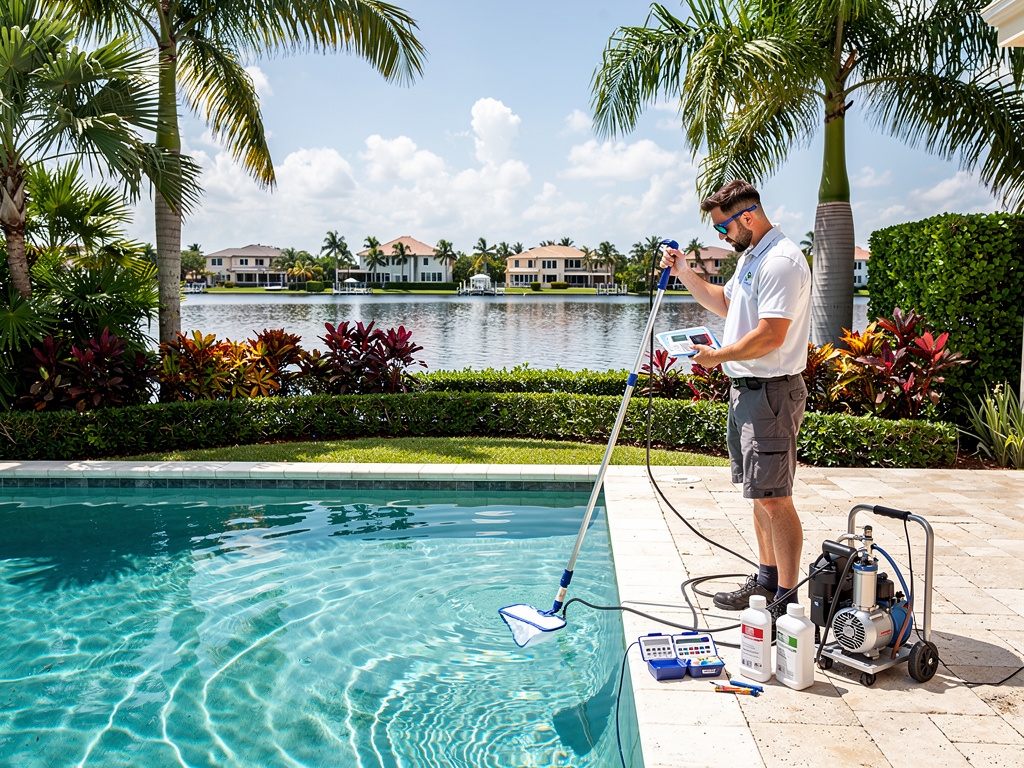
What Makes Miramar’s Lakefront Communities Different for Pool Owners
Silver Lakes, Riviera Isles, Sunset Lakes, and other water-adjacent communities in Miramar were developed around the natural and man-made lake systems that characterize this part of Broward County. The aesthetic appeal of waterfront living is obvious, and the property value premium for lakefront or lake-view lots is real and persistent. What many homeowners discover after moving in, however, is that a pool immediately adjacent to a Florida lake is not quite the same maintenance proposition as a pool on an inland suburban lot.
The lake is a biological system — a living body of water with its own algae populations, bird and wildlife traffic, organic nutrient cycles, and airborne dispersion characteristics. Your pool, sitting a few hundred feet from this system, is continuously receiving inputs from it: airborne algae spores carried by wind from the lake surface, phosphate-rich bird droppings from the ibises, anhingas, herons, and other wading birds that populate Miramar’s lake systems, organic particles blown from aquatic vegetation at the lake edge, and in some cases water intrusion during flood events that bring lake water chemistry directly into contact with the pool’s watershed.
Phosphates: The Hidden Driver of Algae in Lakefront Miramar Pools
Phosphates are the primary nutrient that algae require to grow. In a non-lakefront pool, phosphate sources are limited: fill water, swimmer body residue, and fertilizer overspray from lawn care. In a lakefront pool in Miramar’s Silver Lakes or Riviera Isles, phosphates arrive continuously from bird droppings — which are phosphate-rich because birds excrete phosphorus from their diet directly into their uric acid waste. A single bird’s daily waste contribution introduces measurable phosphate to a residential pool that the bird uses as a resting or drinking spot. Multiply that by the ibis and heron populations that are endemic to Miramar’s lakes, and the phosphate load is significant.
Phosphate levels above 200 ppb (parts per billion) create algae-favorable conditions that make it significantly harder to maintain adequate chlorine effectiveness. Algae doesn’t grow because of low chlorine per se — it grows because phosphates provide the nutrient base that allows algae to colonize surfaces faster than available chlorine can eliminate them. A pool that is consistently struggling with green tinges, cloudy water, or algae on the walls despite adequate chlorine levels is very often a pool with elevated phosphate from environmental loading.
The solution is a monthly phosphate remover treatment (lanthanum-based phosphate removers are the most effective class; brands like PHOSfree, Natural Chemistry Phosfree, or similar) dosed according to your current phosphate level. Phosphate testing should be added to the regular chemistry panel for any Miramar lakefront pool — it’s not typically included in standard test strips but is measured by drop tests or by pool supply store professional water testing. Target below 100 ppb; below 50 ppb is ideal.
Airborne Algae Spores from Lake Surfaces
Florida lake surfaces are productive biological environments, and their algae populations — particularly cyanobacteria (blue-green algae) and green algae species common in Broward County’s warm, nutrient-rich lakes — reproduce via spores that can become airborne when wind disturbs the surface. A pool downwind from a Miramar lake receives a continuous low-level inoculation of algae spores that pools on interior lots never experience.
This is why lakefront pools in Silver Lakes and similar communities need chlorine maintained closer to the upper end of the recommended range (3.0–4.0 ppm free chlorine, not 1.0–2.0 ppm). At the lower end of the range, incoming spore loads can establish themselves on walls and steps faster than available chlorine eliminates them. At 3.0–4.0 ppm with regular brushing, incoming spores encounter an inhospitable environment and are oxidized before they can colonize the surface.
Weekly brushing of pool walls and floor is more important for lakefront Miramar pools than for interior-lot pools. Biofilm — the thin, nearly invisible microbial layer that develops on pool surfaces — is the attachment matrix that algae use to begin colonizing a surface. Regular brushing disrupts biofilm formation before it can develop into a full algae outbreak. Combined with adequate free chlorine, weekly brushing is the most cost-effective algae prevention protocol for Miramar’s lakefront pool owners.
Wildlife and Organic Debris in Lakefront Pools
The wildlife adjacent to Miramar’s lakes is diverse and, from a pool maintenance perspective, intrusive. Frogs are common pool visitors — they’re attracted to the water and often lay egg masses on pool steps and in corners. Frog eggs are phosphate-rich and, if not removed promptly, begin decomposing and consuming chlorine. Lizards, particularly green iguanas which have become abundant in Broward County’s southern communities, occasionally enter pools and — if they can’t exit — drown. A dead iguana in a pool is a significant biological contamination event requiring immediate super-chlorination.
Birds, as discussed above, contribute phosphate loading. Bird feathers, which contain organic compounds that consume chlorine and can cause surface staining, accumulate in skimmer baskets and on pool steps. Daily skimmer basket checks — more frequent than the once-per-service-visit standard — are appropriate for lakefront Miramar pools during high bird activity seasons (fall and winter, when migratory birds supplement the year-round resident population).
Lake-adjacent vegetation — cattails, Brazilian pepper, melaleuca, and ornamental plantings along the lake edge — sheds plant material that winds carry into lakefront pool areas. The organic acids in decomposing vegetation consume chlorine and, if allowed to accumulate on pool surfaces, can cause tannin staining on light plaster finishes. Dark-colored plaster finishes (charcoal, dark blue) are less susceptible to visible tannin staining than traditional white plaster — a design consideration worth noting for Miramar lakefront homeowners planning a resurfacing.
Screen Enclosures: The Practical Solution for Lakefront Miramar Pools
A screen enclosure dramatically reduces all of the inputs described above. Airborne algae spores cannot penetrate fine pool screen. Bird access is blocked, eliminating direct droppings in the pool. Wind-carried plant debris is intercepted at the screen surface rather than landing in the water. The phosphate loading from environmental sources drops by 60–80% with a properly installed enclosure.
For Miramar HOA communities, screen enclosure approval through the ARC is required before installation. Most Miramar HOAs allow screen enclosures on lakefront lots because they are a standard Florida pool feature and do not significantly alter the community’s visual character. The ARC will typically review the frame height, screen color (dark charcoal or black is standard in most communities), and the enclosure’s impact on neighboring sight lines before approval.
Even without an enclosure, a lakefront Miramar pool owner should realistically budget for more frequent service visits and a higher chemical consumption rate than a comparable interior-lot pool. The environmental inputs from the lake are ongoing and cannot be fully managed by a once-per-week service model during high-activity periods.
Pool Service Fort Lauderdale serves lakefront pools throughout Miramar FL including Silver Lakes, Riviera Isles, and Sunset Lakes. Call (954) 501-2754, visit our Miramar pool service page, or see our full website. 9900 W Sample Rd, Coral Springs, FL 33065.
{“@context”:”https://schema.org”,”@type”:”FAQPage”,”mainEntity”:[{“@type”:”Question”,”name”:”Why do pools in Silver Lakes and Riviera Isles Miramar get algae more often?”,”acceptedAnswer”:{“@type”:”Answer”,”text”:”Lake proximity brings higher phosphate loading (from bird droppings), airborne algae spores from the lake surface, and wind-carried organic debris — all of which create algae-favorable conditions. Maintaining free chlorine at 3.0–4.0 ppm rather than 1.0–2.0 ppm, monthly phosphate remover treatments, and weekly brushing are the key countermeasures.”}},{“@type”:”Question”,”name”:”What are phosphates and why do they matter for lakefront Miramar pools?”,”acceptedAnswer”:{“@type”:”Answer”,”text”:”Phosphates are the primary nutrient algae need to grow. Bird droppings, organic runoff, and lake-adjacent vegetation shed phosphates continuously into lakefront pools. Levels above 200 ppb create algae-favorable conditions that overwhelm normal chlorine management. Monthly lanthanum-based phosphate remover keeps levels below 100 ppb.”}},{“@type”:”Question”,”name”:”Does a screen enclosure help with algae on a Miramar lakefront pool?”,”acceptedAnswer”:{“@type”:”Answer”,”text”:”Yes, significantly. Screen enclosures block airborne algae spores, bird access (and their phosphate-rich droppings), and wind-carried plant debris. Environmental phosphate loading in screened Miramar lakefront pools drops by 60–80% compared to open-air pools in the same position. HOA ARC approval is required before installation.”}},{“@type”:”Question”,”name”:”What should I do if an iguana drowns in my Miramar pool?”,”acceptedAnswer”:{“@type”:”Answer”,”text”:”Remove the animal immediately with a net (do not touch directly). Super-chlorinate the pool to 10 ppm free chlorine and run the filter continuously for 24 hours. Retest chemistry before swimming. A dead animal in a pool is a significant biological contamination event; shock treatment is not optional.”}},{“@type”:”Question”,”name”:”How often should I test phosphates in a Miramar lakefront pool?”,”acceptedAnswer”:{“@type”:”Answer”,”text”:”Monthly is the standard recommendation for lakefront Miramar pools, compared to quarterly for interior-lot pools with lower environmental loading. Test at your local pool supply store or use a drop-test kit specific to phosphates — standard test strips do not measure phosphate. Target below 100 ppb; dose phosphate remover when above 200 ppb.”}]}}