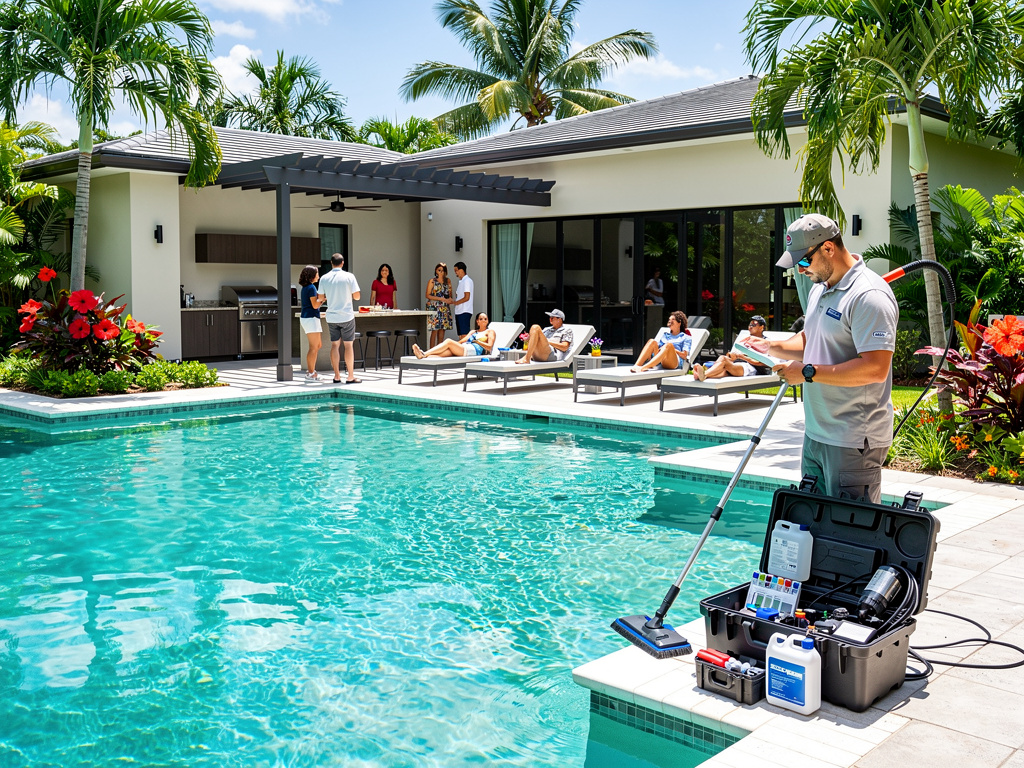
Miramar’s Social Pool Culture and What It Demands
Miramar’s Caribbean and Latin American communities — representing a significant fraction of the city’s diverse and rapidly growing population — share a cultural relationship with outdoor entertaining and family gatherings that places the backyard pool at the center of social life in a way that differs from the more occasional use pattern common in many North American pool-owning households. Pool use is not a weekend-only activity, and it’s not limited to immediate household members. Extended family visits, community social gatherings, birthday parties, holiday celebrations, and simply the deep-rooted outdoor living culture of Caribbean and Latin American households means that Miramar pools in these communities see regular high-use patterns week over week, year-round.
This is a feature, not a problem — a pool that serves as the center of an active social family life is exactly what a residential pool should be. But it requires a different maintenance philosophy than the model designed for a pool that two adults use twice per week. The chemical demand is higher, the filter load is higher, and the consequences of deferred maintenance are more visible and more rapid in a high-use pool than in a lightly used one. Understanding this and adjusting the maintenance program to match actual use intensity is the foundation of successful pool ownership for Miramar’s most socially active pool households.
Year-Round High Use: The Miramar Baseline
In most of the United States, pool maintenance professionals plan around a defined pool season — months of heavy use followed by months of minimal use or winterization. In Miramar, there is no off-season. December, January, and February may see slightly less use during cool spells, but the fundamental pattern is continuous year-round pool activity in households with an active social culture. This means the chemical consumption, filter loading, and equipment wear that northern pool management budgets for 4–6 months must be planned for across 12 months in Miramar.
Annual equipment service and replacement planning should reflect this. A pool pump that might last 10–12 years on a seasonal use pattern in a northern climate may realistically last 7–9 years in a high-use Miramar household where it runs 12 months per year, 365 days per year, often for 10+ hours per day. Salt chlorine generator cells that are rated for 5–7 years at standard use may need replacement at 4–5 years in a high-bather-load Miramar pool where the generator is working at or near capacity for a larger fraction of each day. Plan maintenance budgets accordingly.
Proactive Chemistry: The High-Use Pool Standard
Standard residential pool chemistry guidance targets free chlorine at 1.0–3.0 ppm. For a high-use social pool in Miramar, the target range should be 3.0–4.0 ppm free chlorine. The difference matters: at 1.0 ppm, a heavy bather load of 10–15 people for an afternoon can deplete free chlorine to below 0.5 ppm — the threshold where sanitization becomes marginal. At 3.0–4.0 ppm, the same bather load depletes chlorine but maintains a residual above 1.5 ppm through the event, which is adequate to prevent acute sanitation problems.
Maintaining 3.0–4.0 ppm continuously requires either more frequent chemical additions or a continuous chlorine production source. Trichlor tablet systems, if used, need to be adjusted to match actual consumption rates — not the “one tablet per 10,000 gallons per week” rule of thumb designed for average use. The tablet feeder should be dialed to maintain the actual target range when measured before and after typical use days, not calibrated against a fixed formula.
A saltwater chlorine generator is the most practical continuous production solution for high-use Miramar pool households. The generator’s output percentage can be increased to match periods of heavy use and decreased during lower-use periods, providing flexible production that adapts to actual demand. Unlike tablet systems, the generator cannot be forgotten or allowed to run out between service visits — it produces chlorine whenever the pump is running, regardless of whether anyone remembered to add tablets that week.
Enzyme Treatments: Managing the Organic Load
High bather load introduces a continuous organic burden — body oils, sunscreen, sweat, nitrogen compounds — that chlorine cannot fully address. Chlorine’s role is sanitization, not organic removal; it oxidizes some organic compounds but converts others into combined chlorine (chloramines) rather than breaking them down. The result in a high-use pool that relies on chlorine alone is a gradual buildup of oils, chloramines, and organic byproducts that manifests as waterline scum lines, filter loading, combined chlorine odor, and water that doesn’t feel clean despite adequate chemistry readings.
Enzyme treatments — typically applied weekly or bi-weekly in high-use pools — contain lipase and other enzymes that specifically break down oils, lotions, and organic waste into CO₂ and water, addressing the organic load that chlorine cannot. For a Miramar pool hosting regular large gatherings, a weekly enzyme dose (products like Natural Chemistry Pool Perfect, Bio-Active Pool Enzymes, or similar) prevents the cumulative organic buildup that eventually requires a full drain-and-refill to resolve. The cost — typically $20–$30 per month for a residential enzyme program — is negligible compared to the cost of treating the problems that develop without it.
Filter Management for Continuous High-Use Pools
Standard guidance for pool filter cleaning is monthly backwashing (sand filters) or quarterly cartridge cleaning. For a Miramar high-use social pool, those intervals are insufficient. Sand filters should be backwashed every 2–3 weeks when the pressure rises 8–10 psi above the clean baseline, not monthly as a fixed schedule. Cartridge filters handling a high-organic-load pool should be rinsed every 4–6 weeks and soaked in filter cleaner solution every 2–3 months to break up oil accumulation that hose rinsing alone can’t remove.
The filter run time should be extended during heavy-use periods. A pool that typically runs 8 hours per day should run 12 hours per day the day of a large gathering and 10 hours per day for the two days following. The extended run time addresses both the turbidity from heavy bather load and the need to maintain continuous chlorine production through the generator or tablet feeder during the recovery period. Pool owners with variable-speed pumps can set a “party mode” schedule that runs longer hours at medium speed — maintaining filtration volume without the electricity cost of running at high speed for extended periods.
Pool Service Fort Lauderdale serves Miramar FL’s diverse communities with weekly professional pool maintenance tailored to high-use households. Call (954) 501-2754, visit our Miramar pool service page, or see our full website. 9900 W Sample Rd, Coral Springs, FL 33065.
{“@context”:”https://schema.org”,”@type”:”FAQPage”,”mainEntity”:[{“@type”:”Question”,”name”:”What free chlorine target is correct for a high-use social pool in Miramar FL?”,”acceptedAnswer”:{“@type”:”Answer”,”text”:”3.0–4.0 ppm rather than the minimum 1.0–2.0 ppm recommended for average-use pools. At 3.0–4.0 ppm, a heavy bather load of 10–15 people depletes chlorine during the event but maintains a residual above 1.5 ppm through the gathering. At 1.0 ppm starting point, depletion to below 0.5 ppm (marginal sanitation) during heavy use is likely.”}},{“@type”:”Question”,”name”:”How do enzyme treatments help a high-use Miramar pool?”,”acceptedAnswer”:{“@type”:”Answer”,”text”:”Enzymes break down body oils, sunscreen, and organic waste into CO₂ and water — the compounds that chlorine converts into chloramines rather than eliminating. Weekly enzyme treatment in a high-bather-load Miramar pool prevents the cumulative organic buildup that causes waterline scum, filter loading, chloramine odor, and water that feels unclean despite adequate chemistry readings.”}},{“@type”:”Question”,”name”:”Is a saltwater system better than tablets for a high-use Miramar pool?”,”acceptedAnswer”:{“@type”:”Answer”,”text”:”Yes. Salt chlorine generators produce chlorine continuously whenever the pump is running, adapting to demand by adjusting the output percentage. Tablet systems produce at a fixed rate that may be inadequate on heavy-use days and over-produces on light-use days, causing CYA accumulation over time that reduces chlorine effectiveness.”}},{“@type”:”Question”,”name”:”How often should I backwash a sand filter on a high-use Miramar pool?”,”acceptedAnswer”:{“@type”:”Answer”,”text”:”Every 2–3 weeks, or when filter pressure rises 8–10 psi above the clean baseline — whichever comes first. Monthly backwashing is designed for average-use pools; a high-use Miramar pool loads filters significantly faster, and a saturated filter passes contaminated water rather than filtering it.”}},{“@type”:”Question”,”name”:”How do I manage a pool that hosts frequent large gatherings year-round in Miramar?”,”acceptedAnswer”:{“@type”:”Answer”,”text”:”Maintain free chlorine at 3.0–4.0 ppm continuously; use weekly enzyme treatments; run the filter 12 hours the day of any large gathering and 10 hours the two days after; backwash every 2–3 weeks; and consider a saltwater generator for continuous chlorine production that adjusts to demand rather than relying on fixed tablet dissolution rates.”}]}}