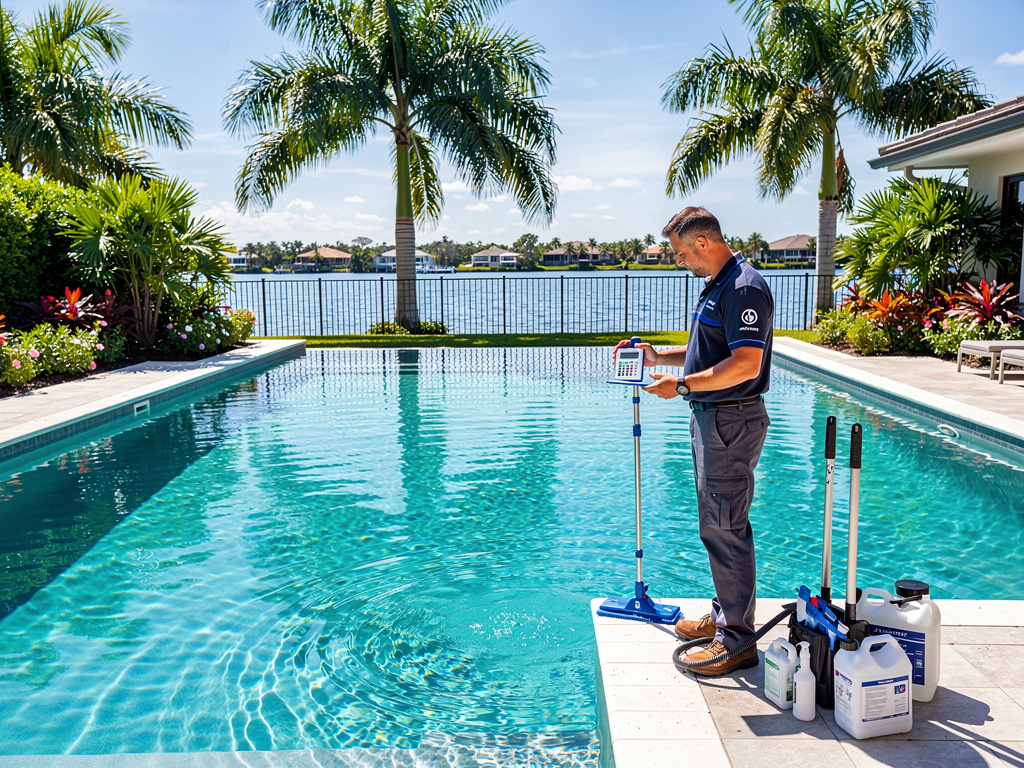
Why Algae Keeps Coming Back in Miramar Lakefront Pools
Algae outbreaks in Miramar’s Silver Lakes, Riviera Isles, and Sunset Lakes pool communities are a recurring frustration for homeowners who feel they’re doing everything right — maintaining chlorine, running the filter, even shocking regularly — but still find green or cloudy water returning week after week. The source of this pattern is almost always phosphates, not chlorine. Understanding the distinction between chlorine management and phosphate management is the key to breaking the cycle.
Algae is a plant, and like all plants it requires nutrients to grow. The primary limiting nutrient for algae in pool water is phosphorus, in the form of soluble phosphate (PO₄³⁻). In the absence of phosphate, algae cannot grow to nuisance levels even when other conditions (warm water, sunlight, some reduction in chlorine) favor it. When phosphate is abundant — as it is in lakefront Miramar pools that receive continuous phosphate input from the surrounding lake environment — algae has the nutrient it needs to colonize surfaces faster than available chlorine can eliminate it. This is the “phosphate-driven algae cycle,” and it cannot be solved by adding more chlorine alone.
How Phosphates Enter Miramar’s Lakefront Pools
Lakefront pools in Silver Lakes, Riviera Isles, and Sunset Lakes receive phosphate from multiple simultaneous sources, which is why the accumulation rate is higher than in interior-lot pools where phosphate sources are limited.
Bird droppings are the dominant phosphate source for most Miramar lakefront pools. The bird activity around Broward County’s lake systems is high and year-round: ibises, anhingas, herons, egrets, moorhens, and coots are permanent residents, supplemented by migratory waterfowl from October through March. These birds use pool areas as landing platforms, drink from pool water, and deposit uric acid waste that is highly phosphate-concentrated — a single ibis’s daily droppings contribute measurable phosphate to a residential pool. Multiply by the dozens of birds that may transit a lakefront Silver Lakes property in a single day, and the phosphate input is continuous and significant.
Organic runoff and sediment from the lake boundary introduces phosphates from decomposing organic matter at the lake edge — algae, aquatic vegetation, and sediment stirred by wind or rain events. This input is more variable (peaking during and after rainstorms) than bird-source phosphate but can contribute substantially after Miramar’s heavy summer storms.
Lawn fertilizer is a non-lake-specific source that is significant in Miramar’s newer developments, where professional lawn care services routinely apply phosphate-containing fertilizers. Overspray or runoff from fertilized turf into the pool (particularly after irrigation or rain) introduces a phosphate pulse. Florida “Green Industries Best Management Practices” prohibit fertilizer application within 10 feet of water bodies, but compliance enforcement in residential settings is limited.
Fill water from Miramar’s municipal supply contains low but non-zero phosphate — typically 0.5–1.0 ppm (500–1,000 ppb) from phosphate-based corrosion inhibitors added during water treatment. This base-level input accumulates in pools that are never partially drained and is the reason that even interior-lot Miramar pools benefit from annual phosphate testing.
Measuring and Interpreting Phosphate Levels
Phosphate is measured in parts per billion (ppb) using a drop test kit specific to phosphates or at a pool supply store with professional water testing equipment. Standard test strips do not measure phosphate — you need a separate dedicated test for this parameter. The key thresholds for Miramar lakefront pools are:
Below 100 ppb: Good. Algae growth rate is limited by phosphate availability at this level, and standard chlorine management (2.0–3.0 ppm free chlorine) is adequate to prevent algae establishment.
100–200 ppb: Caution range. Phosphate is accumulating; apply a maintenance dose of phosphate remover and test again in 2 weeks.
Above 200 ppb: Treatment required. At this level, chlorine alone cannot prevent algae colonization in a Miramar lakefront pool. Apply a full treatment dose of lanthanum-based phosphate remover and expect the water to temporarily cloud (a normal reaction as lanthanum precipitates phosphate out of solution) and then clear within 24–48 hours as the filter removes the precipitate.
Above 500 ppb: Severe. Multiple treatment doses may be needed, spaced 2 weeks apart. At this level, algae outbreaks are virtually certain without aggressive intervention. Evaluate phosphate sources and take steps to reduce them (bird deterrents, fertilizer-free buffer zone, screen enclosure if not already present).
The Lanthanum Treatment Protocol
Lanthanum-based phosphate removers (the active ingredient in products like PHOSfree, Natural Chemistry Phosfree, SeaKlear Phosphate Remover, and similar) work by combining with dissolved phosphate to form an insoluble lanthanum phosphate precipitate that can be removed by the filter. The reaction is fast and visible — pool water will often turn slightly milky or cloudy within hours of treatment as the precipitate forms. This is not an indication of a problem; it’s the treatment working as intended.
During treatment, run the filter continuously for 24–48 hours to capture the lanthanum phosphate precipitate before it can settle on pool surfaces. Backwash or clean the filter at the end of the treatment period — lanthanum phosphate precipitate loads filters significantly. Avoid swimming during the 24 hours immediately after a full-dose treatment, as the cloudiness from precipitate formation reduces water clarity (though the product itself is not harmful at treatment doses).
For Miramar lakefront pools, a phosphate remover maintenance dose — half the treatment dose — applied monthly even when phosphate levels are below 200 ppb prevents accumulation from reaching the treatment threshold in the first place. This “stay below 200 ppb” maintenance approach is more efficient than allowing phosphate to accumulate to 500+ ppb and then treating it aggressively, because the biological cost of allowing algae-favorable phosphate levels for weeks between treatment cycles is paid in chlorine consumption and potential outbreaks.
Chlorine Targets for Phosphate-Managed Lakefront Pools
Even with effective phosphate management, lakefront Miramar pools should target higher free chlorine than the standard 1.0–2.0 ppm minimum. The continuous airborne algae spore input from adjacent lake surfaces means that the pool’s first line of defense against algae establishment is a robust free chlorine residual that destroys incoming spores before they can attach to surfaces. At 3.0–4.0 ppm free chlorine, incoming spores are typically oxidized within minutes of contacting pool water. At 1.0 ppm, the oxidation rate is adequate for normal conditions but may not match the spore input rate near an active Florida lake during warm months.
The combination of monthly phosphate management, free chlorine maintained at 3.0–4.0 ppm, and weekly wall brushing (which disrupts biofilm that algae use as an attachment matrix) provides three independent lines of defense against the algae cycle in Miramar’s lakefront pools. Any one of these alone is insufficient against the environmental load present in Silver Lakes, Riviera Isles, and Sunset Lakes. All three together create a pool that reliably stays clear week over week, even through Miramar’s high-algae-pressure summer months.
Pool Service Fort Lauderdale provides phosphate testing, treatment, and ongoing algae prevention service throughout Miramar FL’s lakefront communities. Call (954) 501-2754, visit our Miramar pool service page, or see our full website. 9900 W Sample Rd, Coral Springs, FL 33065.
{“@context”:”https://schema.org”,”@type”:”FAQPage”,”mainEntity”:[{“@type”:”Question”,”name”:”Why does algae keep coming back in my Silver Lakes or Riviera Isles pool despite regular chlorine?”,”acceptedAnswer”:{“@type”:”Answer”,”text”:”Persistent algae in Miramar lakefront pools is almost always driven by phosphate accumulation, not just low chlorine. Phosphates above 200 ppb provide the nutrient base that allows algae to colonize surfaces faster than available chlorine can eliminate them. Test phosphate monthly and treat with lanthanum-based remover when above 200 ppb.”}},{“@type”:”Question”,”name”:”What is a lanthanum phosphate remover and how does it work?”,”acceptedAnswer”:{“@type”:”Answer”,”text”:”Lanthanum-based products (PHOSfree, Natural Chemistry Phosfree, SeaKlear, etc.) combine with dissolved phosphate to form an insoluble precipitate that the filter removes. The pool may temporarily cloud during treatment — this is normal. Run the filter continuously for 24–48 hours after treatment and clean the filter afterward.”}},{“@type”:”Question”,”name”:”How often should I test phosphates in a Miramar lakefront pool?”,”acceptedAnswer”:{“@type”:”Answer”,”text”:”Monthly. Standard test strips don’t measure phosphate — use a dedicated drop-test kit or pool supply store water analysis. Maintain below 100 ppb for best algae prevention; treat at 200 ppb before reaching the algae-favorable threshold rather than waiting for an outbreak.”}},{“@type”:”Question”,”name”:”What chlorine level should I target in a Silver Lakes or Sunset Lakes pool?”,”acceptedAnswer”:{“@type”:”Answer”,”text”:”3.0–4.0 ppm free chlorine, not the 1.0–2.0 ppm minimum recommended for non-lakefront pools. The continuous airborne algae spore input from adjacent lake surfaces requires a higher residual to destroy incoming spores before they colonize pool walls. Lower levels are inadequate against the spore pressure of an active Florida lake environment.”}},{“@type”:”Question”,”name”:”Does a screen enclosure solve the algae problem in Miramar lakefront pools?”,”acceptedAnswer”:{“@type”:”Answer”,”text”:”It significantly reduces it. Screen enclosures block airborne spores, bird access, and wind-carried organic debris — cutting environmental phosphate input by 60–80%. Screened lakefront Miramar pools still need phosphate monitoring (fill water and occasional bird/insect entry contribute some load) but typically require far less treatment than unscreened pools in the same position.”}]}}