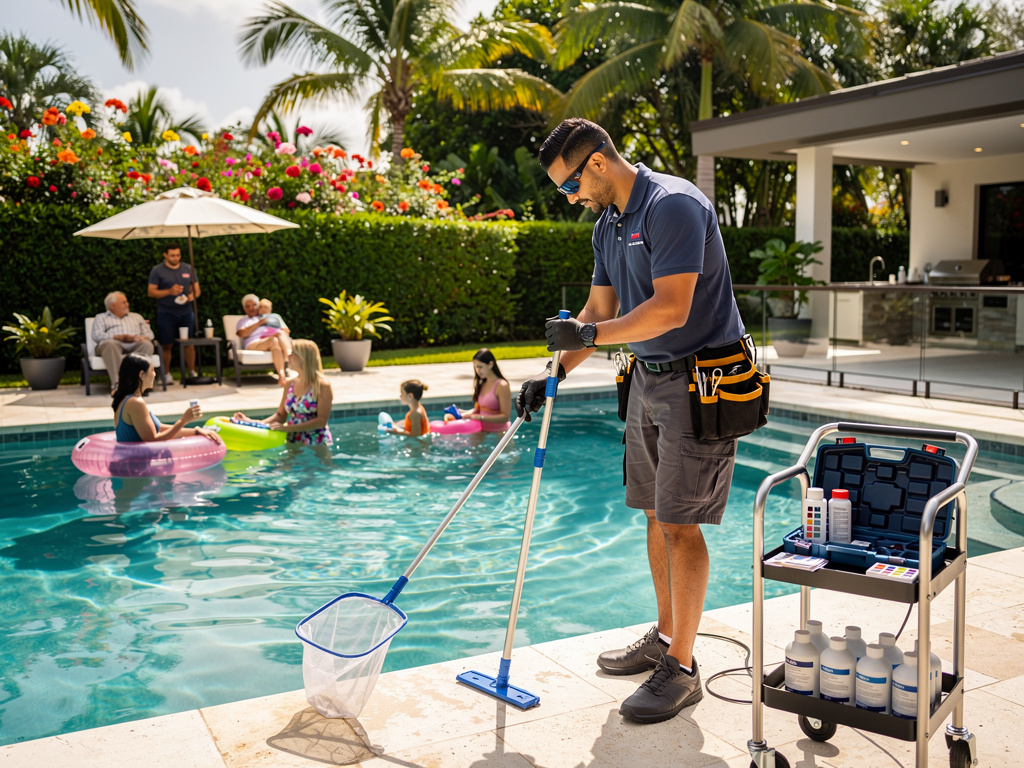
Pembroke Pines’ Venezuelan and Colombian Community and the Backyard Pool
Pembroke Pines has one of the most significant Venezuelan and Colombian communities in South Florida — a demographic that has grown substantially over the past two decades and has profoundly shaped the city’s character, its neighborhoods, and its social culture. For Venezuelan and Colombian families, the backyard pool in Pembroke Pines is not merely a recreational amenity; it is frequently the center of family life — the gathering point for weekend visits, birthday celebrations, holiday gatherings, Sunday afternoon asados, and the kind of casual multi-family socializing that defines the outdoor living culture brought from Caracas, Bogotá, and Medellín.
What makes this pool use pattern distinctive from the standpoint of pool maintenance is its multigenerational nature. A Venezuelan or Colombian household pool in Chapel Trail or Pembroke Falls is likely to see, in a typical weekend, grandparents sitting at the pool edge with feet in the water, parents in the pool with children, toddlers in the shallow end with flotation devices, and teenagers swimming laps or playing games. The age range, the use patterns, and the safety considerations of this multigenerational scenario are significantly different from a household where two adults and two school-age children use the pool. Chemistry management, safety infrastructure, and maintenance scheduling all need to account for the actual use profile, not the average-household model.
Chemistry for Multigenerational Use: Comfort Across Age Groups
Pool water chemistry affects different age groups differently, and a chemistry program designed for adult swimmers may not create a comfortable environment for the youngest and oldest members of a Pembroke Pines multigenerational pool household. The most relevant parameters are pH and free chlorine concentration.
pH has a direct physical comfort impact: pool water at pH 7.4–7.6 has a hydrogen ion concentration that closely matches the natural pH of human tear film (approximately 7.4). At this pH, eyes can open underwater and the water surface does not cause irritation. When pH drifts above 7.8 — as it commonly does in saltwater pools and pools that aren’t receiving weekly acid additions — eye irritation increases, particularly in older adults whose tear film buffering capacity is reduced compared to younger swimmers. Abuelos and abuelas who report that “the pool stings my eyes” are very often swimming in a pool running at pH 7.9–8.2, not a pool with chemistry problems that require aggressive treatment. Consistent pH maintenance at 7.4–7.6 solves this complaint immediately.
Free chlorine targets for multigenerational high-use pools in Pembroke Pines should be 3.0–4.0 ppm — the upper end of the standard range — because this household profile includes infant and toddler swimmers whose immune systems are less robust than healthy adults, making adequate sanitization more important, not less. The concern many parents have about chlorine affecting infants is legitimate if expressed as concern about combined chlorine (chloramines) — which cause skin and eye irritation — but not about free chlorine at 3.0–4.0 ppm, which is both safe and necessary for proper sanitization in a pool that infants use.
The Year-Round Social Pool: Chemistry Load Management
In a Pembroke Pines Venezuelan or Colombian household, the pool’s social use is not limited to summer. Extended family visits, quinceañeras, cumpleaños celebrations, and impromptu weekend gatherings distribute heavy-use events throughout the year. The chemistry management model for this pool cannot rely on “summer mode / off-season mode” — it needs to maintain consistent high-use readiness year-round.
A saltwater chlorine generator is the most appropriate primary sanitation system for a Pembroke Pines multigenerational high-use pool because it produces chlorine continuously and can be adjusted to output level to match varying demand. When a large extended family gathering is anticipated, the output percentage can be increased two days before the event to build the free chlorine reserve to 4.0–5.0 ppm. After the event, the normal output setting maintains the residual through the recovery period. This adaptive capacity is not available from a fixed tablet system, which dissolves at a rate independent of actual demand.
Weekly enzyme treatments address the oil, sunscreen, and nitrogen load from multigenerational swimmers across the full range of body chemistries — from infants who may use baby lotion to seniors who use moisturizers and sunscreens with different formulations than the typical adult swimmer. Enzyme treatment breaks down this varied organic load into compounds the filter can process, preventing the cumulative buildup that causes chronic waterline scum, combined chlorine odor, and water clarity problems in high-use pools.
Safety Design for Multiple Generations
A Pembroke Pines multigenerational pool that serves infants, toddlers, school-age children, adults, and elderly grandparents simultaneously needs safety infrastructure designed for all of these users, not just the average user. The safety requirements of a toddler in the pool area and an elderly grandparent in the pool area are very different — but both must be addressed.
For the youngest users: a secure perimeter fence with a self-closing, self-latching gate that children cannot open is essential. At multigenerational gatherings, adult attention is distributed across conversations and cooking — the fence provides the passive protection that supervision alone cannot guarantee in a multi-adult social setting. Toddler flotation devices, shallow-end depth markers, and a designated “no dive” zone for pools where depth changes are present are additional physical risk reducers.
For elderly grandparents: the primary safety concerns are pool entry and exit (falls on wet pool decks and on pool steps are the most common senior pool injury) and support within the water. Handrail installations at pool steps — not just the standard two-anchor handrail but a full staircase handrail with a grip surface — and a non-slip deck treatment around the pool access point are the highest-value safety investments for a multigenerational Pembroke Pines pool that elderly users will access regularly. A shallow tanning ledge or wading area provides a safe transition space where seniors can enter gradually and sit with partial body immersion.
Scheduling Around Community Rhythms
In Pembroke Pines’ Venezuelan and Colombian community, pool use peaks align with cultural rhythms that a professional service company should understand. Weekly service visits should be scheduled so that the pool is at its best chemistry condition on weekend afternoons — when extended family visits are most common. A Tuesday or Wednesday service visit allows 3–4 days for chemistry to settle into optimal range before the Friday–Sunday peak use period. A Friday service visit, while it produces a perfectly maintained pool immediately after service, doesn’t allow the pool to absorb weekend use before the next service correction.
Pre-event service — a targeted visit 24 hours before a planned large gathering — is a value-add that many Pembroke Pines pool service companies offer to clients with high-use social households. This visit super-chlorinates the pool, confirms pH, cleans the skimmer and filter, and verifies that all equipment is running correctly before the gathering. The cost is a single additional service call; the benefit is a pool that performs reliably during the event rather than one that the host is managing chemistry on during their own party.
Pool Service Fort Lauderdale serves Pembroke Pines FL including Chapel Trail, Pembroke Falls, Silver Lakes, and the surrounding communities. Call (954) 501-2754, visit our Pembroke Pines pool service page, or see our main website. 9900 W Sample Rd, Coral Springs, FL 33065.
{“@context”:”https://schema.org”,”@type”:”FAQPage”,”mainEntity”:[{“@type”:”Question”,”name”:”What chlorine level is safe for infants and elderly grandparents in a Pembroke Pines pool?”,”acceptedAnswer”:{“@type”:”Answer”,”text”:”Free chlorine at 3.0–4.0 ppm is both safe and appropriate for multigenerational pools. Infants need adequate sanitization more, not less, because their immune systems are still developing. Eye and skin irritation attributed to ‘too much chlorine’ is almost always caused by combined chlorine (chloramines) at elevated pH — the solution is better chemistry management, not lower chlorine.”}},{“@type”:”Question”,”name”:”Why does pool water sting the eyes of elderly swimmers in Pembroke Pines?”,”acceptedAnswer”:{“@type”:”Answer”,”text”:”Eye irritation in older swimmers is most commonly caused by pH above 7.8, not excess chlorine. Elderly adults have reduced tear film buffering capacity compared to younger swimmers, making them more sensitive to pH imbalance. Maintaining pH at 7.4–7.6 — the same pH as human tear film — eliminates this complaint for nearly all older swimmers.”}},{“@type”:”Question”,”name”:”Is a saltwater pool better for a multigenerational family in Pembroke Pines FL?”,”acceptedAnswer”:{“@type”:”Answer”,”text”:”Yes. Salt chlorine generators produce continuous, consistent chlorine that adapts to demand by adjusting output percentage. For a high-use Pembroke Pines multigenerational household with variable use patterns, the generator’s adjustable output — increased before large gatherings, maintained at normal between events — provides better chemistry stability than a fixed tablet-dissolution rate.”}},{“@type”:”Question”,”name”:”What pool safety features are most important for elderly grandparents?”,”acceptedAnswer”:{“@type”:”Answer”,”text”:”Full handrails at pool steps (with slip-resistant grip surface), non-slip deck treatment around access points, and a shallow tanning ledge or wading area for gradual entry. Falls at pool entry and exit are the most common serious injury for seniors — these features directly address that risk more effectively than most other safety investments.”}},{“@type”:”Question”,”name”:”When is the best time to schedule pool service for a Pembroke Pines family that gathers on weekends?”,”acceptedAnswer”:{“@type”:”Answer”,”text”:”Tuesday or Wednesday. This allows chemistry to settle to optimal range over 3–4 days before the Friday–Sunday peak use window. A pre-event service call 24 hours before any planned large gathering super-chlorinates the pool and confirms all equipment is running correctly for the event.”}]}}