Pembroke Pines Families and the Home Practice Pool
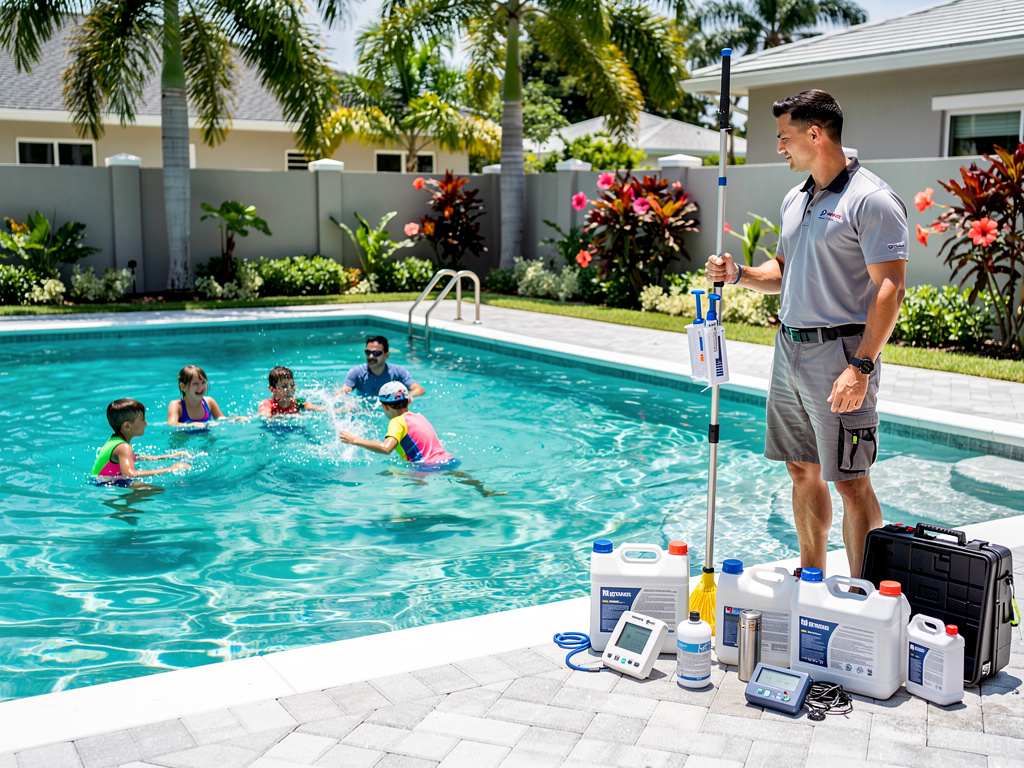
Pembroke Pines is a deeply family-oriented community, and competitive youth swimming is a natural extension of the city’s pool culture and its emphasis on youth activities and sports. Many Pembroke Pines families with pools in Chapel Trail, Silver Lakes, Pembroke Falls, and surrounding neighborhoods use their residential pool as a daily swim training environment for children who are developing competitive swimming skills, training for high school teams, or simply doing structured daily exercise. In the summer months especially, a Pembroke Pines residential pool hosting three to six children for two to three hours of daily structured swimming is a meaningful chemistry management challenge that weekly service alone cannot address.
The distinction between recreational pool use and structured swim training use matters for chemistry. Recreational swimmers spend a portion of their time in the pool resting, floating, or socializing — their body chemistry impact per hour in the water is lower than a swimmer doing continuous lap training. A competitive swimmer doing drills or intervals for 90 minutes is generating significantly more sweat, consuming more energy, and breathing more heavily near the water surface — all of which increase the nitrogen load, organic compound load, and heat that the water chemistry system must manage. Three children doing daily practice introduces approximately the same daily chemical burden as six to eight recreational swimmers, but they do it every day rather than just on weekends.
Nitrogen Load and Combined Chlorine in a Youth Practice Pool
The primary chemistry challenge of daily youth swim training use is nitrogen load management. Sweat contains urea and other nitrogen compounds at concentrations significantly higher than the average recreational swimmer’s contribution. Competitive training generates a sweat rate that recreational swimming doesn’t approach — a child swimming hard for 90 minutes in Pembroke Pines’ warm summer conditions generates considerable sweat load. All of that nitrogen combines with free chlorine to form chloramines — combined chlorine — which irritates eyes, skin, and respiratory passages and is the reason competitive swimming pools are historically notorious for their “chlorine smell.”
In a 20,000-gallon Pembroke Pines residential pool used for daily youth practice, free chlorine can drop from a 3.0 ppm starting point to below 1.0 ppm within a single 2-hour training session on a hot day if the pool is relying entirely on existing chlorine reserve without supplemental production during the session. This is why a continuous chlorine production source — a saltwater generator or an automatic liquid chlorine feeder — is more appropriate for a daily-practice Pembroke Pines pool than a tablet-only system. Tablets dissolve at a fixed rate regardless of demand; they cannot ramp up production in response to the elevated bather load of a practice session.
Weekly breakpoint chlorination is mandatory for a Pembroke Pines youth practice pool, not optional. The weekly shock treatment destroys the combined chlorine that accumulates through six days of practice sessions and prevents the progressive buildup of chloramines that causes the eye irritation and “pool smell” that coaches, parents, and children associate with poorly maintained competitive pools. Use calcium hypochlorite shock in the evening after the day’s last practice session to allow overnight treatment before the following morning’s session.
Sunscreen: The Daily Practice Pool’s Secondary Challenge
Youth swimmers in Pembroke Pines arrive at the pool with sunscreen applied by parents — a rational and necessary health practice given South Florida’s UV intensity. But sunscreen is an oil-based compound that is not broken down by chlorine. In a pool where sunscreen-coated children are training daily, the cumulative oil load in the water and filter media builds rapidly. The visual evidence is a floating oil film at the waterline and a greasy skimmer basket basket after even a modest training session.
Monthly enzyme treatment (weekly for high-use periods) breaks down the oil load that chlorine cannot address. The enzyme product cost for a Pembroke Pines residential practice pool is typically $15–$30 per month — a negligible expense compared to the cost of the filter media degradation that occurs without it. Cartridge filter elements on a daily-practice pool should be rinsed every 2–3 weeks and soaked in filter cleaning solution monthly, versus the quarterly cleaning appropriate for a light-use pool. Sand filters should be backwashed every 2–3 weeks.
Goggles, Swimsuits, and Water Temperature for Youth Practice
Beyond chemistry, two physical aspects of the training pool environment affect daily-use youth swimmers in Pembroke Pines specifically. Water temperature is the first: competitive swimming training is typically performed at 78–82°F — cooler than the 84–86°F recommended for leisurely or therapeutic swimming — because training generates substantial body heat and swimmers performing vigorous sets need the cooler water to manage body temperature. A Pembroke Pines pool that’s been heated to 86°F for the parents and grandparents who use it leisurely may be uncomfortably warm for the children doing active training. A programmable heat pump or heater controller can manage different temperature targets at different times of day — cooler during morning practice, warmer in the afternoon when elderly household members use the pool.
Pool water at correctly maintained chemistry — pH 7.4–7.5, free chlorine 3.0–4.0 ppm, combined chlorine below 0.2 ppm — does not bleach swimsuits or degrade goggles at a rate beyond normal wear. The common belief that “the chlorine is eating my daughter’s swimsuit” is almost always explained by high combined chlorine (chloramine environment) at high pH — the corrosive condition, not the sanitation condition. Correct chemistry maintenance is the swimsuit preservation strategy, counterintuitively enough.
Communication with Your Pool Service Company
A Pembroke Pines pool service company managing a residential pool that doubles as a daily youth swim training facility needs to know about the actual use pattern in order to provide appropriate service. A company calibrating their service to a “family pool, two adults and two children, weekend use” assumption will leave a daily-practice pool consistently under-served — not because of neglect, but because the service protocol assumes the wrong use profile.
When contracting for service on a Pembroke Pines youth practice pool, communicate specifically: the number of swimmers, the approximate daily training duration, whether training happens 5, 6, or 7 days per week, and the time of day that training occurs relative to the weekly service visit. This information allows the service company to calibrate chemical dosing, determine whether supplemental mid-week visits are warranted, and schedule the weekly service visit at the optimal point in the weekly practice cycle to provide the best water quality for the most practice sessions.
Pool Service Fort Lauderdale provides youth-swim-optimized pool service throughout Pembroke Pines FL. Call (954) 501-2754, visit our Pembroke Pines pool service page, or see our full website. 9900 W Sample Rd, Coral Springs, FL 33065.
{“@context”:”https://schema.org”,”@type”:”FAQPage”,”mainEntity”:[{“@type”:”Question”,”name”:”What chlorine level should I maintain in a Pembroke Pines pool used for daily youth swim practice?”,”acceptedAnswer”:{“@type”:”Answer”,”text”:”3.0–4.0 ppm free chlorine, maintained continuously with a saltwater generator or automatic liquid chlorine feeder. Tablet-only systems dissolve at a fixed rate that cannot ramp up to match practice-day demand, causing mid-session depletion below 1.0 ppm in warm, high-bather-load conditions.”}},{“@type”:”Question”,”name”:”Why does a youth swim practice pool in Pembroke Pines smell like chlorine?”,”acceptedAnswer”:{“@type”:”Answer”,”text”:”The smell is chloramines (combined chlorine), not free chlorine. Daily practice sweat loads generate high nitrogen that combines with free chlorine to form chloramines. Weekly breakpoint chlorination — shocking with calcium hypochlorite in the evening after the last practice of the week — destroys accumulated chloramines and eliminates the odor and eye irritation.”}},{“@type”:”Question”,”name”:”How does sunscreen from youth swimmers affect a Pembroke Pines pool?”,”acceptedAnswer”:{“@type”:”Answer”,”text”:”Sunscreen is oil-based and not broken down by chlorine. Daily sunscreen-coated youth swimmers create rapid oil accumulation in the water and filter. Monthly enzyme treatment (weekly during heavy use periods) breaks down oil load. Cartridge filters should be rinsed every 2–3 weeks and soaked in cleaning solution monthly rather than the quarterly schedule appropriate for light-use pools.”}},{“@type”:”Question”,”name”:”What water temperature is correct for competitive swim training in Pembroke Pines FL?”,”acceptedAnswer”:{“@type”:”Answer”,”text”:”78–82°F for active competitive training, compared to 84–86°F for leisurely or therapeutic use. Training generates substantial body heat and swimmers performing vigorous sets find water above 84°F uncomfortable. A programmable controller can manage different temperatures at different times of day — cooler during morning practice, warmer for afternoon leisure use.”}},{“@type”:”Question”,”name”:”Does pool chlorine damage children’s swimsuits at a Pembroke Pines swim practice pool?”,”acceptedAnswer”:{“@type”:”Answer”,”text”:”Swimsuit degradation is caused by high combined chlorine (chloramine environment) and high pH — not by well-maintained free chlorine levels. At pH 7.4–7.5 and free chlorine 3.0–4.0 ppm with combined chlorine below 0.2 ppm, swimsuit degradation is no faster than normal wear. Correct chemistry maintenance is paradoxically the swimsuit preservation strategy.”}]}}