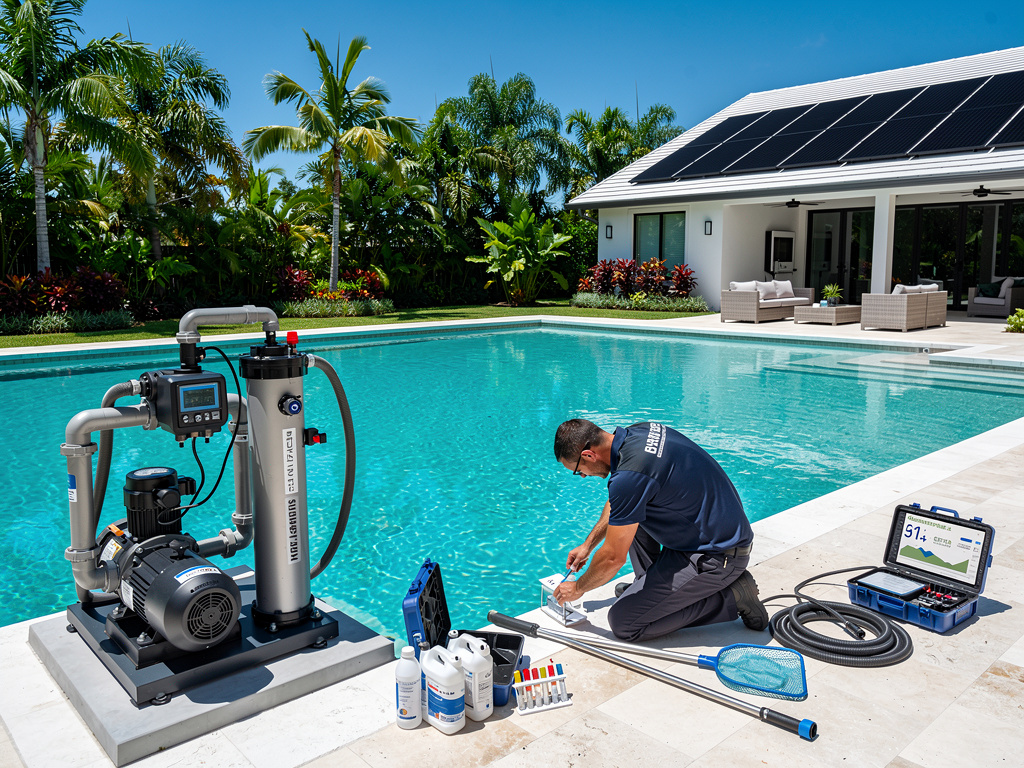
Why Energy Efficiency Matters More in Pembroke Pines
Pembroke Pines’ combination of large residential pool stock, year-round pool operation, and Florida’s moderately high electricity rates makes pool energy efficiency a financial calculation that delivers meaningful returns. A pool pump running 10 hours per day, 365 days per year is one of the largest single electricity consumers in a residential home — comparable to an aging central air conditioning system in its annual energy consumption. Unlike the air conditioner, which is already subject to Energy Star ratings and consumer awareness, pool pump efficiency is often overlooked by homeowners who assume “a pool pump is a pool pump” and focus their efficiency attention elsewhere.
The math changes when the numbers are calculated specifically for Pembroke Pines’ year-round operating environment. In a northern market where a pool runs for 150 days per year, the annual electricity cost difference between a single-speed and variable-speed pump may be $300–$400 — significant but not dramatic. In Pembroke Pines’ 365-day operation at FPL’s current tiered residential rates, that same comparison produces an annual savings of $1,000–$1,800. Over the 10-year typical service life of a variable-speed pump, the cumulative electricity savings substantially exceed the hardware cost — making the efficiency upgrade not just an environmental choice but a straightforward financial investment.
Variable-Speed Pump Savings: The Pembroke Pines Calculation
The electricity cost of a pool pump is determined by two variables: wattage and operating hours. A standard single-speed 1.5 HP pool pump draws approximately 1,500–2,000 watts at full speed. Running at 10 hours per day, 365 days per year, that’s 5,475–7,300 kWh per year. At FPL’s current residential rate of approximately $0.12–$0.14 per kWh (base rate before tier adjustments), the annual electricity cost for the pump alone is $660–$1,020 per year — and that’s before the higher-consumption tier that many Pembroke Pines households hit with their combined household and pool electricity load.
A variable-speed pump running the same pool at 2,000–2,500 RPM (a mid-range efficiency speed that still provides adequate filtration for most Pembroke Pines pools) draws 300–500 watts — roughly 25–30% of the full-speed consumption. Running 10 hours per day at this speed, the annual electricity consumption drops to 1,095–1,825 kWh per year — an annual saving of 4,380–5,475 kWh. At $0.12–$0.14 per kWh, that’s $525–$766 per year in electricity savings at the base rate. In practice, because pools using variable-speed pumps can afford to run longer hours at lower speeds (achieving better filtration at lower total cost), Pembroke Pines pool owners who switch typically extend their daily runtime from 8 to 10 hours and still save $1,000–$1,500 per year compared to their former single-speed operating cost.
Variable-speed pump hardware costs $800–$1,500 for a quality unit; installation adds $300–$600. Total installed cost of $1,100–$2,100 with annual savings of $1,000–$1,500 produces a payback period of roughly 1–2 years for most Pembroke Pines installations. After payback, the savings continue for the remaining 8–9 years of the pump’s service life, representing $8,000–$13,000 in cumulative electricity cost reduction compared to continued single-speed operation.
Solar Pool Heating in Pembroke Pines: When It Makes Financial Sense
Pembroke Pines receives approximately 2,800–3,000 hours of sunshine per year and has a climate where outdoor pool water temperatures are comfortable for swimming from mid-March through mid-November without any heating intervention. The primary heating need in Pembroke Pines is: extending the swimming season through the December–February cool period, and maintaining consistent temperatures for year-round therapeutic or training use.
Solar pool heating addresses this need with zero ongoing fuel cost. A solar system — rooftop-mounted polypropylene or rubber panels connected to the pool circulation system — circulates pool water through the panels during daylight hours, absorbing solar radiation and returning warmed water to the pool. In Pembroke Pines, a correctly sized solar system can maintain pool temperature at 80–84°F through November and into December, and can bring a 70°F-morning pool back to a comfortable temperature by midday during January cold snaps. The system produces no heat on cloudy days or at night, which means Pembroke Pines solar pool systems are typically paired with a gas or heat pump backup heater for the December–February period when reliable heating is needed.
Solar system cost for a Pembroke Pines residential pool typically runs $2,500–$5,000 installed, depending on panel quantity and roof configuration. A heat pump backup heater that might otherwise run continuously from November through February — consuming $100–$200 per month in electricity — runs much less frequently with solar supplementation, reducing its operating cost by 60–80% during the shoulder seasons. The payback calculation versus a heat-pump-only approach typically runs 2–4 years, and the solar system’s useful life is 15–25 years with minimal maintenance (annual inspection of panel connections and valve actuators).
HOA Approval for Solar in Pembroke Pines Planned Communities
For Pembroke Pines pool owners in Chapel Trail, Pembroke Falls, or other HOA communities, solar heating installation requires ARC approval before installation. Florida law (F.S. 163.04) prohibits HOAs from prohibiting solar energy devices outright, but HOAs retain the right to regulate the visual appearance of solar installations — specifically, placement that is not visible from the street is typically a requirement that satisfies both the HOA’s aesthetic concerns and the statute’s protection of solar energy rights.
In practice, most Pembroke Pines HOA communities approve solar pool heating systems that are mounted on rear-facing roof sections not visible from the street. The panels’ muted dark color typically blends with standard roofing material well enough that rear-yard or non-street-facing roof placement receives ARC approval in most communities. A pre-application conversation with the ARC or property manager before contracting with a solar installer is worthwhile to confirm the placement requirements and approval process.
LED Pool Lighting: The Overlooked Efficiency Upgrade
Pool lighting is often overlooked in energy efficiency discussions focused on pumps and heaters, but older incandescent or halogen pool lights — which are common in Pembroke Pines’ 1990s–2000s vintage pool stock — consume 300–500 watts per fixture and generate significant heat that dissipates wastefully. LED pool light replacements for standard light fixtures consume 30–70 watts per fixture — a 70–90% reduction in lighting electricity consumption. LED fixtures last 30,000–50,000 hours versus 1,000–2,000 hours for incandescent bulbs, dramatically reducing the labor cost of bulb replacements (which require partial pool draining and a technician for the underwater fixture work).
LED pool lights in Pembroke Pines also offer color-changing capability, timer programmability, and compatibility with smart home automation systems that incandescent fixtures don’t provide. The upgrade cost for a standard Pembroke Pines pool with two fixtures is typically $500–$900 installed per fixture, with payback in 3–5 years at current electricity rates and frequency of use typical for Pembroke Pines year-round pools.
Pool Service Fort Lauderdale provides energy efficiency consultations and variable-speed pump installation throughout Pembroke Pines FL. Call (954) 501-2754, visit our Pembroke Pines pool service page, or see our full website. 9900 W Sample Rd, Coral Springs, FL 33065.
{“@context”:”https://schema.org”,”@type”:”FAQPage”,”mainEntity”:[{“@type”:”Question”,”name”:”How much can I save with a variable-speed pump in Pembroke Pines FL?”,”acceptedAnswer”:{“@type”:”Answer”,”text”:”Typically $1,000–$1,500 per year in electricity for a year-round Pembroke Pines pool. Variable-speed pumps at 2,000–2,500 RPM draw 300–500 watts vs. 1,500–2,000 watts for a single-speed at full speed. Installed cost of $1,100–$2,100 typically pays back in 1–2 years in Pembroke Pines’ 365-day operating environment.”}},{“@type”:”Question”,”name”:”Is solar pool heating worth it in Pembroke Pines FL?”,”acceptedAnswer”:{“@type”:”Answer”,”text”:”Yes for most properties. Solar pool heating costs $2,500–$5,000 installed and reduces heat pump or gas heater operating costs by 60–80% during shoulder seasons. Payback versus heat-pump-only operation is typically 2–4 years. System lifespan is 15–25 years with minimal maintenance. Florida law also prevents HOAs from prohibiting solar installations outright.”}},{“@type”:”Question”,”name”:”Do I need HOA approval for solar pool heating in Chapel Trail or Pembroke Falls?”,”acceptedAnswer”:{“@type”:”Answer”,”text”:”Yes — ARC approval is required, but Florida law (F.S. 163.04) prohibits HOAs from banning solar energy devices. HOAs can regulate placement. Most Pembroke Pines communities approve rear-facing roof installations not visible from the street. Request a pre-application meeting with the ARC before contracting with a solar installer.”}},{“@type”:”Question”,”name”:”What is the payback period for LED pool lighting in Pembroke Pines?”,”acceptedAnswer”:{“@type”:”Answer”,”text”:”Typically 3–5 years at current electricity rates for year-round Pembroke Pines pools. LED fixtures use 30–70 watts vs. 300–500 watts for incandescent and last 30,000–50,000 hours vs. 1,000–2,000 hours. Installed cost is $500–$900 per fixture. Color-changing and smart home integration are additional benefits beyond electricity savings.”}},{“@type”:”Question”,”name”:”Does Florida require variable-speed pumps for residential pools in Pembroke Pines?”,”acceptedAnswer”:{“@type”:”Answer”,”text”:”Yes. Florida Building Code requires variable-speed replacement when a pool pump over 1 HP is replaced (with narrow exceptions). Single-speed replacement is generally not permitted for permitted work. This means any pool pump replacement in Pembroke Pines will result in a variable-speed installation in any case — proactive replacement before failure lets you plan timing and specifications rather than reacting under emergency conditions.”}]}}