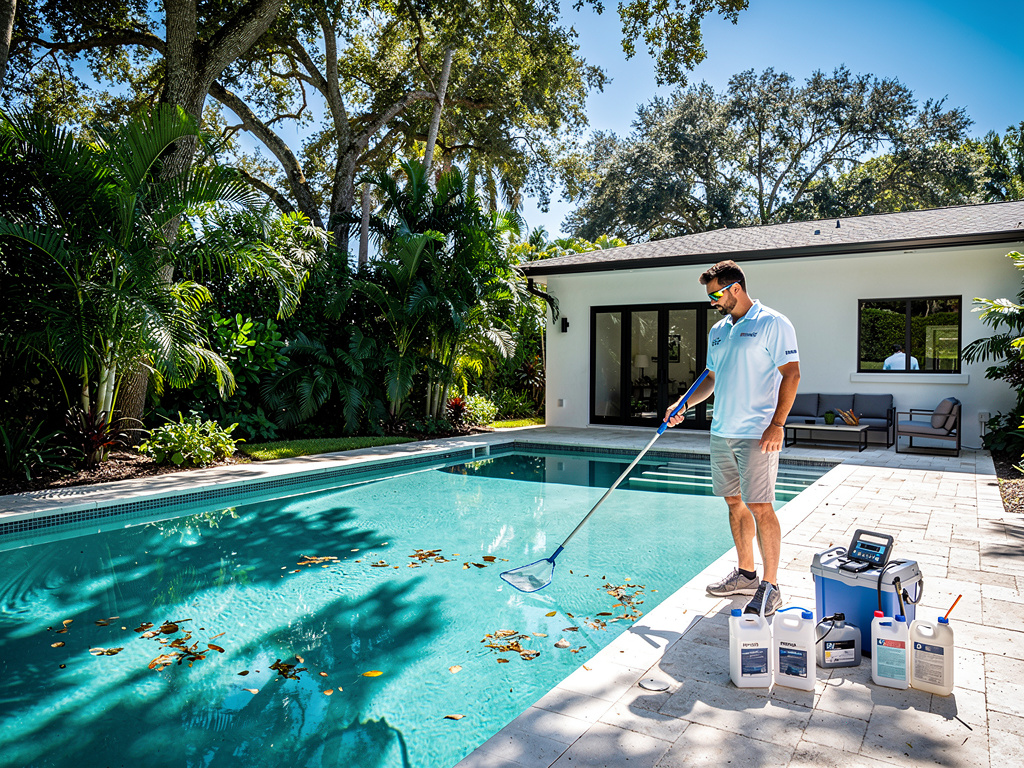
Why Plantation’s Trees Create a Unique Pool Management Challenge
Plantation FL earned its nickname — “The Grass is Greener” — partly because of the city’s exceptional green canopy. Decades of mature tree growth in neighborhoods like Plantation Isles, Plantation Gardens, and Plantation Acres have produced one of the most densely wooded residential environments in Broward County. Live oaks with canopies spanning 60–80 feet, ancient banyans with complex aerial root systems, mature ficus hedges, and the full range of South Florida’s tropical trees create extraordinary streetscape beauty — and the most challenging organic pool maintenance environment in the county.
The distinction between Plantation’s pool debris environment and that of a newer Broward city like Miramar or Pembroke Pines is stark. Newer communities have younger landscaping — 10 to 20-year-old trees that are still establishing and producing modest debris loads. Plantation’s 40 to 60-year-old oaks and tropicals are at mature canopy density, producing leaf fall, seed pods, bark fragments, catkins, and airborne organic particulates that make their way into pools continuously, not just seasonally. A pool adjacent to or beneath a mature live oak in Plantation’s established neighborhoods receives organic input year-round, with peak periods in late fall when oaks shed their leaves and in spring when new growth produces catkins and pollen in volume.
The Chemistry Consequences of High Organic Load
Organic debris entering a Plantation pool creates chemistry challenges through three parallel mechanisms: phosphate loading, tannin introduction, and chlorine demand from organic decomposition.
Phosphate loading from leaf and organic debris decomposition is significant in Plantation pools. Leaves contain phosphate as a structural plant nutrient, and as they decompose in pool water — even partially, before being removed by skimming — they release phosphate into solution. A single live oak leaf falling into a pool and remaining overnight releases measurable phosphate into the water. Multiply that by dozens of leaves daily during Plantation’s oak shedding periods, and the phosphate accumulation rate can exceed the baseline from municipal water and fertilizer sources. Monthly phosphate testing and a consistent phosphate remover program is a baseline requirement for any Plantation pool adjacent to mature trees, not an optional upgrade.
Tannin introduction from oak bark, leaf decomposition, and seed pod dissolution creates the visible yellow-to-brown water coloration and surface staining that Plantation pool owners recognize. Tannins are polyphenolic compounds — complex organic molecules that chlorine oxidizes only partially and slowly. A pool receiving daily tannin input from surrounding oaks gradually develops a yellow tint to the water that doesn’t respond to shock treatment because the source is continuous, not a one-time event. Tannin staining on plaster surfaces and grout lines is a long-term consequence of inadequate tannin management in Plantation’s tree-rich environment.
Chlorine demand from organic matter decomposition is elevated in heavily wooded Plantation properties. Every organic molecule entering the pool consumes free chlorine as it oxidizes and breaks down. A pool in a low-debris environment might lose 0.5–1.0 ppm of free chlorine daily to organic demand; a Plantation pool under a mature oak canopy may lose 2–3 ppm daily from organic demand alone, before accounting for sunlight UV degradation of unstabilized chlorine or bather load consumption. This is why standard weekly tablet dosing that maintains adequate chlorine levels in a less debris-heavy environment may fail to maintain minimum chlorine in a Plantation canopy-environment pool.
Filter Load Management in Plantation’s Debris Environment
The physical debris load in Plantation pools — leaves, catkins, seed pods, bark fragments, airborne organic dust — places elevated demands on pool filtration systems compared to cleaner-environment pools. Skimmer baskets fill faster, requiring more frequent clearing. Filter pressure builds more rapidly, requiring more frequent backwashing or cartridge cleaning. And the organic film that accumulates on filter media — particularly in cartridge filters — reduces flow rate and filtration efficiency at an accelerated rate.
For Plantation pools with cartridge filters, monthly cartridge cleaning (including an overnight soak in filter cleaning solution to break up the tannin and oil film that standard rinsing doesn’t remove) is appropriate, versus the quarterly cleaning that’s adequate in lower-debris environments. For sand filters, backwashing every 2–3 weeks rather than monthly keeps flow rate and filtration efficiency at the level Plantation’s debris load demands. A filter running at reduced flow because the media is heavily loaded allows organic particles to pass through into the pool water — contributing to chemistry problems that look like chemical failures but are actually filtration capacity failures.
Robotic pool cleaners in Plantation’s high-debris environment need their filter baskets emptied after every run rather than every other run. The typical “clean after every 2–3 cycles” recommendation assumes a light-to-moderate debris environment that Plantation’s mature canopy properties don’t match. A robotic cleaner running through a debris-heavy Plantation pool will fill its filter basket before completing the cleaning cycle if the basket isn’t cleared prior to each run.
Root Proximity: The Structural Consideration
Plantation’s mature tree canopy means mature root systems — some extending significantly beyond the tree’s visible drip line. In Plantation’s older neighborhoods where pools were installed 30–50 years ago when surrounding trees were much smaller, the current relationship between pool structure and tree root systems may be quite different from the situation at the time of pool construction. Live oak root systems can extend horizontally 2–3 times the height of the tree and reach depths of 6–10 feet in some soils.
Root intrusion into pool plumbing — particularly older cast-iron or clay pipe fittings that have degraded and developed cracks — is a documented pool maintenance issue in Plantation’s established neighborhoods. Root-caused plumbing leaks can be slow and difficult to diagnose because the symptom (water loss) is identical to evaporation and splash-out at low loss rates. A Plantation pool owner noticing gradual water level reduction that isn’t attributable to seasonal evaporation changes should investigate plumbing integrity, particularly if large trees are within 20–30 feet of the pool equipment or plumbing runs.
Developing a Plantation-Appropriate Maintenance Protocol
A maintenance approach calibrated for Plantation’s tree environment needs to address debris, chemistry, and filtration differently than the standard protocol for a Broward pool in a low-canopy setting. Core modifications: weekly skimming and basket clearing as part of scheduled service (rather than relying on pool owner skimming between service visits); monthly enzyme treatment to break down tannins and organic oils; monthly phosphate testing and remover application; more frequent filter cleaning intervals; and a chlorine delivery method capable of responding to elevated daily demand (saltwater generator or automatic liquid feeder rather than tablet-only).
These modifications are not optional upgrades for Plantation’s canopy-environment pools — they’re the baseline protocol required to maintain water quality in the city’s distinctive landscape context.
Pool Service Fort Lauderdale provides canopy-environment pool service throughout Plantation FL. Call (954) 501-2754, visit our Plantation pool service page, or see our main website. 9900 W Sample Rd, Coral Springs, FL 33065.
{“@context”:”https://schema.org”,”@type”:”FAQPage”,”mainEntity”:[{“@type”:”Question”,”name”:”Why does my Plantation FL pool have brown or yellow water even with regular chlorination?”,”acceptedAnswer”:{“@type”:”Answer”,”text”:”Yellow-to-brown water tint in Plantation pools is typically caused by tannins from oak, ficus, and tropical tree debris decomposing in the pool. Chlorine oxidizes tannins slowly and partially — it cannot overcome a continuous daily tannin input from surrounding trees. Monthly enzyme treatment and a phosphate remover program (not more chlorine) addresses the root cause.”}},{“@type”:”Question”,”name”:”How often should I clean my pool filter if I live under a mature oak in Plantation FL?”,”acceptedAnswer”:{“@type”:”Answer”,”text”:”Cartridge filters: monthly cleaning with an overnight soak in filter cleaning solution, not the quarterly interval appropriate for low-debris environments. Sand filters: backwash every 2–3 weeks. Heavy organic debris from Plantation’s mature canopy reduces filter capacity faster than in open-yard pools, and a partially clogged filter allows organic particles to pass through into the water, worsening chemistry problems.”}},{“@type”:”Question”,”name”:”Can tree roots damage my pool in Plantation FL?”,”acceptedAnswer”:{“@type”:”Answer”,”text”:”Yes. Plantation’s mature live oaks have root systems that extend 2–3 times the tree’s height horizontally. In neighborhoods where pools were built 30–50 years ago alongside much smaller trees, current root proximity to plumbing and pool structure may be significant. Root intrusion into cracked plumbing causes slow leaks that mimic evaporation — gradual unexplained water loss near large trees warrants a plumbing pressure test.”}},{“@type”:”Question”,”name”:”Does a saltwater pool help manage organic debris in a Plantation FL canopy environment?”,”acceptedAnswer”:{“@type”:”Answer”,”text”:”Yes — a saltwater generator is better-suited to Plantation’s canopy environment than tablets because it can maintain continuous chlorine production proportional to daily organic demand. Tablets dissolve at a fixed rate regardless of organic load; a generator’s output can be adjusted upward when leaf-fall seasons increase chlorine demand.”}},{“@type”:”Question”,”name”:”How does Plantation FL’s tree canopy affect phosphate levels in the pool?”,”acceptedAnswer”:{“@type”:”Answer”,”text”:”Significantly. Leaf decomposition releases phosphate into pool water at a rate that can exceed contributions from fill water and fertilizer runoff in heavily wooded Plantation yards. Monthly phosphate testing is a baseline requirement for canopy-environment Plantation pools — not an optional add-on. Target below 100 ppb with monthly phosphate remover maintenance.”}]}}