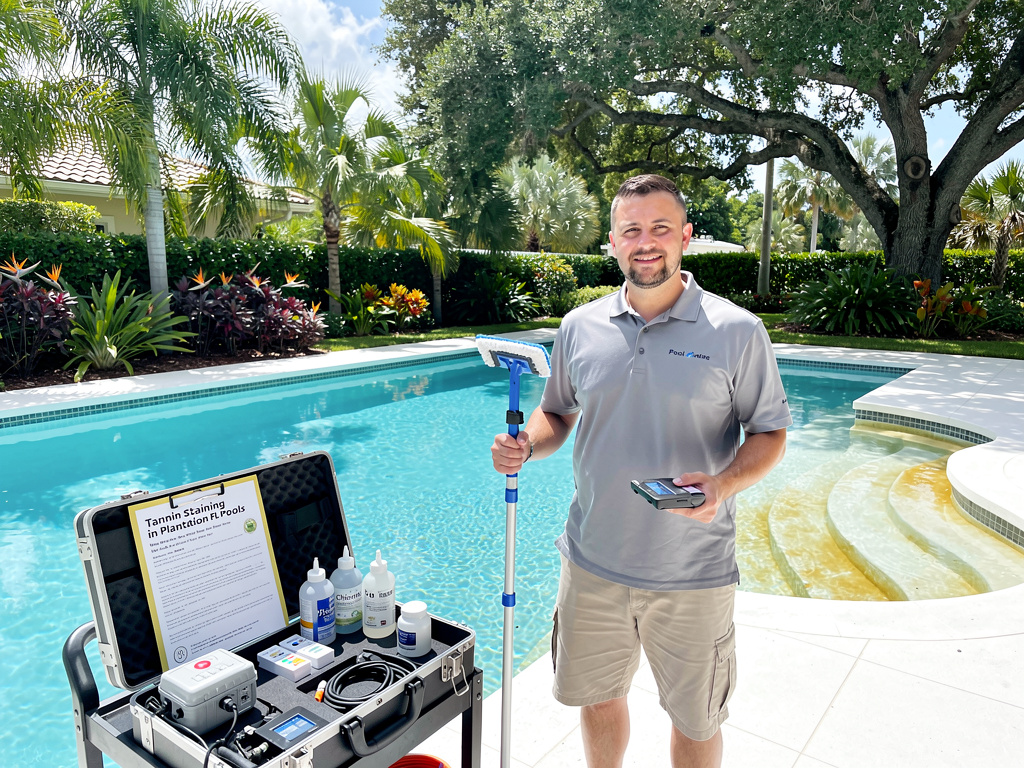
What Tannins Are and Why Plantation’s Trees Produce Them
Tannins are polyphenolic organic compounds produced by plants as part of their structural chemistry and as a defense mechanism against biological degradation. They are abundant in the bark, leaves, and seed pods of many trees — particularly oaks, which are among the highest tannin-producing trees in the temperate and subtropical world. Live oaks (Quercus virginiana), the signature tree of Plantation FL’s residential neighborhoods, are exceptionally high tannin producers. Their bark contains condensed tannins in high concentration, their leaves contain hydrolyzable tannins, and their acorns and catkins contribute additional tannin load to the surrounding environment.
Tannins are responsible for the brown color of tea (made by steeping tannin-rich leaves in hot water), the color of coffee, and the characteristic color of blackwater rivers in Florida’s coastal swamp environments. The mechanism is the same in each case: tannins dissolve in water and produce a yellow-to-brown coloration at concentrations well below what affects water clarity in other respects. A Plantation pool can look visually clear — you can see the bottom, the water is not murky — while having a pronounced yellow tint from dissolved tannins.
In Plantation’s high-canopy neighborhoods, the tannin input to pools adjacent to mature oaks is continuous. Leaves falling into the pool dissolve tannins as they decompose. Rain washing across bark and root surfaces carries dissolved bark tannins into pool water via runoff. Catkins (the small pollen-producing flower structures that oaks shed in spring) are exceptionally tannin-rich and, when deposited in volume on a pool surface, dissolve rapidly. Even the mulch in landscaping beds adjacent to the pool releases tannins through decomposition, which can reach the pool via irrigation overspray or rainfall.
Why Chlorine Alone Doesn’t Solve Tannin Coloration
Pool owners and even some pool service technicians sometimes respond to tannin coloration by shocking the pool repeatedly with high doses of chlorine. This approach is based on the correct understanding that chlorine oxidizes organic compounds — but it misunderstands the kinetics of tannin oxidation. Chlorine does oxidize tannins, but the reaction is slow and incomplete, particularly for the larger, more complex condensed tannin molecules that make up a significant portion of oak-derived tannin input. At normal pool chemistry parameters, chlorine will gradually oxidize tannins over days — but if new tannin input is occurring daily from surrounding trees, the rate of oxidation is always chasing the rate of input.
The result in a Plantation pool under continuous tannin input is a persistent yellow tint that improves temporarily after shock treatment (as a high chlorine dose rapidly oxidizes some tannins) but returns within days as new tannin input resumes. This cycle — shock, improvement, return of color, shock again — can continue indefinitely without resolving the underlying dynamic. Pool owners in this cycle sometimes conclude that the pool chemistry is fundamentally broken when the actual issue is a source control and management protocol problem, not a chemistry failure.
The Clarifier and Vacuum Approach for Active Tannin Coloration
When a Plantation pool has developed visible tannin coloration — yellow water, stained plaster surfaces, brown deposits on grout lines — the most effective intervention combines a flocculant or clarifier with physical removal. Alum-based flocculants (aluminum sulfate) or chitosan-based clarifiers work by coagulating suspended and dissolved tannin molecules into larger particles that sink to the floor of the pool and can be physically vacuumed up and removed to waste (not returned through the filter).
The procedure: add the flocculant/clarifier per product instructions to the pool with circulation running for 2–4 hours, then shut off circulation and allow the pool to remain still for 8–12 hours (overnight works well). During this rest period, the coagulated tannin particles settle to the pool floor. The following morning, vacuum the entire pool floor to waste — meaning the vacuum waste line goes directly to drain, not back through the filter — removing the settled particles and the tannin-laden water they carry. Finish with a partial refill of fresh water to replace the volume vacuumed out.
This approach removes the existing tannin load effectively. But in a Plantation pool under active tree input, the coloration will begin to return within weeks without an ongoing prevention protocol to manage the continuous tannin source.
Enzyme Treatment: The Ongoing Prevention Strategy
Enzyme-based pool treatments are the most effective ongoing management tool for tannin-prone Plantation pools. Pool enzyme products contain specialized biological catalysts that break down complex organic molecules — including tannins — into simpler compounds that chlorine can oxidize rapidly and completely. Unlike chlorine, which attacks tannins slowly and produces color-free but stable oxidation intermediates, enzymes break the tannin molecule’s backbone, converting large, color-producing polyphenolics into simple carbon compounds that are quickly oxidized to water and carbon dioxide by chlorine.
A weekly enzyme dose in a Plantation oak-canopy pool provides continuous degradation capacity that matches the rate of tannin input during normal debris seasons. During peak input seasons (spring catkin drop in March–April, fall leaf drop in October–November), doubling the enzyme dose or increasing to twice-weekly application maintains control. The enzyme product cost for a typical Plantation pool is $20–$40 per month — a negligible expense compared to the cost of repeated shock treatments and clarifier applications to manage tannin coloration reactively.
Surface Staining: Treatment for Established Tannin Deposits
Tannins that have been present in a Plantation pool for an extended period can deposit on plaster, pebble aggregate, grout lines, and vinyl liner surfaces as a yellowish-brown stain. Unlike calcium scale (which is a mineral deposit) or metal staining (which is a metallic oxide), tannin staining is organic — it responds to oxidation treatment, not acid washing or vitamin C treatment. A high-dose chlorine treatment (superchlorination to 10–20 ppm) held for 24–48 hours is effective for light to moderate tannin surface staining. Severe, embedded tannin staining may require professional acid washing of plaster surfaces or enzyme soak treatment.
Preventing staining is substantially easier than removing established staining — which reinforces the case for the weekly enzyme protocol as a standard maintenance element in any Plantation pool adjacent to mature oaks.
Pool Service Fort Lauderdale provides tannin management and enzyme treatment for Plantation FL pools. Call (954) 501-2754, visit our Plantation pool service page, or see our full website. 9900 W Sample Rd, Coral Springs, FL 33065.
{“@context”:”https://schema.org”,”@type”:”FAQPage”,”mainEntity”:[{“@type”:”Question”,”name”:”Why is my Plantation FL pool water yellow even when the chlorine level is correct?”,”acceptedAnswer”:{“@type”:”Answer”,”text”:”Yellow pool water in Plantation FL is almost always caused by tannins from live oak leaves, bark, and seed pods dissolving in the water. Chlorine oxidizes tannins slowly and incompletely — when tannin input from surrounding trees is continuous, chlorine cannot keep pace. Enzyme treatment breaks down tannins faster than chlorine can, providing the ongoing management needed in Plantation’s high-canopy environment.”}},{“@type”:”Question”,”name”:”Can I fix tannin staining in my Plantation FL pool without draining it?”,”acceptedAnswer”:{“@type”:”Answer”,”text”:”For water coloration (not surface staining): yes. Add an alum flocculant or clarifier, let circulation run 2–4 hours, then allow the pool to rest undisturbed overnight. The coagulated tannins settle to the floor. Vacuum to waste the following morning and replace the vacuumed volume with fresh water. For surface staining: superchlorinate to 10–20 ppm for 24–48 hours. Only severe embedded staining requires acid washing.”}},{“@type”:”Question”,”name”:”How often should I add enzyme treatment to my Plantation FL pool?”,”acceptedAnswer”:{“@type”:”Answer”,”text”:”Weekly during normal conditions; twice weekly during peak tannin seasons (spring catkin drop in March–April, fall leaf drop in October–November). Weekly enzyme treatment maintains ongoing tannin breakdown capacity that matches the continuous input rate from Plantation’s mature oak canopy, preventing the accumulation that leads to visible coloration.”}},{“@type”:”Question”,”name”:”Is tannin staining in a Plantation FL pool a permanent problem?”,”acceptedAnswer”:{“@type”:”Answer”,”text”:”Established surface staining can be treated — light-to-moderate tannin staining responds to 24–48 hour superchlorination; severe staining may need professional acid washing. Ongoing coloration is prevented rather than treated by maintaining a weekly enzyme program and removing debris before it decomposes in the water. The source (surrounding trees) doesn’t go away, so prevention is more effective than repeated reactive treatment.”}},{“@type”:”Question”,”name”:”Do tannins affect pool chemistry beyond water color in Plantation FL?”,”acceptedAnswer”:{“@type”:”Answer”,”text”:”Yes. Tannin-producing leaf and bark decomposition also releases phosphate, which feeds algae. Organic tannin load increases chlorine demand, depleting free chlorine faster. And tannins that deposit on filter media reduce filtration efficiency over time. A comprehensive Plantation oak-canopy pool management protocol addresses tannin chemistry, phosphate, elevated chlorine demand, and filter maintenance together.”}]}}